Oklahoma Math 4.GM.1
Standard Cluster
Name, describe, classify, and construct polygons and three-dimensional figures based on their attributes; recognize polygons and three-dimensional figures in real-life and mathematical situations. Identify points, lines, line segments, rays, angles, endpoints, and parallel and perpendicular lines in various models. Describe, classify, and construct quadrilaterals, including squares, rectangles, trapezoids, rhombuses, parallelograms, and kites. Recognize quadrilaterals in various models. Given two three-dimensional shapes, identify each shape. Compare and contrast their similarities and differences based on their attributes.
Oklahoma Academic Standards for Mathematics (2022)
Cluster contents
Standards in This Cluster
4.GM.1 is a cluster heading. These are the individual standards under it.
- 4.GM.1.1
Identify points, lines, line segments, rays, angles, endpoints, and parallel and perpendicular lines in various models.
- 4.GM.1.2
Describe, classify, and construct quadrilaterals, including squares, rectangles, trapezoids, rhombuses, parallelograms, and kites. Recognize quadrilaterals in v...
- 4.GM.1.3
Given two three-dimensional shapes, identify each shape. Compare and contrast their similarities and differences based on their attributes.
Teacher's field guide
What This Cluster Means
What Students Need to Do
- Students name and draw polygons and solid figures using sides, angles, faces, edges, and vertices. They sort quadrilaterals by their features and label points, lines, segments, rays, endpoints, and angles in diagrams. They find parallel and perpendicular lines and compare two solids.
What Mastery Looks Like
- A student draws and names squares, rectangles, trapezoids, rhombuses, parallelograms, and kites, then explains how they sorted them. They identify a cube and a triangular prism and compare their faces, edges, and vertices. They label a ray's endpoint and spot parallel and perpendicular lines in a drawing.
Common Misconceptions
- Students may think a tilted square is no longer a square, or that a square cannot also be a rectangle. They may give a ray two endpoints or count a solid's faces as edges.
How to Assess It
- Show a tilted square, a ray, a cube, and a triangular prism. Ask students to name the shapes, mark the ray's endpoint, and write one similarity and one difference between the solids.
Lesson moves
Ways to Teach It
Give pairs paper, rulers, straws, and clay to draw three quadrilaterals and build two solids, then label sides, faces, edges, and vertices.
Ask, "Can a square also be a rectangle?" Have students write an answer using the number of sides and the types of angles.
Play a card sort with quadrilateral drawings, including tilted examples; students group them by shared features and explain each group.
Have students find a rectangle, a solid figure, and perpendicular lines in the classroom, then sketch and label each example.
Free download
Printable 4.GM.1 Worksheet
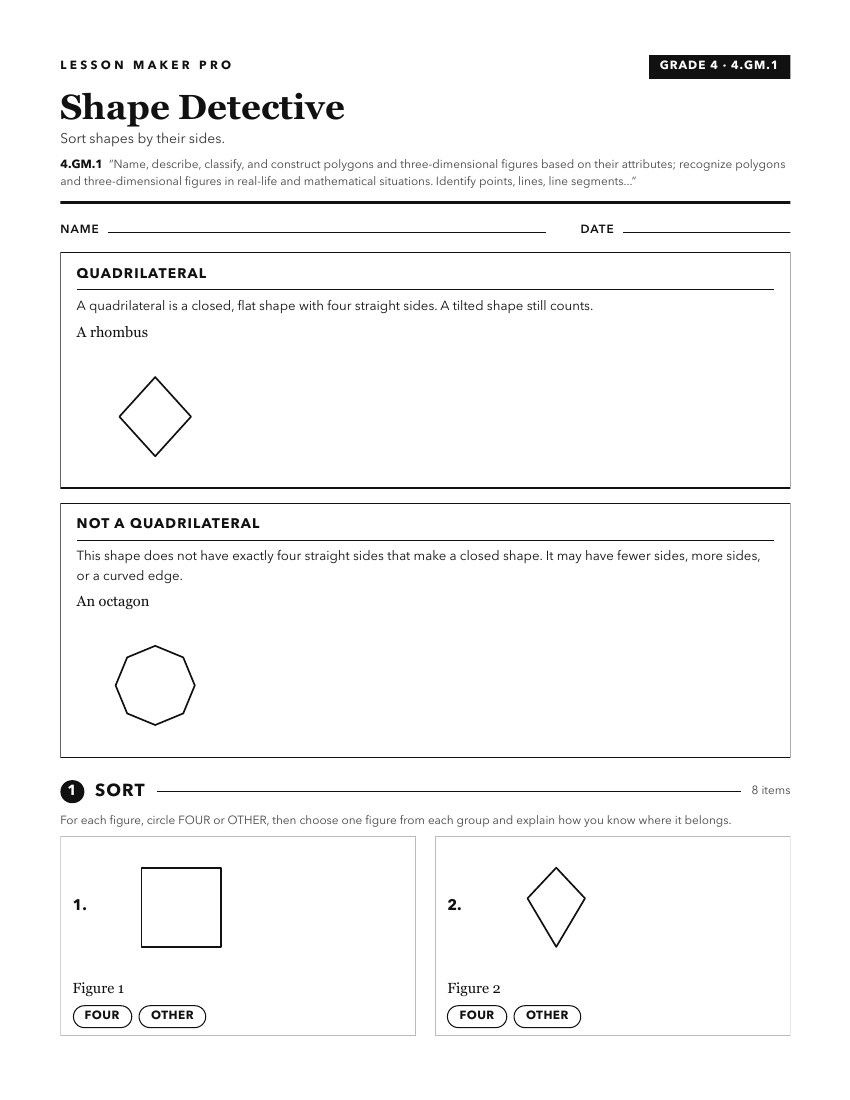
A ready-to-print activity worksheet aligned to 4.GM.1, with an answer key for the teacher on its own page. No account needed.
PDF, US Letter, prints cleanly in black and white.
Download the worksheetKeep exploring
Related Standards
- 5.GM.1
Describe, identify, classify, and construct two- and three-dimensional figures using their geometric attributes.
- 3.GM.1
Analyze and use geometric attributes to describe and create polygons and three-dimensional figures in various contexts.
- 5.GM.1.2
Describe, identify, and classify three-dimensional figures (cubes, rectangular prisms, and pyramids) and their attributes (number of edges, faces, vertices, sha...
- G.2D.1.7
Apply the properties of polygons, and use them to represent and apply mathematical models involving perimeter and area (e.g., triangles, special quadrilaterals,...
Turn this cluster into a lesson
Grade, subject, topic, and the complete cluster are prefilled. Create one free, no account needed.
Also for this cluster:Make a WorksheetMake a QuizMake a Sub Lesson