Oklahoma Math PA.GM.2
Standard Cluster
Justify and use formulas to calculate surface area and volume of three-dimensional figures. Calculate the surface area of a rectangular prism using decomposition or nets. Use appropriate units (e.g., cm²). Calculate the surface area of a cylinder, in terms of pi (π) and using approximations for pi (π), using decomposition or nets. Use appropriate units (e.g., cm²). Justify why base area (B) and height (h) in the formula V=Bh are multiplied to find the volume of a rectangular prism. Use appropriate units (e.g., cm³). Develop and use the formulas V=πr²h and V=Bh to determine the volume of right cylinders, in terms of π and using approximations for pi (π). Justify why base area (B) and height (h) are multiplied to find the volume of a right cylinder. Use appropriate units (e.g., cm³).
Oklahoma Academic Standards for Mathematics (2022)
Cluster contents
Standards in This Cluster
PA.GM.2 is a cluster heading. These are the individual standards under it.
- PA.GM.2.1
Calculate the surface area of a rectangular prism using decomposition or nets. Use appropriate units (e.g., cm²).
- PA.GM.2.2
Calculate the surface area of a cylinder, in terms of pi (Π) and using approximations for pi (Π), using decomposition or nets. Use appropriate units (e.g., cm²)...
- PA.GM.2.3
Justify why base area (B) and height (h) in the formula V=Bh are multiplied to find the volume of a rectangular prism. Use appropriate units (e.g., cm³).
- PA.GM.2.4
Develop and use the formulas V = (πr)h and V = Bh to determine the volume of right cylinders, in terms of π and using approximations for pi (Τ). Justify why bas...
Teacher's field guide
What This Cluster Means
What Students Need to Do
- Students use nets to find the surface area of rectangular prisms and cylinders. They explain why base area times height gives volume, then calculate volume for both shapes.
What Mastery Looks Like
- Students add the six faces of a prism or the two circles and rectangle of a cylinder. They use V=Bh for prisms and V=πr²h for cylinders, explaining volume as layers of base area. They give cylinder answers with π and as decimal estimates, using cm² for area and cm³ for volume.
Common Misconceptions
- Students may use diameter instead of radius, leave out one circular end, or use the diameter instead of the circumference for the net rectangle's edge that wraps around the base. Some add base area and height instead of multiplying, or label volume in cm².
How to Assess It
- Exit ticket: Draw a net for a cylinder with radius 2 cm and height 4 cm, then find its surface area and volume with π and using 3.14. Label the units and explain why multiplying base area by height gives volume.
Lesson moves
Ways to Teach It
Build a capped paper cylinder and a small paper box, unfold both, and label the area of every net piece.
Ask: Why does a 5 cm high prism with a 12 cm² base hold 60 cm³, and why does the same reasoning work for cylinders?
Match prism and cylinder dimension cards to surface area and volume cards, including cylinder answers with π and as decimals.
Measure a soup can's diameter and height, then estimate the metal for its sides and lids and the volume inside.
Free download
Printable PA.GM.2 Worksheet
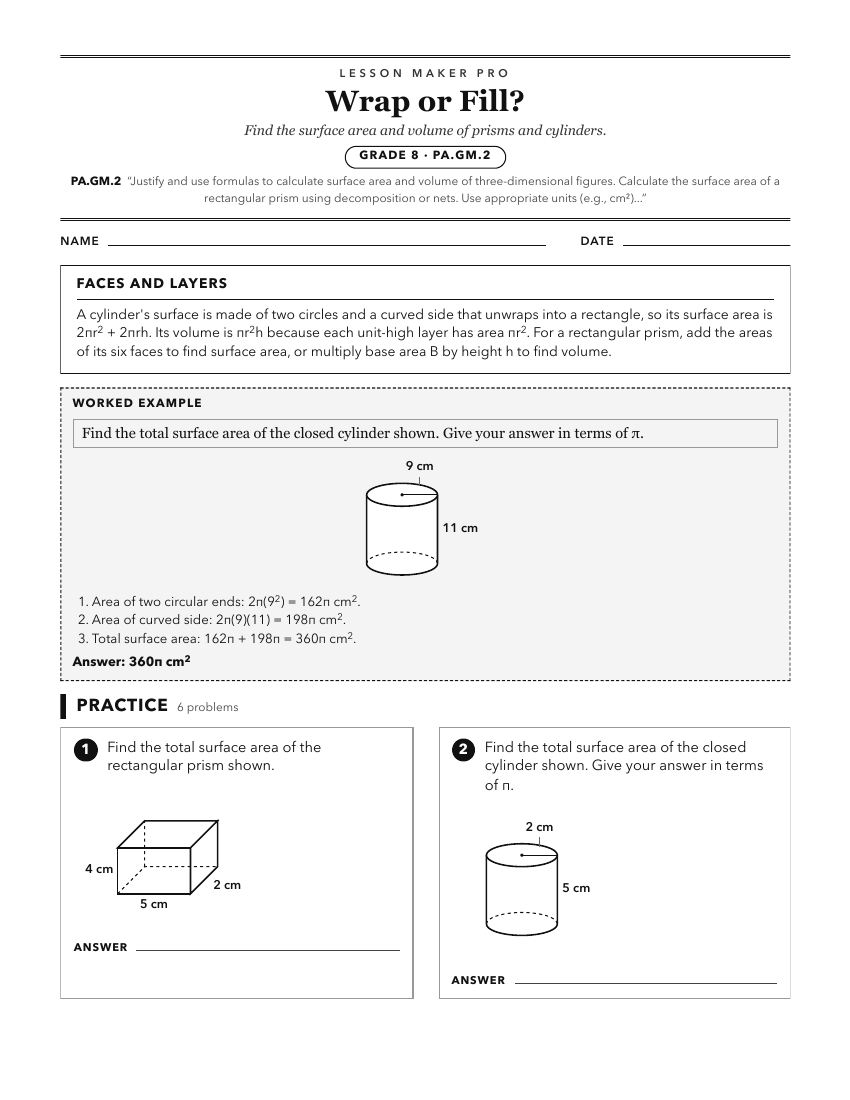
A ready-to-print activity worksheet aligned to PA.GM.2, with an answer key for the teacher on its own page. No account needed.
PDF, US Letter, prints cleanly in black and white.
Download the worksheetKeep exploring
Related Standards
- G.3D.1.1
Represent, use, and apply mathematical models and other tools (e.g., nets, measuring devices, formulas) to solve problems involving surface area and volume of t...
- G.3D.1.2
Use ratios derived from similar three-dimensional figures to make conjectures, generalize, and to solve for unknown values such as angles, side lengths, perimet...
- G.3D.1
Solve real-world and mathematical problems involving three-dimensional figures.
- 6.GM.2.2
Develop and use formulas to determine the area of triangles and find unknown measures.
Turn this cluster into a lesson
Grade, subject, topic, and the complete cluster are prefilled. Create one free, no account needed.
Also for this cluster:Make a WorksheetMake a QuizMake a Sub Lesson