Oklahoma Math PA.GM.2.4
The Standard
- PA.GM.2
- Justify and use formulas to calculate surface area and volume of three-dimensional figures.
Develop and use the formulas V=πr²h and V=Bh to determine the volume of right cylinders, in terms of π and using approximations for pi (π). Justify why base area (B) and height (h) are multiplied to find the volume of a right cylinder. Use appropriate units (e.g., cm³).
Oklahoma Academic Standards for Mathematics (2022)
Teacher's field guide
What This Standard Means
What Students Need to Do
- Students find the area of a cylinder's circular base, then multiply it by the height. They explain why this works by thinking of the cylinder as a stack of equal circular layers. They give answers in terms of π and as decimal estimates, using cubic units.
What Mastery Looks Like
- For a cylinder with radius 3 cm and height 8 cm, a student finds a base area of 9π cm² and a volume of 72π cm³. Using 3.14 for π, they get about 226.08 cm³. They can explain why multiplying base area by height works.
Common Misconceptions
- Students may use the diameter as the radius or multiply the circumference by the height. Some label volume in square units, or replace π with 3.14 when asked to leave an answer in terms of π.
How to Assess It
- Exit ticket: A cylinder has radius 2 cm and height 5 cm. Find its volume in terms of π and using 3.14, then explain why you multiply the base area by the height.
Lesson moves
Ways to Teach It
Stack identical cardboard circles, measure the stack height, and explain why the area of one circle times the height gives its volume.
Ask, "Why does πr²h work for a cylinder but 2πrh does not?" Have students write two sentences about base area and layers.
Give pairs cylinder cards with radii and heights to match with exact volumes and estimates using 3.14.
Measure a soup can's diameter and height, estimate its capacity in cubic centimeters, and compare it with the milliliters printed on the label.
Free download
Printable PA.GM.2.4 Worksheet
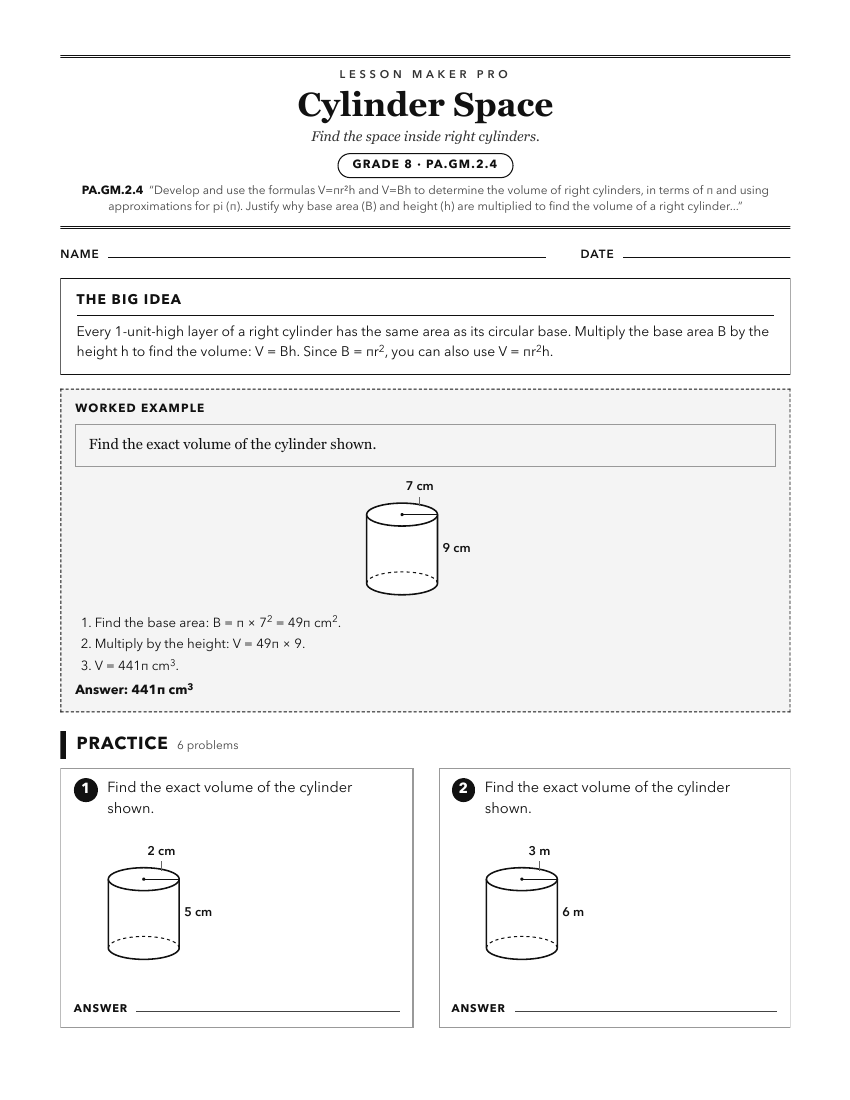
A ready-to-print activity worksheet aligned to PA.GM.2.4, with an answer key for the teacher on its own page. No account needed.
PDF, US Letter, prints cleanly in black and white.
Download the worksheetKeep exploring
Related Standards
- PA.GM.2.3
Justify why base area (B) and height (h) in the formula V=Bh are multiplied to find the volume of a rectangular prism. Use appropriate units (e.g., cm³).
- PA.GM.2.2
Calculate the surface area of a cylinder, in terms of pi (Π) and using approximations for pi (Π), using decomposition or nets. Use appropriate units (e.g., cm²)...
- 7.GM.1.3
Using a variety of tools and strategies, develop the concept that the volume of rectangular prisms can be found by counting the total number of same-sized unit ...
- PA.GM.2
Justify and use formulas to calculate surface area and volume of three-dimensional figures.
Turn this exact standard into a lesson
Grade, subject, topic, and the complete standard are prefilled. Create one free, no account needed.
Also for this standard:Make a WorksheetMake a QuizMake a Sub Lesson