Oklahoma Math PA.GM.2.2
The Standard
- PA.GM.2
- Justify and use formulas to calculate surface area and volume of three-dimensional figures.
Calculate the surface area of a cylinder, in terms of pi (π) and using approximations for pi (π), using decomposition or nets. Use appropriate units (e.g., cm²).
Oklahoma Academic Standards for Mathematics (2022)
Teacher's field guide
What This Standard Means
What Students Need to Do
- Students draw a cylinder as two circles and a rectangle. They use the net to find the total area, first with π, then with a decimal approximation, and label the answer in square units.
What Mastery Looks Like
- A student finds the area of both circles and the curved side. They use the circle’s circumference for the rectangle’s width and can explain where each part of their calculation comes from.
Common Misconceptions
- Students may use the diameter as the rectangle’s width instead of the circumference. They may count only one circle, use the diameter in place of the radius, or give the answer in cubic units.
How to Assess It
- Exit ticket: A cylinder has radius 3 cm and height 5 cm. Sketch its net and find its total surface area in terms of π and using 3.14, with units.
Lesson moves
Ways to Teach It
Wrap a paper strip around a soup can, trace both ends, and label the rectangle and circles in the net.
Ask: Why is the rectangle’s width 2πr rather than 2r? Have students point to that length on a can.
Give students cards with cylinder dimensions and net dimensions to match, then have them calculate each surface area in terms of π.
A cylindrical gift box has radius 4 cm and height 10 cm. Have students calculate the material needed to cover its sides and both ends.
Free download
Printable PA.GM.2.2 Worksheet
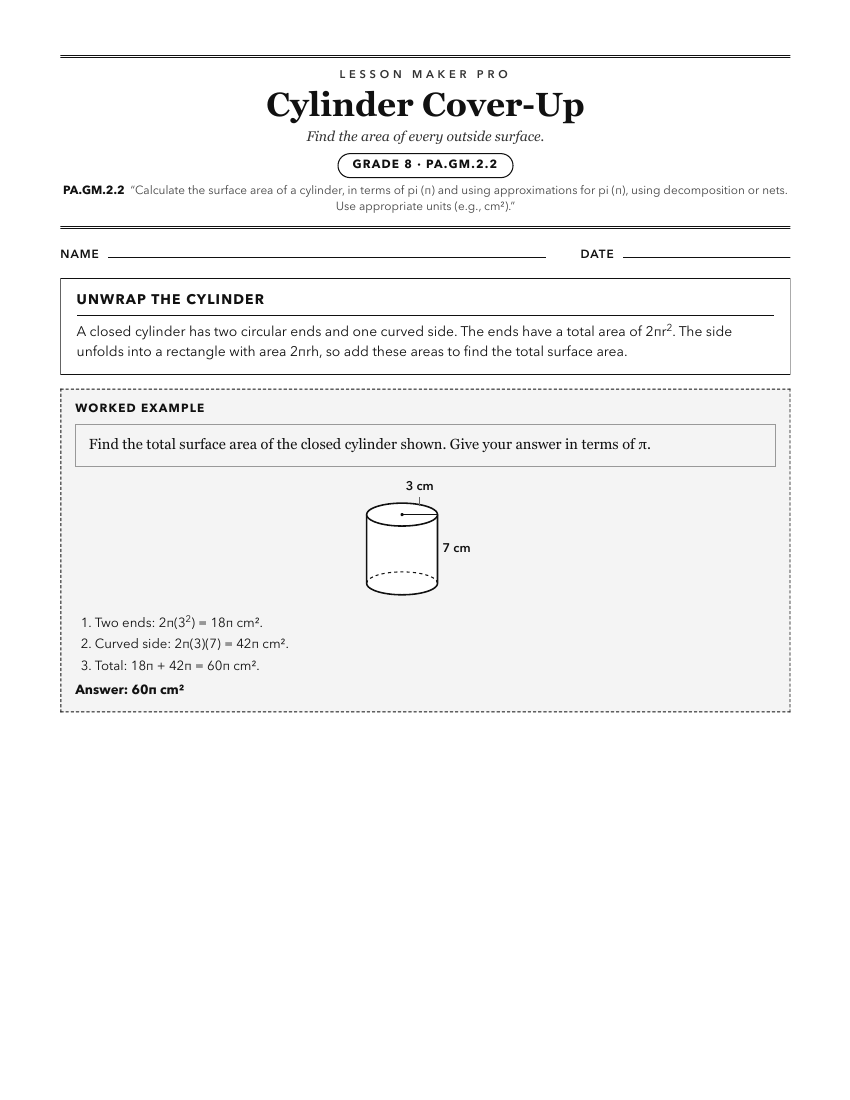
A ready-to-print activity worksheet aligned to PA.GM.2.2, with an answer key for the teacher on its own page. No account needed.
PDF, US Letter, prints cleanly in black and white.
Download the worksheetKeep exploring
Related Standards
- 7.GM.3.3
Calculate the circumference and area of circles to solve problems in various contexts, in terms of pi (π) and using approximations for pi (π).
- PA.GM.2.4
Develop and use the formulas V = (πr)h and V = Bh to determine the volume of right cylinders, in terms of π and using approximations for pi (Τ). Justify why bas...
- PA.GM.2.1
Calculate the surface area of a rectangular prism using decomposition or nets. Use appropriate units (e.g., cm²).
- G.C.1.1
Apply the properties of circles to solve problems involving circumference and area, using approximate values and in terms of pi, using algebraic and logical rea...
Turn this exact standard into a lesson
Grade, subject, topic, and the complete standard are prefilled. Create one free, no account needed.
Also for this standard:Make a WorksheetMake a QuizMake a Sub Lesson