Oklahoma Math PC.T.1.6
The Standard
- PC.T.1
- Make sense of the unit circle and its relationship to the graphs of trigonometric functions.
Estimate trigonometric values of any angle.
Oklahoma Academic Standards for Mathematics (2022)
Teacher's field guide
What This Standard Means
What Students Need to Do
- Students locate angles, including negative angles and angles greater than 360°, on a unit circle. They use reference angles and quadrants to estimate sine, cosine, and tangent without a calculator.
What Mastery Looks Like
- For 200°, a student estimates sine near -0.34, cosine near -0.94, and tangent near 0.36. They use the quadrant to explain each sign. They know tangent is undefined at 90°.
Common Misconceptions
- Students treat 200° like 20° and miss the negative signs. They may use the y-coordinate for cosine or assume tangent has a value at 90°.
How to Assess It
- Exit ticket: Without a calculator, estimate sin 200°, cos 200°, and tan 200°. Sketch the angle and explain the signs.
Lesson moves
Ways to Teach It
Give pairs a unit-circle printout with a 10-square radius; have them draw a 200° ray and estimate sine and cosine from its endpoint.
Ask, "Why is sin 200° negative but tan 200° positive?" Have students defend their answers with a sketch.
Play angle-card sort: students place 30°, 150°, 215°, and 400° in quadrants, then estimate sine and cosine for each.
Sketch a Ferris wheel of radius 10 meters with a rider starting at the right edge; estimate the rider's height after a 110° turn.
Free download
Printable PC.T.1.6 Worksheet
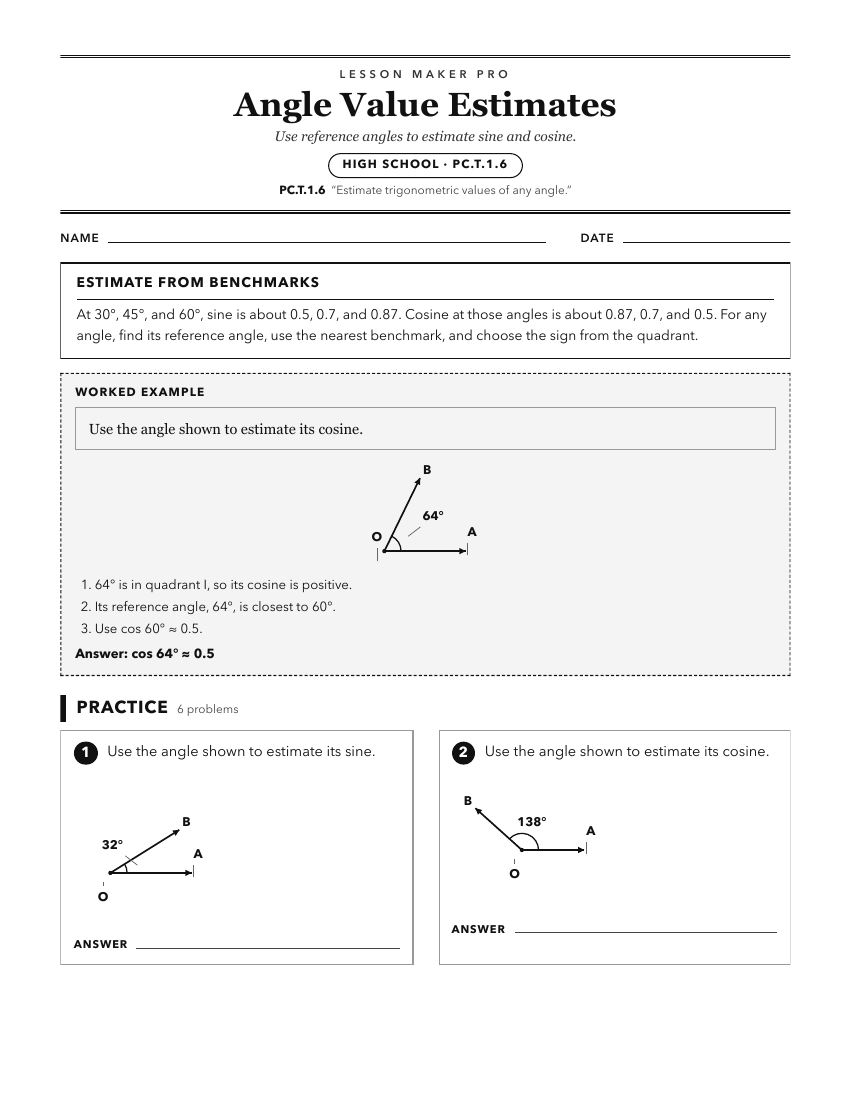
A ready-to-print activity worksheet aligned to PC.T.1.6, with an answer key for the teacher on its own page. No account needed.
PDF, US Letter, prints cleanly in black and white.
Download the worksheetKeep exploring
Related Standards
Turn this exact standard into a lesson
Grade, subject, topic, and the complete standard are prefilled. Create one free, no account needed.
Also for this standard:Make a WorksheetMake a QuizMake a Sub Lesson