Oklahoma Math 4.A.1.2
The Standard
- 4.A.1
- Describe, create, and analyze multiple representations of patterns to solve real-world and mathematical problems.
Describe the single operation rule for a pattern from an input/output table or function machine involving any operation of a whole number.
Oklahoma Academic Standards for Mathematics (2022)
Teacher's field guide
What This Standard Means
What Students Need to Do
- Students look at input/output pairs and find the one operation that changes each input to its output. They check the rule against every pair, then use it for a new input.
What Mastery Looks Like
- A student can name a rule such as divide by 4 for 12→3, 20→5, and 32→8. They can use it to find that 28→7 and explain why it works.
Common Misconceptions
- Students may look at the gaps between outputs instead of comparing each input with its output. They may choose a rule that works for one pair but fails on the next.
How to Assess It
- Put 12→3, 20→5, and 32→8 on an exit ticket. Ask: What single operation works for every pair, and what is the output for 28?
Lesson moves
Ways to Teach It
Give students counters and input cards 8, 12, and 20; have them make four equal groups and record the count in each group.
Show 2→6, 5→15, and 8→24; ask, “Why does add 4 fail, and which operation works for every pair?”
Play rule match with table cards labeled 2→7, 5→10; 8→5, 9→6; 3→6, 4→8; 8→2, 12→3, and matching rule cards.
Give groups of four students 12, 20, or 28 stickers; have them record stickers per student and name the rule.
Free download
Printable 4.A.1.2 Worksheet
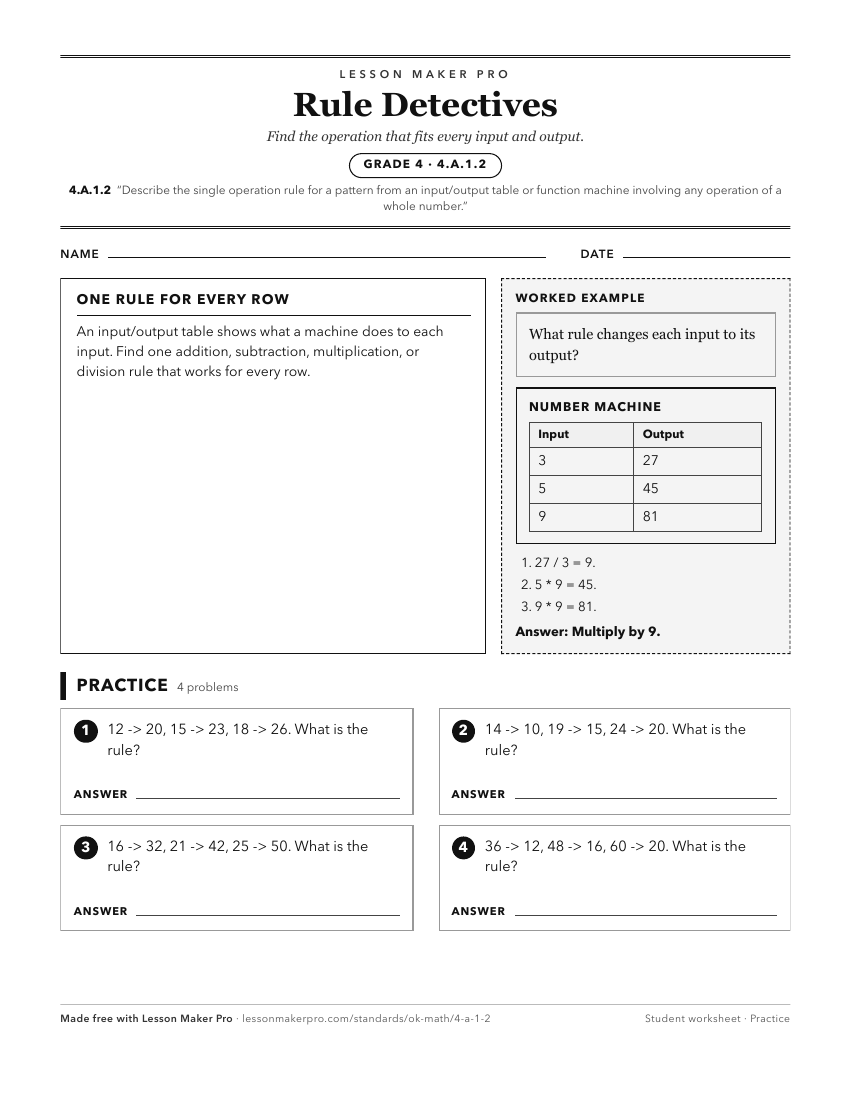
A ready-to-print activity worksheet aligned to 4.A.1.2, with an answer key for the teacher on its own page. No account needed.
PDF, US Letter, prints cleanly in black and white.
Download the worksheetKeep exploring
Related Standards
- 3.A.1.2
Describe the rule (limited to a single operation) for a pattern from an input/output table or function machine involving addition, subtraction, or multiplicatio...
- 5.A.1.1
Use tables and rules with up to two operations to describe patterns of change and make predictions and generalizations about various mathematical situations.
- 6.N.2
Read, write, and model whole number and integer operations to solve problems.
- K.N.1
Understand the relationship between quantities and whole numbers.
Turn this exact standard into a lesson
Grade, subject, topic, and the complete standard are prefilled. Create one free, no account needed.
Also for this standard:Make a WorksheetMake a QuizMake a Sub Lesson