Oklahoma Math 5.A.1.1
The Standard
- 5.A.1
- Describe and graph patterns of change created through numerical patterns.
Use tables and rules with up to two operations to describe patterns of change and make predictions and generalizations about various mathematical situations.
Oklahoma Academic Standards for Mathematics (2022)
Teacher's field guide
What This Standard Means
What Students Need to Do
- Students use input-output tables to find a one-step or two-step rule. They use the rule to fill missing values and predict outputs for inputs not shown.
What Mastery Looks Like
- Given inputs 1, 2, 3 and outputs 5, 7, 9, a student writes “double the input, then add 3.” They find 23 for input 10 without extending the table one row at a time. They can plot the pairs and describe how the outputs rise.
Common Misconceptions
- Students may notice that the outputs go up by 2 and use “add 2” as the input-output rule. That works for finding the next output, but not for finding the output for any input. Others add 3 before doubling, which gives different results.
How to Assess It
- Give students inputs 1, 2, 3 and outputs 5, 7, 9. Ask them to write a two-step rule, find the output for input 10, and explain their answer.
Lesson moves
Ways to Teach It
Give pairs number cards 1 to 5 and counters; have them build two groups of each number, add three counters, and record totals.
Show “double, then add 3” and “add 3, then double.” Ask which gives 13 for input 5 and why.
Play rule detective: post the pairs (1, 5), (2, 7), and (3, 9); partners write a rule and predict the output for 20.
Use a $3 delivery fee plus $2 per item; make a cost table for 1 to 5 items, then predict the cost for 10.
Free download
Printable 5.A.1.1 Worksheet
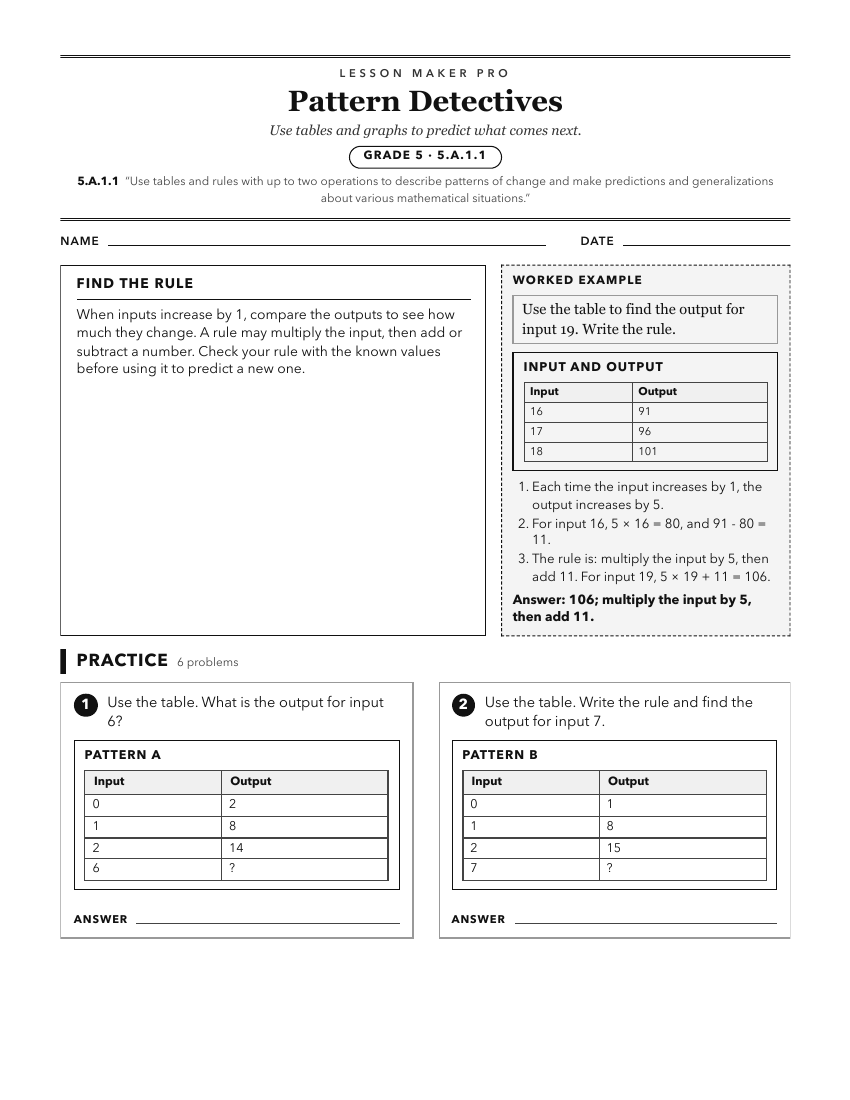
A ready-to-print activity worksheet aligned to 5.A.1.1, with an answer key for the teacher on its own page. No account needed.
PDF, US Letter, prints cleanly in black and white.
Download the worksheetKeep exploring
Related Standards
- 6.A.1
Recognize and represent relationships between varying quantities; translate from one representation to another; use patterns, tables, graphs, and rules to model...
- 4.A.1
Describe, create, and analyze multiple representations of patterns to solve real-world and mathematical problems.
- 3.A.1.1
Create, describe, and extend patterns involving addition, subtraction, or multiplication to solve problems in a variety of contexts.
- PA.A.1.2
Use linear functions to represent and model mathematical situations.
Turn this exact standard into a lesson
Grade, subject, topic, and the complete standard are prefilled. Create one free, no account needed.
Also for this standard:Make a WorksheetMake a QuizMake a Sub Lesson