Oklahoma Math K.N.1
Standard Cluster
Understand the relationship between quantities and whole numbers. Count aloud forward in sequence to 100 by 1s and 10s. Recognize that a number can be used to represent how many objects are in a set up to 10. Use ordinal numbers to represent the position of an object in a sequence up to 10. Recognize without counting (subitize) the quantity of a small group of objects in organized and random arrangements up to 10. Count forward, with and without objects, from any given number up to 20. Read, write, discuss, and represent whole numbers from 0 to at least 20. Representations may include numerals, pictures, real-object and pictographs, spoken words, and manipulatives. Find a number that is 1 more or 1 less than a given number up to 10. Compare and order whole numbers from 0 to 10 with and without objects, using the vocabulary "more than,” “less than,” or “equal to.”
Oklahoma Academic Standards for Mathematics (2022)
Cluster contents
Standards in This Cluster
K.N.1 is a cluster heading. These are the individual standards under it.
- K.N.1.2
Recognize that a number can be used to represent how many objects are in a set up to 10.
- K.N.1.3
Use ordinal numbers to represent the position of an object in a sequence up to 10.
- K.N.1.4
Recognize without counting (subitize) the quantity of a small group of objects in organized and random arrangements up to 10.
- K.N.1.5
Count forward, with and without objects, from any given number up to 20.
- K.N.1.6
Read, write, discuss, and represent whole numbers from 0 to at least 20. Representations may include numerals, pictures, real-object and pictographs, spoken wor...
- K.N.1.7
Find a number that is 1 more or 1 less than a given number up to 10.
- K.N.1.8
Compare and order whole numbers from 0 to 10 with and without objects, using the vocabulary "more than," "less than," or "equal to."
Teacher's field guide
What This Cluster Means
What Students Need to Do
- Students count to 100 by ones and tens, and count on from any number up to 20. They show numbers through 20 with numerals, words, pictures, and objects, including zero. They recognize small groups without counting, name positions in a line, and compare groups up to 10.
What Mastery Looks Like
- A student sees seven dots briefly, says seven, and writes 7 without pointing to each dot. They count from 16 to 20 and tell which of two numbers up to 10 is greater without using objects. They name the fourth toy in a row and find one more and one less than 8.
Common Misconceptions
- Students may skip a teen number when counting from 14 or mix up 14 and 40. They may think a spread-out group has more than a tight group with the same number of objects. They may count the first item in a line as zero.
How to Assess It
- Show a seven-dot card for two seconds. Ask students to write how many dots they saw, then draw a group with one more dot and write its number.
Lesson moves
Ways to Teach It
Line up ten blocks, ask partners to point to the seventh block, then build groups of one more and one less than eight.
Flash a nine-dot card for two seconds and ask, “Which smaller groups helped you see nine?”
Draw a card from 0 to 20, count from that number to 20, then count by tens to 100.
Set out trays with six and eight crackers; ask students which tray has more and have them write both numbers.
Free download
Printable K.N.1 Worksheet
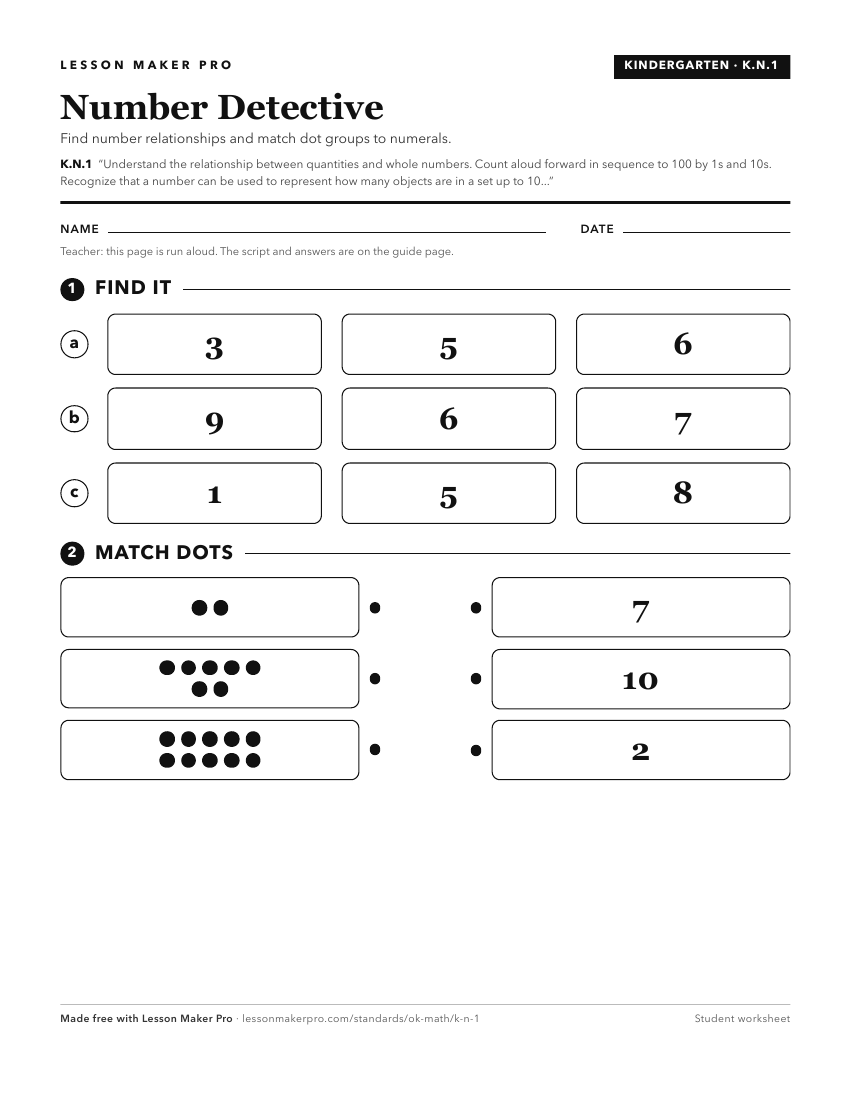
A ready-to-print activity worksheet aligned to K.N.1, with an answer key for the teacher on its own page. No account needed.
PDF, US Letter, prints cleanly in black and white.
Download the worksheetKeep exploring
Related Standards
- K.N.3
Understand the relationship between whole numbers and fractions through fair share.
- 3.N.3.4
Use models and number lines to order and compare fractions that are related to the same whole.
- 2.N.1
Compare and represent whole numbers up to 1,000 with an emphasis on place value and equality.
- 1.N.1
Count, compare, and represent whole numbers up to 100, with an emphasis on grouping in terms of tens and ones.
Turn this cluster into a lesson
Grade, subject, topic, and the complete cluster are prefilled. Create one free, no account needed.
Also for this cluster:Make a WorksheetMake a QuizMake a Sub Lesson