Oklahoma Math 2.N.1
Standard Cluster
Compare and represent whole numbers up to 1,000 with an emphasis on place value and equality. Read, write, discuss, and represent whole numbers up to 1,000. Representations should include, but are not limited to, numerals, words, pictures, tally marks, number lines, and manipulatives. Use knowledge of number relationships to locate the position of a given whole number, up to 100, on an open number line. Use place value to describe whole numbers between 10 and 1,000 in terms of hundreds, tens, and ones, including written, standard, and expanded forms. Know that 10 is equivalent to 10 ones and 100 is equivalent to 10 tens. Find 10 more or 10 less than a given three-digit number. Find 100 more or 100 less than a given three-digit number. Use objects to determine whether a number is even or odd. Use place value understanding to round numbers to the nearest ten and nearest hundred (up to 1,000). Recognize when to round in real-world situations. Use place value to compare and order whole numbers up to 1,000 using comparative language, numbers, and symbols (e.g., 425 > 276, 73 < 107, page 351 comes after page 350, 753 is between 700 and 800).
Oklahoma Academic Standards for Mathematics (2022)
Cluster contents
Standards in This Cluster
2.N.1 is a cluster heading. These are the individual standards under it.
- 2.N.1.1
Read, write, discuss, and represent whole numbers up to 1,000. Representations should include, but are not limited to, numerals, words, pictures, tally marks, n...
- 2.N.1.2
Use knowledge of number relationships to locate the position of a given whole number, up to 100, on an open number line.
- 2.N.1.3
Use place value to describe whole numbers between 10 and 1,000 in terms of hundreds, tens, and ones, including written, standard, and expanded forms. Know that ...
- 2.N.1.4
Find 10 more or 10 less than a given three-digit number. Find 100 more or 100 less than a given three-digit number.
- 2.N.1.5
Use objects to determine whether a number is even or odd.
- 2.N.1.6
Use place value understanding to round numbers to the nearest ten and nearest hundred (up to 1,000). Recognize when to round in real-world situations.
- 2.N.1.7
Use place value to compare and order whole numbers up to 1,000 using comparative language, numbers, and symbols (e.g., 425 > 276, 73 < 107, page 351 comes after...
Teacher's field guide
What This Cluster Means
What Students Need to Do
- Students read and write numbers to 1,000 in digits and words. They show numbers with blocks, pictures, and tallies, and place numbers up to 100 on an open number line. They compare numbers, find 10 or 100 more or less, use objects to check even or odd, and round to tens or hundreds.
What Mastery Looks Like
- A student can write 364 as three hundred sixty-four and 300 + 60 + 4, and explain that ten tens make one hundred. They can order three numbers, place 68 on a 0 to 100 line, and round 364 to 360 or 400. They can pair objects to show that 364 is even.
Common Misconceptions
- Students may say 98 is greater than 103 because 9 is greater than 1. They may treat the 6 in 364 as six ones or miss the new hundred when adding 10 to 390. They may call 312 odd because its hundreds digit is odd, or round 351 down to 300 by checking the ones digit.
How to Assess It
- Exit ticket: Write 372 in expanded form, find 10 less, and round it to the nearest hundred. Explain which digit helped you round.
Lesson moves
Ways to Teach It
Give students twelve ten-rods and six cubes; trade ten rods for a hundred-flat, then pair cubes to check whether 126 is even.
Draw an open number line labeled 0 and 100; ask, "Where would 68 go, and which nearby tens help you decide?"
Give each pair two cards numbered 100 to 899, allowing repeats; students compare with <, >, or =, then find 100 more.
Show an order for 276 pencils sold in boxes of 100; ask how many boxes to buy and why 300 is useful.
Free download
Printable 2.N.1 Worksheet
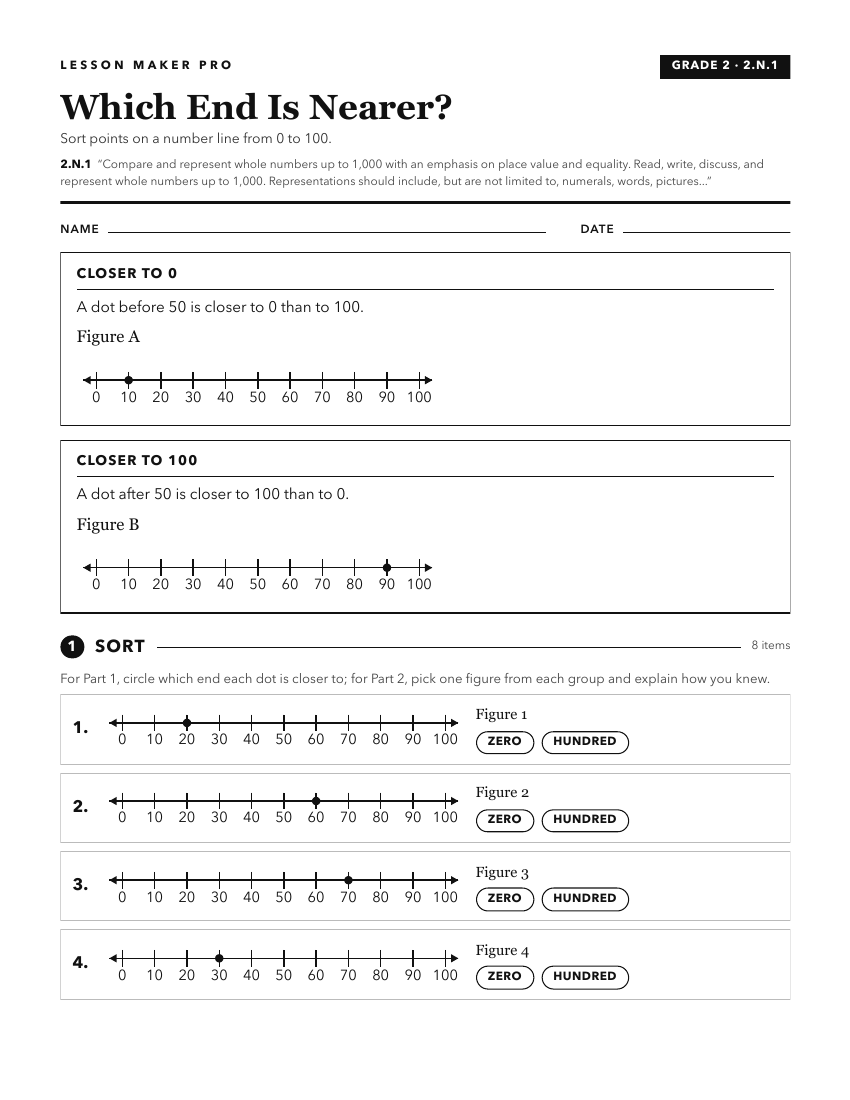
A ready-to-print activity worksheet aligned to 2.N.1, with an answer key for the teacher on its own page. No account needed.
PDF, US Letter, prints cleanly in black and white.
Download the worksheetKeep exploring
Related Standards
- 4.N.1
Compare and represent whole numbers up to 1,000,000 with an emphasis on place value and equality.
- 3.N.1
Compare and represent whole numbers up to 100,000 with an emphasis on place value and equality.
- 1.N.1
Count, compare, and represent whole numbers up to 100, with an emphasis on grouping in terms of tens and ones.
- 4.N.1.4
Use place value to compare and order whole numbers up to 1,000,000, using comparative language, numbers, and symbols.
Turn this cluster into a lesson
Grade, subject, topic, and the complete cluster are prefilled. Create one free, no account needed.
Also for this cluster:Make a WorksheetMake a QuizMake a Sub Lesson