Oklahoma Math 3.N.1
Standard Cluster
Compare and represent whole numbers up to 100,000 with an emphasis on place value and equality. Read, write, discuss, and represent whole numbers up to 100,000. Representations should include but are not limited to numerals, words, pictures, number lines, and manipulatives (e.g., 350 = 3 hundreds, 5 tens = 35 tens = 3 hundreds, 4 tens, 10 ones). Use place value to describe whole numbers between 1,000 and 100,000 in terms of ten-thousands, thousands, hundreds, tens and ones, including written, standard, and expanded forms. Applying knowledge of place values, use mental strategies (no written computations) to find 100 more or 100 less than a given number, 1,000 more or 1,000 less than a given number, and 10,000 more or 10,000 less than a given number, up to a five-digit number. Use place value to compare and order whole numbers, up to 100,000, using comparative language, numbers, and symbols. Use place value understanding to round numbers to the nearest thousand, ten-thousand and hundred-thousand.
Oklahoma Academic Standards for Mathematics (2022)
Cluster contents
Standards in This Cluster
3.N.1 is a cluster heading. These are the individual standards under it.
- 3.N.1.1
Read, write, discuss, and represent whole numbers up to 100,000. Representations should include but are not limited to numerals, words, pictures, number lines, ...
- 3.N.1.2
Use place value to describe whole numbers between 1,000 and 100,000 in terms of ten thousands, thousands, hundreds, tens and ones, including written, standard, ...
- 3.N.1.3
Applying knowledge of place values, use mental strategies (no written computations) to find 100 more or 100 less than a given number, 1,000 more or 1,000 less t...
- 3.N.1.4
Use place value to compare and order whole numbers, up to 100,000, using comparative language, numbers, and symbols.
- 3.N.1.5
Use place value understanding to round numbers to the nearest thousand, ten-thousand and hundred thousand.
Teacher's field guide
What This Cluster Means
What Students Need to Do
- Students show numbers up to 100,000 with digits, words, drawings, and place-value pieces. They place numbers on a number line, compare and order them, and find 100, 1,000, or 10,000 more or less in their heads. They round numbers to the nearest thousand, ten-thousand, and hundred-thousand.
What Mastery Looks Like
- A student writes 63,040 in words and expanded form and places it correctly on a number line. They explain why 63,040 is greater than 62,940 and find 73,040 as 10,000 more without written calculation. They round 63,040 to 63,000, 60,000, or 100,000 when asked for each place.
Common Misconceptions
- Students may read 40,506 as 4,506 because they skip a zero, or say 59,999 is greater than 60,001 because it has more nines. They may write 39,600 for 1,000 more than 39,500, or round 48,650 to 100,000 because it has five digits.
How to Assess It
- Exit ticket: Write 58,650 in expanded form, find 1,000 less mentally, compare it with 58,560, and round it to the nearest thousand and hundred-thousand.
Lesson moves
Ways to Teach It
Give pairs place-value disks to build 32,400, then trade one thousand disk for ten hundred disks and record both forms.
Ask, "Why is 49,999 less than 50,001 even though it has more nines?" Have students write a two-sentence explanation.
Play Round and Compare: show 48,650 and 58,650; pairs round each to the nearest thousand, ten-thousand, and hundred-thousand, then compare.
Use town population cards marked 38,460 and 45,205; students compare them and round each to the nearest ten-thousand for a newspaper headline.
Free download
Printable 3.N.1 Worksheet
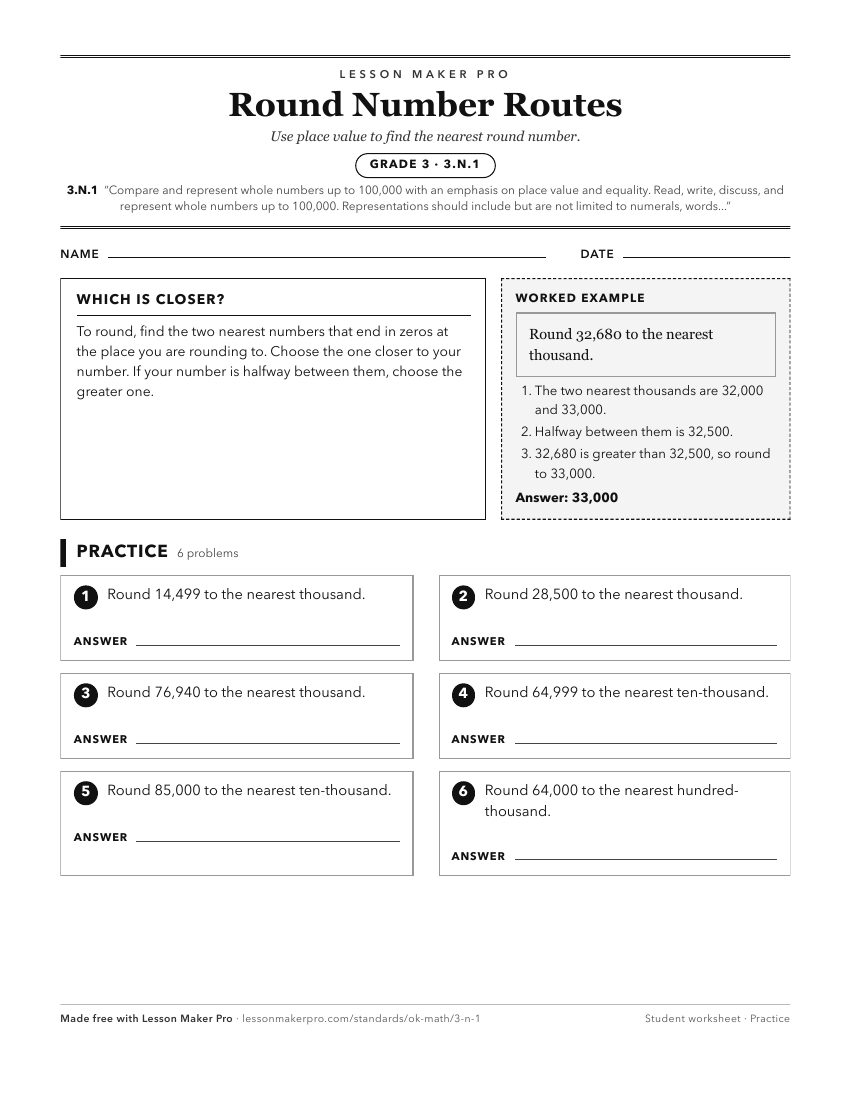
A ready-to-print activity worksheet aligned to 3.N.1, with an answer key for the teacher on its own page. No account needed.
PDF, US Letter, prints cleanly in black and white.
Download the worksheetKeep exploring
Related Standards
- 4.N.1
Compare and represent whole numbers up to 1,000,000 with an emphasis on place value and equality.
- 2.N.1
Compare and represent whole numbers up to 1,000 with an emphasis on place value and equality.
- 4.N.1.4
Use place value to compare and order whole numbers up to 1,000,000, using comparative language, numbers, and symbols.
Turn this cluster into a lesson
Grade, subject, topic, and the complete cluster are prefilled. Create one free, no account needed.
Also for this cluster:Make a WorksheetMake a QuizMake a Sub Lesson