Oklahoma Math 1.N.1
Standard Cluster
Count, compare, and represent whole numbers up to 100, with an emphasis on grouping in terms of tens and ones. Recognize numbers to 20 without counting (subitize) the quantity of structured arrangements. Use concrete representations to describe whole numbers between 10 and 100 in terms of tens and ones. Know that 10 is equivalent to 10 ones and 100 is equivalent to 10 tens. Read, write, discuss, and represent whole numbers up to 100. Representations may include numerals, words, addition and subtraction, pictures, tally marks, number lines, and manipulatives. Count forward, with objects, from any given number up to 100 by 1s, 2s, 5s and 10s. Count forward, without objects, by multiples of 1s, 2s, 5s, and 10s, up to 100. Find a number that is 10 more or 10 less than a given number up to 100. Compare and order whole numbers from 0 to 100. Use knowledge of number relationships to locate the position of a given whole number, up to 20, on an open number line. Use words such as “more than,” “less than,” and “equal to” to describe the relative value of numbers.
Oklahoma Academic Standards for Mathematics (2022)
Cluster contents
Standards in This Cluster
1.N.1 is a cluster heading. These are the individual standards under it.
- 1.N.1.1
Recognize numbers to 20 without counting (subitize) the quantity of structured arrangements.
- 1.N.1.2
Use concrete representations to describe whole numbers between 10 and 100 in terms of tens and ones. Know that 10 is equivalent to 10 ones and 100 is equivalent...
- 1.N.1.3
Read, write, discuss, and represent whole numbers up to 100. Representations may include numerals, words, addition and subtraction, pictures, tally marks, numbe...
- 1.N.1.4
Count forward, with objects, from any given number up to 100 by 1s, 2s, 5s and 10s.
- 1.N.1.5
Count forward, without objects, by multiples of 1s, 2s, 5s, and 10s, up to 100.
- 1.N.1.6
Find a number that is 10 more or 10 less than a given number up to 100.
- 1.N.1.7
Compare and order whole numbers from 0 to 100.
- 1.N.1.8
Use knowledge of number relationships to locate the position of a given whole number, up to 20, on an open number line.
- 1.N.1.9
Use words such as "more than," "less than," and "equal to" to describe the relative value of numbers.
Teacher's field guide
What This Cluster Means
What Students Need to Do
- Students name amounts up to 20 from groups of dots without counting each dot. They build, read, write, and compare numbers to 100 using tens and ones. They count forward by 1s, 2s, 5s, and 10s, find 10 more or less, and place numbers to 20 on an open number line.
What Mastery Looks Like
- Shown 47, a student makes four groups of ten and seven singles, then writes 40 + 7. They know ten ones make one ten and ten tens make 100. They can say that 57 is 10 more than 47, order 47, 52, and 70, and place 14 between 10 and 20 on an open number line.
Common Misconceptions
- Students may read 47 as seven tens and four ones, or count every dot on a ten-frame. Some change the ones digit when adding 10, skip numbers when counting by 2s or 5s, or place 14 halfway between 10 and 20.
How to Assess It
- Exit ticket: Draw three groups of ten sticks and four single sticks. Ask, “What number is this? Draw 10 more sticks and write the new number.”
Lesson moves
Ways to Teach It
Have pairs bundle 100 craft sticks into tens, trade ten bundles for a hundred, then build 63 with bundles and singles.
Flash ten-frame cards showing 17 for two seconds; ask, “How did you see 17 without counting every dot?”
Play Count Around: draw a 2, 5, or 10 card, then take turns saying the next multiple up to 100.
Show price tags of 47¢ and 57¢; ask which snack costs 10¢ more, then show both prices with dimes and pennies.
Free download
Printable 1.N.1 Worksheet
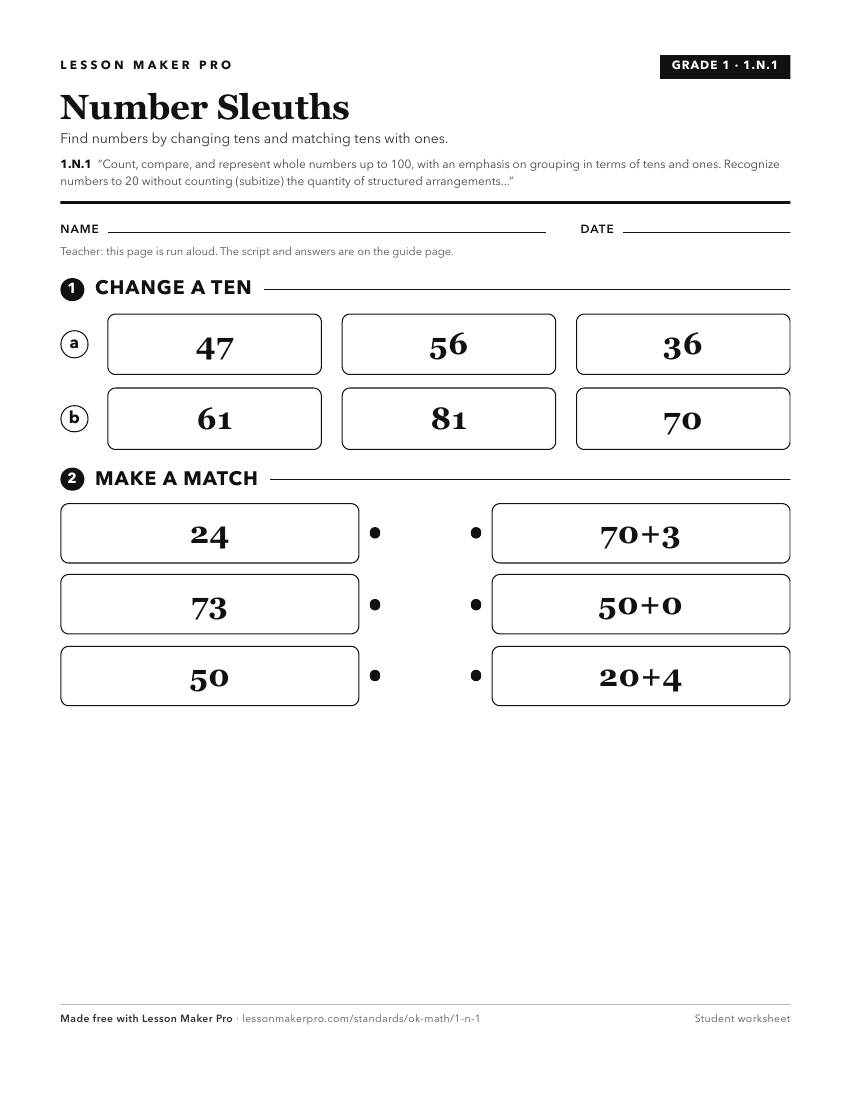
A ready-to-print activity worksheet aligned to 1.N.1, with an answer key for the teacher on its own page. No account needed.
PDF, US Letter, prints cleanly in black and white.
Download the worksheetKeep exploring
Related Standards
- 2.N.1
Compare and represent whole numbers up to 1,000 with an emphasis on place value and equality.
- 3.N.1
Compare and represent whole numbers up to 100,000 with an emphasis on place value and equality.
- 4.N.1
Compare and represent whole numbers up to 1,000,000 with an emphasis on place value and equality.
- 3.N.1.1
Read, write, discuss, and represent whole numbers up to 100,000. Representations should include but are not limited to numerals, words, pictures, number lines, ...
Turn this cluster into a lesson
Grade, subject, topic, and the complete cluster are prefilled. Create one free, no account needed.
Also for this cluster:Make a WorksheetMake a QuizMake a Sub Lesson