Oklahoma Math 3.N.3
Standard Cluster
Use and justify fractional representations in real-world and mathematical problems. Read and write fractions with words and symbols using appropriate terminology (i.e., numerator and denominator). Model fractions using length, set, and area for halves, thirds, fourths, sixths, and eighths. Apply understanding of unit fractions and use this understanding to compose and decompose fractions related to the same whole. Use models and number lines to order and compare fractions that are related to the same whole.
Oklahoma Academic Standards for Mathematics (2022)
Cluster contents
Standards in This Cluster
3.N.3 is a cluster heading. These are the individual standards under it.
- 3.N.3.1
Read and write fractions with words and symbols using appropriate terminology (i.e., numerator and denominator).
- 3.N.3.2
Model fractions using length, set, and area for halves, thirds, fourths, sixths, and eighths.
- 3.N.3.3
Apply understanding of unit fractions and use this understanding to compose and decompose fractions related to the same whole.
- 3.N.3.4
Use models and number lines to order and compare fractions that are related to the same whole.
Teacher's field guide
What This Cluster Means
What Students Need to Do
- Students read and write halves, thirds, fourths, sixths, and eighths in words and symbols. They show fractions with strips, shaded shapes, and groups of objects. They build fractions from unit fractions and compare them using models and number lines.
What Mastery Looks Like
- A student names the numerator and denominator and writes three fourths as 3/4. They show 3/4 as three 1/4 pieces and explain why 3/4 is greater than 3/8 when the wholes match.
Common Misconceptions
- Students may think 1/8 is larger than 1/4 because 8 is larger than 4. They may divide a shape into unequal pieces or compare fractions from different-sized wholes as if the pieces match. In a group of objects, some count every object as the numerator instead of counting only the selected ones.
How to Assess It
- Exit ticket: Draw equal-length bars for 3/4 and 3/8, circle the larger fraction, and explain your choice. Write 3/4 as a sum of unit fractions.
Lesson moves
Ways to Teach It
Give pairs equal-length strips, 12 counters, and 4-by-4 grids; have them model 3/4 with each and label three 1/4 parts.
Ask students to sketch two different-sized pizzas and explain in writing why one fourth of each gives different amounts.
Play Fraction Line-Up: hand out 1/2, 2/3, 3/4, 5/6, and 7/8 cards for students to place on one zero-to-one number line.
Measure a 12-inch ribbon; mark fourths and eighths, then decide whether 3/4 or 5/8 uses more ribbon and explain why.
Free download
Printable 3.N.3 Worksheet
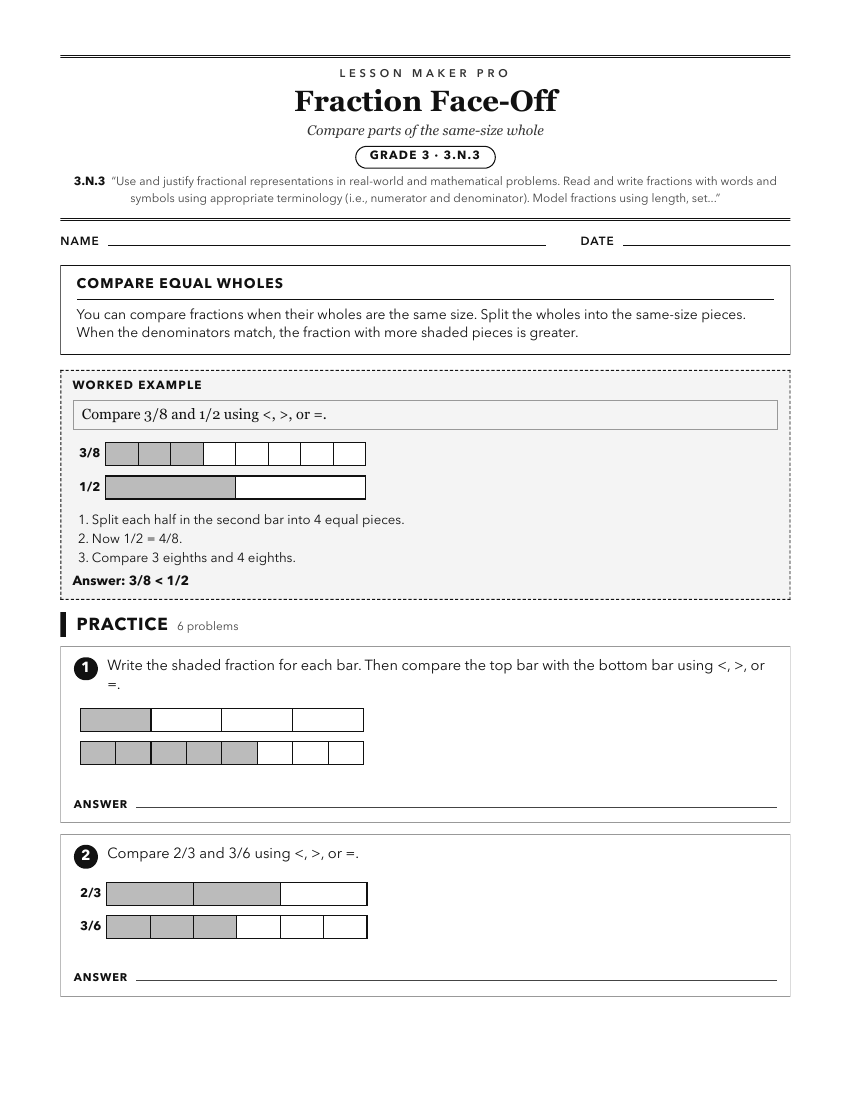
A ready-to-print activity worksheet aligned to 3.N.3, with an answer key for the teacher on its own page. No account needed.
PDF, US Letter, prints cleanly in black and white.
Download the worksheetKeep exploring
Related Standards
- 4.N.3
Represent and compare fractions and decimals in real-world and mathematical situations; use place value to understand decimal quantities.
- A1.F.3
Represent functions in multiple ways and use the representation to interpret real-world and mathematical problems.
- 7.N.1.2
Recognize and generate equivalent representations of rational numbers, including equivalent fractions.
- 6.N.1
Read, write, and represent rational numbers expressed as integers, fractions, decimals, percents, and ratios; use these representations in real-world and mathem...
Turn this cluster into a lesson
Grade, subject, topic, and the complete cluster are prefilled. Create one free, no account needed.
Also for this cluster:Make a WorksheetMake a QuizMake a Sub Lesson