Oklahoma Math 4.N.3
Standard Cluster
Represent and compare fractions and decimals in real-world and mathematical situations; use place value to understand decimal quantities. Represent and rename equivalent fractions using fraction models (e.g., parts of a set, area models, fraction strips, number lines). Use benchmark fractions (0, 1/4, 1/3, 1/2, 2/3, 3/4, 1) to locate additional fractions with denominators up to twelfths on a number line. Use models to order and compare whole numbers and fractions less than and greater than one, using comparative language and symbols. Decompose a fraction into a sum of fractions with the same denominator in more than one way, using concrete and pictorial models and recording results with numerical representations (e.g., 3/4 = 1/4 + 1/4 + 1/4 and 3/4 = 2/4 + 1/4). Use models to add and subtract fractions with like denominators. Represent tenths and hundredths with concrete and pictorial models, making connections between fractions and decimals. Read and write decimals in standard, word, and expanded form up to at least the hundredths place in a variety of contexts, including money. Compare and order decimals and whole numbers using place value and various models including but not limited to grids, number lines, and base 10 blocks. Compare and order benchmark fractions (0, 1/4, 1/3, 1/2, 2/3, 3/4, 1) and decimals (0, 0.25, 0.50, 0.75, 1.00) in a variety of representations.
Oklahoma Academic Standards for Mathematics (2022)
Cluster contents
Standards in This Cluster
4.N.3 is a cluster heading. These are the individual standards under it.
- 4.N.3.1
Represent and rename equivalent fractions using fraction models (e.g., parts of a set, area models, fraction strips, number lines).
- 4.N.3.2
Use benchmark fractions (0, 1/4, 1/3, 1/2, 2/3, 3/4, 1) to locate additional fractions with denominators up to twelfths on a number line.
- 4.N.3.3
Use models to order and compare whole numbers and fractions less than and greater than one, using comparative language and symbols.
- 4.N.3.4
Decompose a fraction into a sum of fractions with the same denominator in more than one way, using concrete and pictorial models and recording results with nume...
- 4.N.3.5
Use models to add and subtract fractions with like denominators.
- 4.N.3.6
Represent tenths and hundredths with concrete and pictorial models, making connections between fractions and decimals.
- 4.N.3.7
Read and write decimals in standard, word, and expanded form up to at least the hundredths place in a variety of contexts, including money.
- 4.N.3.8
Compare and order decimals and whole numbers using place value and various models including but not limited to grids, number lines, and base 10 blocks.
- 4.N.3.9
Compare and order benchmark fractions (0, 1/4, 1/3, 1/2, 2/3, 3/4, 1) and decimals (0, 0.25, 0.50, 0.75, 1.00) in a variety of representations.
Teacher's field guide
What This Cluster Means
What Students Need to Do
- Use strips, grids, and number lines to rename fractions, compare values above and below one, and add or subtract fractions with the same denominator. Show tenths and hundredths as fractions and decimals. Read, write, expand, and order decimals through hundredths, including money.
What Mastery Looks Like
- A student can use strips to show 3/4 = 6/8 and 3/8 + 2/8 = 5/8. They can place 3/4, 1, and 5/4 in order and explain why 5/4 is greatest. They can write 1.25 in words and expanded form, then compare $1.25 with $1.52 by place value.
Common Misconceptions
- Students may think 1/8 is greater than 1/4 because 8 is greater than 4. They may add denominators when adding fractions, or say 0.35 is greater than 0.4 because 35 is greater than 4.
How to Assess It
- On an exit ticket, have students shade a 100-square grid for 0.25, write its fraction and word form, then compare 0.25 and 0.3 using a symbol. Ask them to sketch fraction strips for 2/4 + 1/4.
Lesson moves
Ways to Teach It
Give pairs fraction strips to show 2/4 = 1/2, place 5/4 beside 1, and model 2/4 + 1/4.
Ask, 'Is 0.4 greater than 0.35?' Have students draw a 100-square grid and explain their answer to a partner.
Play decimal match: students pair 0.25, 25/100, a shaded grid card, and 'twenty-five hundredths,' then write 0.25 in expanded form.
Give students a mock menu priced $1.05, $1.50, and $1.55; have them order the prices and write $1.05 in expanded form.
Free download
Printable 4.N.3 Worksheet
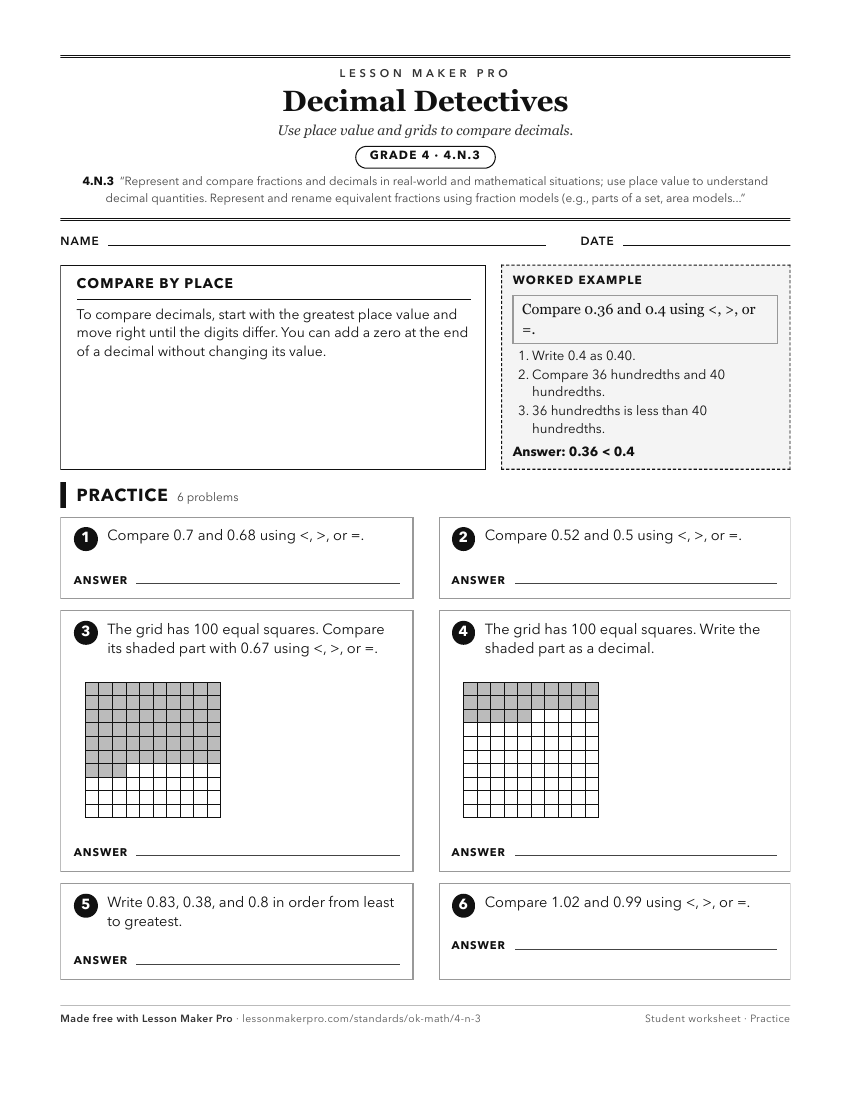
A ready-to-print activity worksheet aligned to 4.N.3, with an answer key for the teacher on its own page. No account needed.
PDF, US Letter, prints cleanly in black and white.
Download the worksheetKeep exploring
Related Standards
- 5.N.1
Read, write, represent, and compare fractions and decimals; recognize and write equivalent fractions; convert between fractions and decimals; use fractions and ...
- 5.N.1.2
Read, write, and represent decimals using place value to describe decimal numbers including fractional numbers as small as thousandths and whole numbers up to s...
- 3.N.3
Use and justify fractional representations in real-world and mathematical problems.
Turn this cluster into a lesson
Grade, subject, topic, and the complete cluster are prefilled. Create one free, no account needed.
Also for this cluster:Make a WorksheetMake a QuizMake a Sub Lesson