NY Next Generation Math NY-K.CC.6
The Standard
Identify whether the number of objects in one group is greater than (more than), less than (fewer than), or equal to (the same as) the number of objects in another group.
New York State Next Generation Mathematics Learning Standards
Teacher's field guide
What This Standard Means
What Students Need to Do
- Students compare two groups containing up to ten objects and identify which has more, fewer, or the same number. They use matching or counting to support the comparison.
What Mastery Looks Like
- A student pairs seven red counters with five blue counters and notices two red counters remain. The student says the red group has more and the blue group has fewer.
Common Misconceptions
- Students may judge by how spread out a group looks or count one group inaccurately. They may use more and fewer without naming which group the word describes.
How to Assess It
- Show one group of seven buttons and one group of five buttons. Ask the student to compare them by matching or counting and state both groups' relationship.
Lesson moves
Ways to Teach It
Pair objects from two groups of up to ten, then inspect leftovers to decide more, fewer, or the same.
Ask students how spreading one group farther apart affects its number of objects.
Play group comparison with counter cards and more, fewer, or same labels.
Compare two small collections of classroom supplies to decide which group needs more items.
Free download
Printable NY-K.CC.6 Worksheet
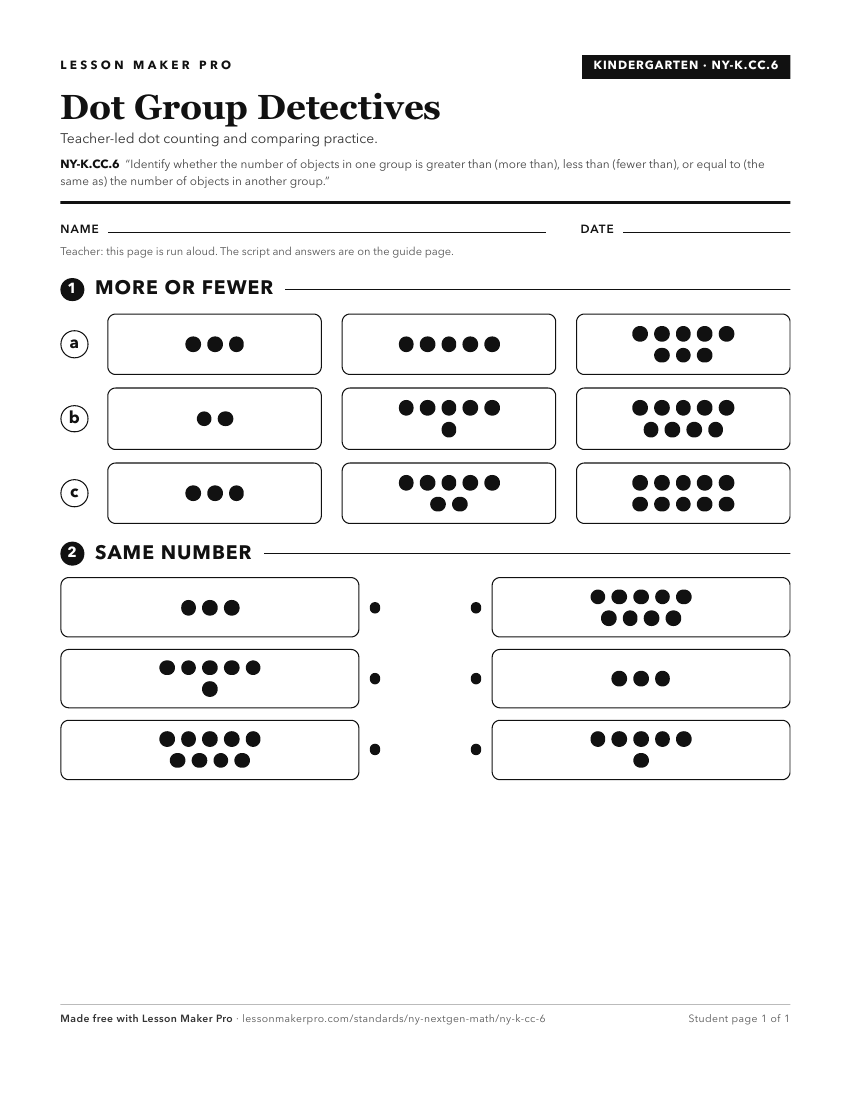
A ready-to-print activity worksheet aligned to NY-K.CC.6, with an answer key for the teacher on its own page. No account needed.
PDF, US Letter, prints cleanly in black and white.
Download the worksheetKeep exploring
Related Standards
- NY-K.CC.5.b
Given a number from 1–20, count out that many objects.
- NY-2.OA.3.a
Determine whether a group of objects (up to 20) has an odd or even number of members.
- NY-1.MD.4
Organize, represent, and interpret data with up to three categories; ask and answer questions about the total number of data points, how many in each category, ...
Turn this exact standard into a lesson
Grade, subject, topic, and the complete standard are prefilled. Create one free, no account needed.
Also for this standard:Make a WorksheetMake a QuizMake a Sub Lesson