NY Next Generation Math NY-K.CC.4.d
The Standard
Understand the concept of ordinal numbers (first through tenth) to describe the relative position and magnitude of whole numbers.
New York State Next Generation Mathematics Learning Standards
Teacher's field guide
What This Standard Means
What Students Need to Do
- Students use first through tenth to name an object's place in an ordered line. They connect later ordinal positions with larger position numbers.
What Mastery Looks Like
- The student identifies the seventh object from a stated starting end and places an object in the fourth position. The student knows sixth comes after fifth and before seventh.
Common Misconceptions
- Students may count from the wrong end or use six instead of sixth. They may confuse the sixth object's position with a group containing six objects.
How to Assess It
- Arrange ten picture cards in a row and mark the starting end. Ask the student to point to the eighth card and place another card fifth.
Lesson moves
Ways to Teach It
Line up ten toy animals and have students place name cards labeled first through tenth beneath them.
Ask students to explain how fifth tells a position while five tells how many objects are in a set.
Play ordinal directions by moving a token to called positions from first through tenth on a path.
Use a pretend race finish to identify runners' positions from first through tenth.
Free download
Printable NY-K.CC.4.d Worksheet
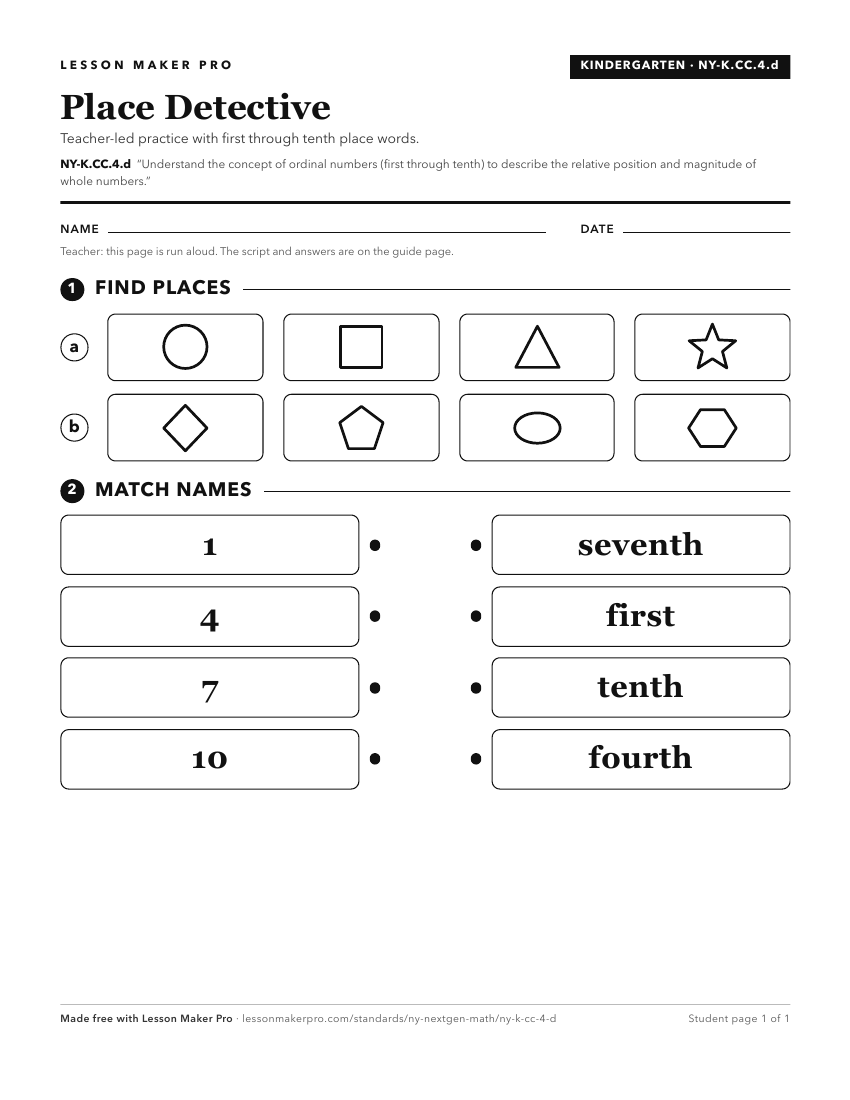
A ready-to-print activity worksheet aligned to NY-K.CC.4.d, with an answer key for the teacher on its own page. No account needed.
PDF, US Letter, prints cleanly in black and white.
Download the worksheetKeep exploring
Related Standards
- NY-1.NBT.2.c
Understand the numbers 10, 20, 30, 40, 50, 60, 70, 80, 90 refer to one, two, three, four, five, six, seven, eight, or nine tens (and 0 ones).
- NY-8.EE.3
Use numbers expressed in the form of a single digit times an integer power of 10 to estimate very large or very small quantities, and to express how many times ...
- NY-K.CC.4.c
Understand the concept that each successive number name refers to a quantity that is one larger.
- NY-2.MD.6
Represent whole numbers as lengths from 0 on a number line with equally spaced points corresponding to the numbers 0, 1, 2, …, and represent whole-number sums a...
Turn this exact standard into a lesson
Grade, subject, topic, and the complete standard are prefilled. Create one free, no account needed.
Also for this standard:Make a WorksheetMake a QuizMake a Sub Lesson