NY Next Generation Math NY-8.EE.3
The Standard
Use numbers expressed in the form of a single digit times an integer power of 10 to estimate very large or very small quantities, and to express how many times as much one is than the other.
New York State Next Generation Mathematics Learning Standards
Teacher's field guide
What This Standard Means
What Students Need to Do
- Students estimate very large and very small quantities as a single digit times an integer power of ten. They compare estimates by finding how many times as large one quantity is as another.
What Mastery Looks Like
- The student represents 68,000,000 as about 7 times 10 to the seventh power. The student uses exponent differences and leading digits to estimate a multiplicative comparison.
Common Misconceptions
- Students may use more than one digit before the power of ten or choose the wrong exponent. They may subtract estimates when the question asks how many times as large.
How to Assess It
- Estimate 620,000,000 and 31,000,000 using one-digit factors and powers of ten. Ask how many times as large the first quantity is.
Lesson moves
Ways to Teach It
Place quantity cards on a power-of-ten number line, then rewrite each estimate with one leading digit.
Ask students to explain why comparing exponents alone may miss the effect of the leading digits.
Play estimate-and-compare with paired population or measurement cards, scoring both notation and multiplicative comparison.
Compare estimated sizes of a cell and a dust particle using powers of ten and a times-as-large statement.
Free download
Printable NY-8.EE.3 Worksheet
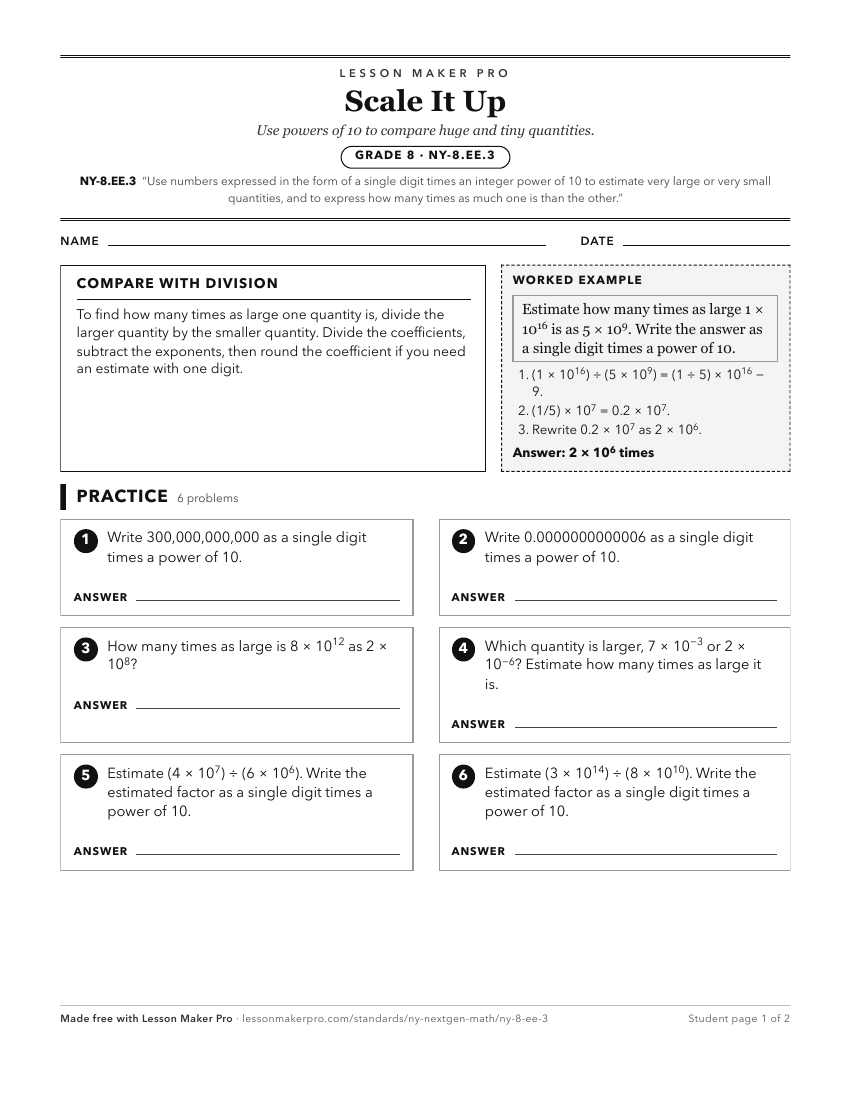
A ready-to-print activity worksheet aligned to NY-8.EE.3, with an answer key for the teacher on its own page. No account needed.
PDF, US Letter, prints cleanly in black and white.
Download the worksheetKeep exploring
Related Standards
- NY-3.NBT.3
Multiply one-digit whole numbers by multiples of 10 in the range 10-90 using strategies based on place value and properties of operations.
- NY-4.NBT.1
Recognize that in a multi-digit whole number, a digit in one place represents ten times what it represents in the place to its right.
- NY-8.EE.4
Perform multiplication and division with numbers expressed in scientific notation, including problems where both standard decimal form and scientific notation a...
- NY-5.NBT.2
Use whole-number exponents to denote powers of 10. Explain patterns in the number of zeros of the product when multiplying a number by powers of 10, and explain...
Turn this exact standard into a lesson
Grade, subject, topic, and the complete standard are prefilled. Create one free, no account needed.
Also for this standard:Make a WorksheetMake a QuizMake a Sub Lesson