NY Next Generation Math NY-K.CC.4.c
The Standard
Understand the concept that each successive number name refers to a quantity that is one larger.
New York State Next Generation Mathematics Learning Standards
Teacher's field guide
What This Standard Means
What Students Need to Do
- Students connect each next counting number to a quantity that has one more object. They build or identify the next quantity in a counting sequence.
What Mastery Looks Like
- Given a set of seven objects, the student adds one and says there are eight. The student explains that eight is one more than seven.
Common Misconceptions
- Students may recite the next number without connecting it to an added object. They may think the next quantity is two more after losing track of the starting set.
How to Assess It
- Show six counters, ask how many, then add one counter. Ask for the new total and why the next number names it.
Lesson moves
Ways to Teach It
Build a staircase of cube towers from one to ten, adding exactly one cube to each next tower.
Ask students to explain what changes in a set when the next counting number is used.
Play one-more cover-up, where students predict the next quantity before a hidden extra counter is revealed.
Set one more plate at a pretend table and connect the new number of plates to the next number word.
Free download
Printable NY-K.CC.4.c Worksheet
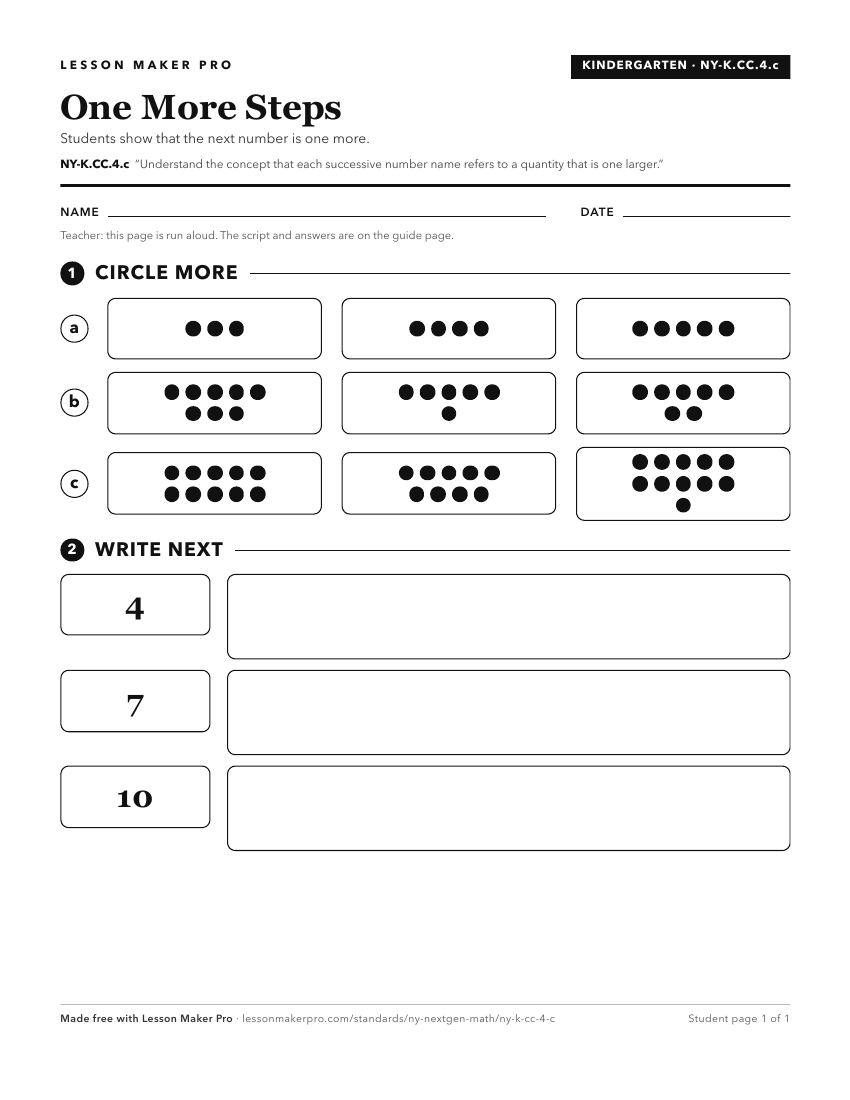
A ready-to-print activity worksheet aligned to NY-K.CC.4.c, with an answer key for the teacher on its own page. No account needed.
PDF, US Letter, prints cleanly in black and white.
Download the worksheetKeep exploring
Related Standards
- NY-1.NBT.2.c
Understand the numbers 10, 20, 30, 40, 50, 60, 70, 80, 90 refer to one, two, three, four, five, six, seven, eight, or nine tens (and 0 ones).
- NY-8.EE.3
Use numbers expressed in the form of a single digit times an integer power of 10 to estimate very large or very small quantities, and to express how many times ...
- NY-K.CC.4.d
Understand the concept of ordinal numbers (first through tenth) to describe the relative position and magnitude of whole numbers.
- NY-2.NBT.1.b
Understand the numbers 100, 200, 300, 400, 500, 600, 700, 800, 900 refer to one, two, three, four, five, six, seven, eight, or nine hundreds (and 0 tens and 0 o...
Turn this exact standard into a lesson
Grade, subject, topic, and the complete standard are prefilled. Create one free, no account needed.
Also for this standard:Make a WorksheetMake a QuizMake a Sub Lesson