NY Next Generation Math NY-1.NBT.2.c
The Standard
Understand the numbers 10, 20, 30, 40, 50, 60, 70, 80, 90 refer to one, two, three, four, five, six, seven, eight, or nine tens (and 0 ones).
New York State Next Generation Mathematics Learning Standards
Teacher's field guide
What This Standard Means
What Students Need to Do
- Students interpret 10, 20, and the other multiples of ten through 90 as groups of tens. They recognize that these numbers contain no leftover ones.
What Mastery Looks Like
- A student builds 70 with seven ten-sticks and explains that it has seven tens and zero ones. The student matches the model to the numeral 70 and its number name.
Common Misconceptions
- Students may count the ten-sticks as seven ones or read 70 as seventeen. They may ignore the zero instead of understanding that it records no ones.
How to Assess It
- Show the numeral 50 and ask the student to build it, name the number of tens and ones, and explain the zero.
Lesson moves
Ways to Teach It
Build each multiple of ten with ten-sticks, then place the model beside its numeral and number-name card.
Ask students what stays the same about 20, 40, and 80 and what changes.
Play exact-tens bingo using models, spoken number names, numerals, and tens-and-ones clues.
Bundle classroom supplies into complete groups of ten and label totals with no leftover ones.
Free download
Printable NY-1.NBT.2.c Worksheet
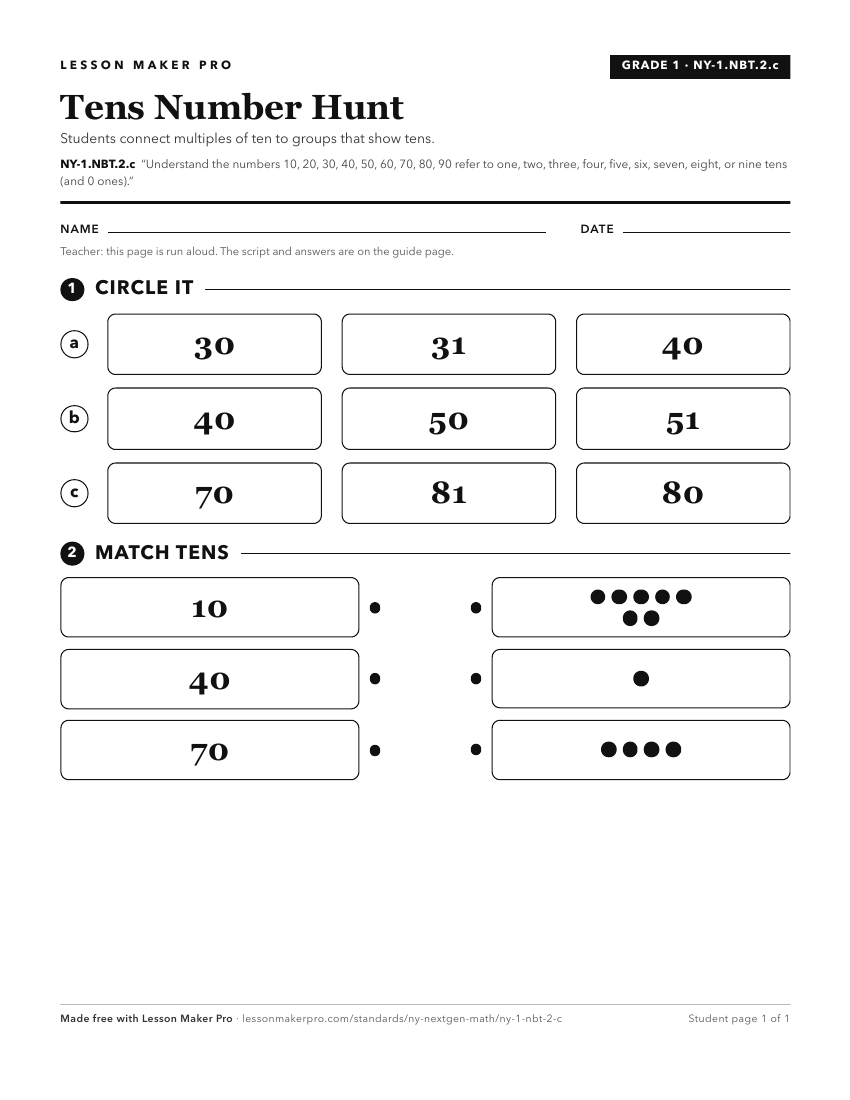
A ready-to-print activity worksheet aligned to NY-1.NBT.2.c, with an answer key for the teacher on its own page. No account needed.
PDF, US Letter, prints cleanly in black and white.
Download the worksheetKeep exploring
Related Standards
- NY-1.NBT.2
Understand that the two digits of a two-digit number represent amounts of tens and ones.
- NY-2.NBT.1
Understand that the digits of a three-digit number represent amounts of hundreds, tens, and ones.
- NY-1.NBT.2.b
Understand the numbers from 11 to 19 are composed of a ten and one, two, three, four, five, six, seven, eight, or nine ones.
- NY-2.NBT.1.b
Understand the numbers 100, 200, 300, 400, 500, 600, 700, 800, 900 refer to one, two, three, four, five, six, seven, eight, or nine hundreds (and 0 tens and 0 o...
Turn this exact standard into a lesson
Grade, subject, topic, and the complete standard are prefilled. Create one free, no account needed.
Also for this standard:Make a WorksheetMake a QuizMake a Sub Lesson