NY Next Generation Math NY-1.NBT.2.b
The Standard
Understand the numbers from 11 to 19 are composed of a ten and one, two, three, four, five, six, seven, eight, or nine ones.
New York State Next Generation Mathematics Learning Standards
Teacher's field guide
What This Standard Means
What Students Need to Do
- Students compose each number from 11 through 19 as one ten and some additional ones. They connect a teen numeral to a ten bundle, leftover ones, and a spoken number name.
What Mastery Looks Like
- A student builds 16 with one group of ten and six single objects. The student explains that the digit 1 represents one ten and the digit 6 represents six ones.
Common Misconceptions
- Students may treat both digits as separate ones or reverse the tens and ones. They may say 16 is one and six rather than recognizing the ten contained in the number.
How to Assess It
- Ask the student to build 14 with a ten bundle and single counters, write the numeral, and explain each digit's value.
Lesson moves
Ways to Teach It
Build teen numbers with one ten-frame filled and loose counters beside it, then match each model to a numeral.
Ask students how 13 can contain one ten even though the numeral does not show a zero.
Play teen-number match with number names, numerals, ten-and-ones models, and place-value descriptions.
Package 11 through 19 classroom items as one group of ten and leftover singles for inventory.
Free download
Printable NY-1.NBT.2.b Worksheet
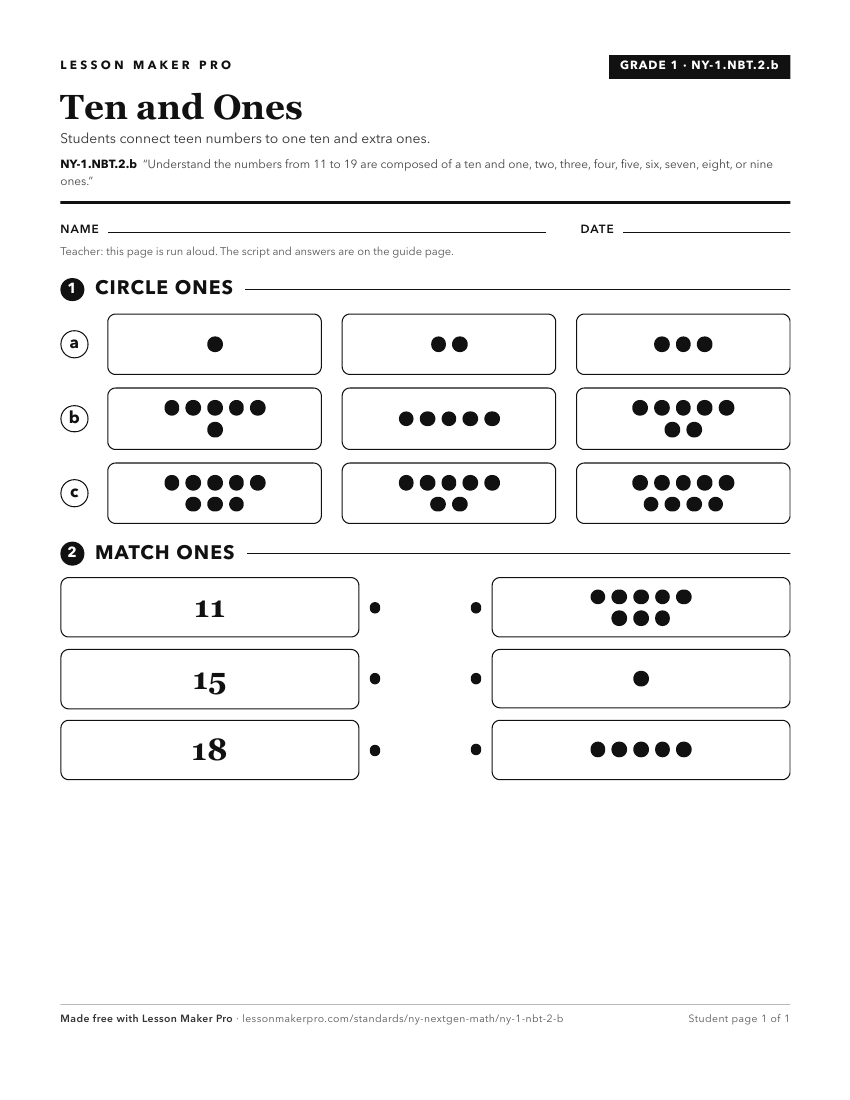
A ready-to-print activity worksheet aligned to NY-1.NBT.2.b, with an answer key for the teacher on its own page. No account needed.
PDF, US Letter, prints cleanly in black and white.
Download the worksheetKeep exploring
Related Standards
- NY-1.NBT.2.c
Understand the numbers 10, 20, 30, 40, 50, 60, 70, 80, 90 refer to one, two, three, four, five, six, seven, eight, or nine tens (and 0 ones).
- NY-1.NBT.2.a
Understand 10 can be thought of as a bundle of ten ones, called a "ten".
- NY-K.NBT.1
Compose and decompose the numbers from 11 to 19 into ten ones and one, two, three, four, five, six, seven, eight, or nine ones.
- NY-2.NBT.1.b
Understand the numbers 100, 200, 300, 400, 500, 600, 700, 800, 900 refer to one, two, three, four, five, six, seven, eight, or nine hundreds (and 0 tens and 0 o...
Turn this exact standard into a lesson
Grade, subject, topic, and the complete standard are prefilled. Create one free, no account needed.
Also for this standard:Make a WorksheetMake a QuizMake a Sub Lesson