NY Next Generation Math NY-8.G.5
The Standard
Use informal arguments to establish facts about the angle sum and exterior angle of triangles, about the angles created when parallel lines are cut by a transversal, and the angle-angle criterion for similarity of triangles.
New York State Next Generation Mathematics Learning Standards
Teacher's field guide
What This Standard Means
What Students Need to Do
- Students use informal arguments to establish triangle angle-sum, exterior-angle, transversal-angle, and angle-angle similarity facts. They connect diagrams and known angle relationships without formal proof.
What Mastery Looks Like
- The student explains why triangle angles sum to 180 degrees and why an exterior angle equals two remote interior angles. The student applies transversal facts and angle-angle reasoning accurately.
Common Misconceptions
- Students may assume diagrams are drawn to scale or confuse corresponding and alternate interior angles. They may cite a fact without linking it to the marked parallel lines.
How to Assess It
- Give parallel lines cut by a transversal beside a triangle sharing one line. Ask students to find two angles and explain the facts used.
Lesson moves
Ways to Teach It
Tear the three corners from a paper triangle and arrange them to form a straight angle.
Ask students how parallel-line angle facts explain the triangle angle sum.
Play Angle Reason Match with diagrams, conclusions, and informal justifications.
Use roof trusses to identify triangle, exterior, and parallel-line angle relationships.
Free download
Printable NY-8.G.5 Worksheet
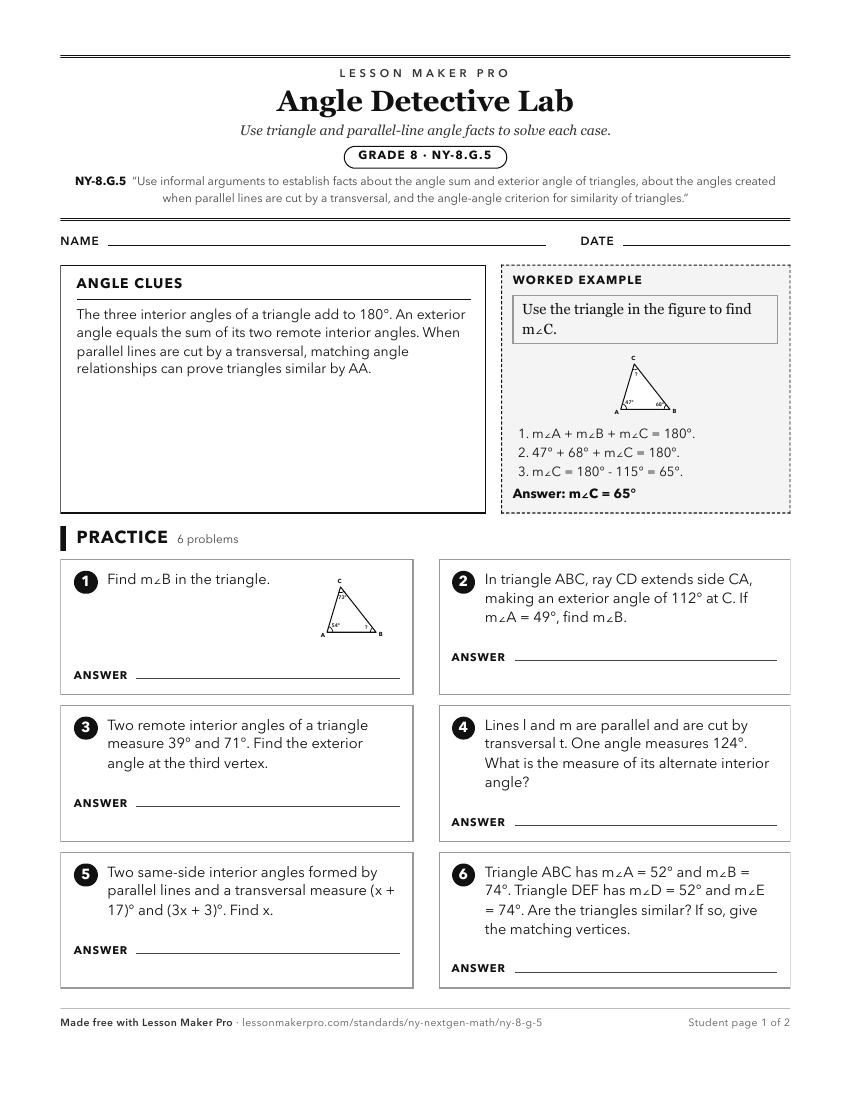
A ready-to-print activity worksheet aligned to NY-8.G.5, with an answer key for the teacher on its own page. No account needed.
PDF, US Letter, prints cleanly in black and white.
Download the worksheetKeep exploring
Related Standards
- NY-7.G.5
Use facts about supplementary, complementary, vertical, and adjacent angles in a multi-step problem to write and solve simple equations for an unknown angle in ...
- NY-7.G.2
Draw triangles when given measures of angles and/or sides, noticing when the conditions determine a unique triangle, more than one triangle, or no triangle.
- NY-4.MD.5
Recognize angles as geometric shapes that are formed wherever two rays share a common endpoint, and understand concepts of angle measurement.
- NY-4.G.2.a
Identify and name triangles based on angle size (right, obtuse, acute).
Turn this exact standard into a lesson
Grade, subject, topic, and the complete standard are prefilled. Create one free, no account needed.
Also for this standard:Make a WorksheetMake a QuizMake a Sub Lesson