NY Next Generation Math NY-7.G.2
The Standard
Draw triangles when given measures of angles and/or sides, noticing when the conditions determine a unique triangle, more than one triangle, or no triangle.
New York State Next Generation Mathematics Learning Standards
Teacher's field guide
What This Standard Means
What Students Need to Do
- Students draw or build triangles from given side lengths, angle measures, or combinations of both. They decide whether the conditions produce one unique triangle, more than one triangle, or no triangle.
What Mastery Looks Like
- A student explains that side lengths 4, 5, and 6 determine one triangle, while angles 50°, 60°, and 70° allow different sizes. The student recognizes that sides 2, 3, and 6 cannot form a triangle.
Common Misconceptions
- Students may assume every set of three measures creates a triangle or that three angle measures determine its size. They may also ignore the required included angle or the triangle inequality.
How to Assess It
- Give students the conditions 4-5-6 sides, 50°-60°-70° angles, and 2-3-6 sides. Ask them to attempt one construction for each set, compare angle-only results with a partner, and classify each as unique, multiple, or impossible.
Lesson moves
Ways to Teach It
Build triangles from measured toothpicks and angle guides, then compare classmates’ results for the same conditions.
Ask students why three angle measures can fix a triangle’s shape without fixing its size.
Sort condition cards into unique, multiple, or impossible, then test each choice with a ruler and protractor.
Analyze side and angle requirements for a triangular roof brace before drawing a construction plan.
Free download
Printable NY-7.G.2 Worksheet
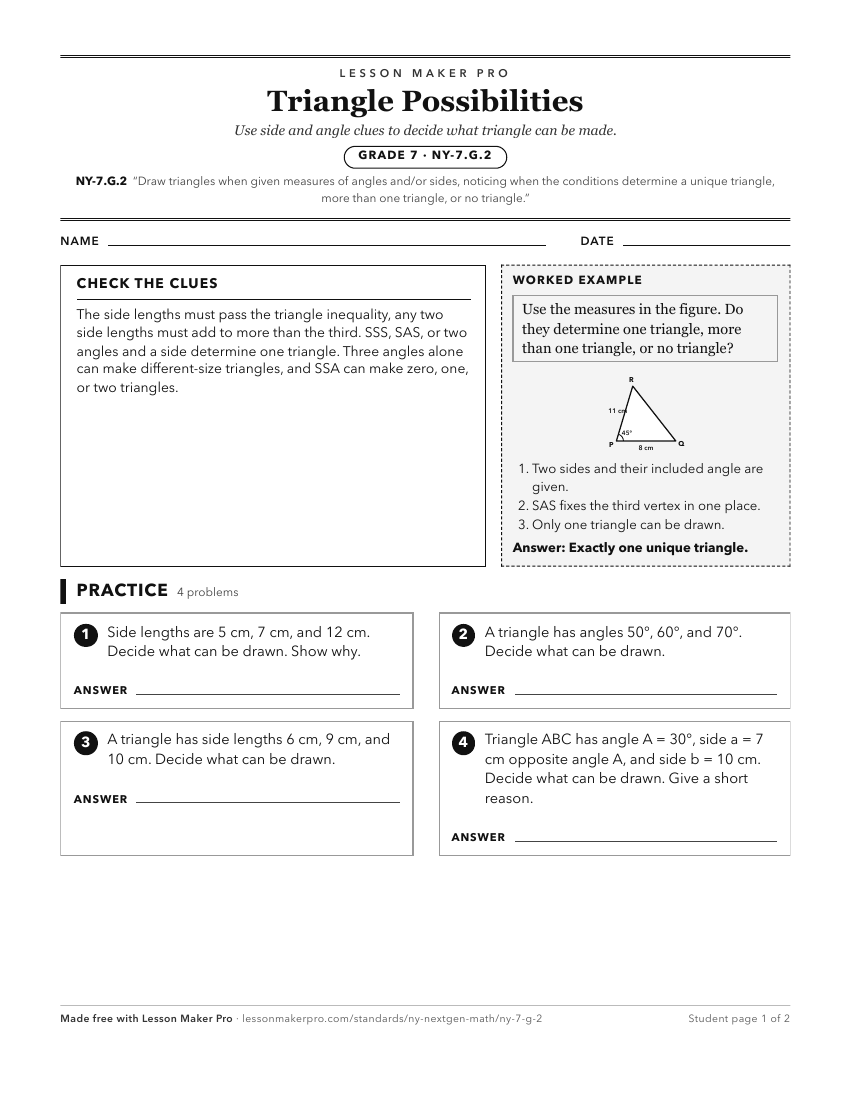
A ready-to-print activity worksheet aligned to NY-7.G.2, with an answer key for the teacher on its own page. No account needed.
PDF, US Letter, prints cleanly in black and white.
Download the worksheetKeep exploring
Related Standards
- NY-6.G.1
Find area of triangles, trapezoids, and other polygons by composing into rectangles or decomposing into triangles and quadrilaterals. Apply these techniques in ...
- NY-8.G.5
Use informal arguments to establish facts about the angle sum and exterior angle of triangles, about the angles created when parallel lines are cut by a transve...
- NY-4.G.2.a
Identify and name triangles based on angle size (right, obtuse, acute).
Turn this exact standard into a lesson
Grade, subject, topic, and the complete standard are prefilled. Create one free, no account needed.
Also for this standard:Make a WorksheetMake a QuizMake a Sub Lesson