NY Next Generation Math NY-6.G.1
The Standard
Find area of triangles, trapezoids, and other polygons by composing into rectangles or decomposing into triangles and quadrilaterals. Apply these techniques in the context of solving real-world and mathematical problems.
New York State Next Generation Mathematics Learning Standards
Teacher's field guide
What This Standard Means
What Students Need to Do
- Students find polygon areas by splitting figures into triangles and quadrilaterals or combining pieces into rectangles. They apply the resulting areas to mathematical and real situations.
What Mastery Looks Like
- A student draws a useful decomposition, identifies perpendicular base-height pairs, and sums nonoverlapping piece areas. The student labels the final area in square units.
Common Misconceptions
- Students may use a slanted side as a triangle's height or forget the one-half factor. They may double-count overlapping pieces or leave gaps in a decomposition.
How to Assess It
- Give students an irregular polygon on a grid and ask them to decompose it two ways, calculate its area, and compare the results.
Lesson moves
Ways to Teach It
Cut a paper trapezoid into triangles and rearrange the pieces into a rectangle, then compare both area calculations.
Ask students which decomposition of an irregular polygon is easiest to calculate and why.
Play area puzzle exchange where partners draw composite polygons, mark dimensions, and solve each other's designs.
Calculate material needed for a garden bed, sign, or floor plan shaped as a composite polygon.
Free download
Printable NY-6.G.1 Worksheet
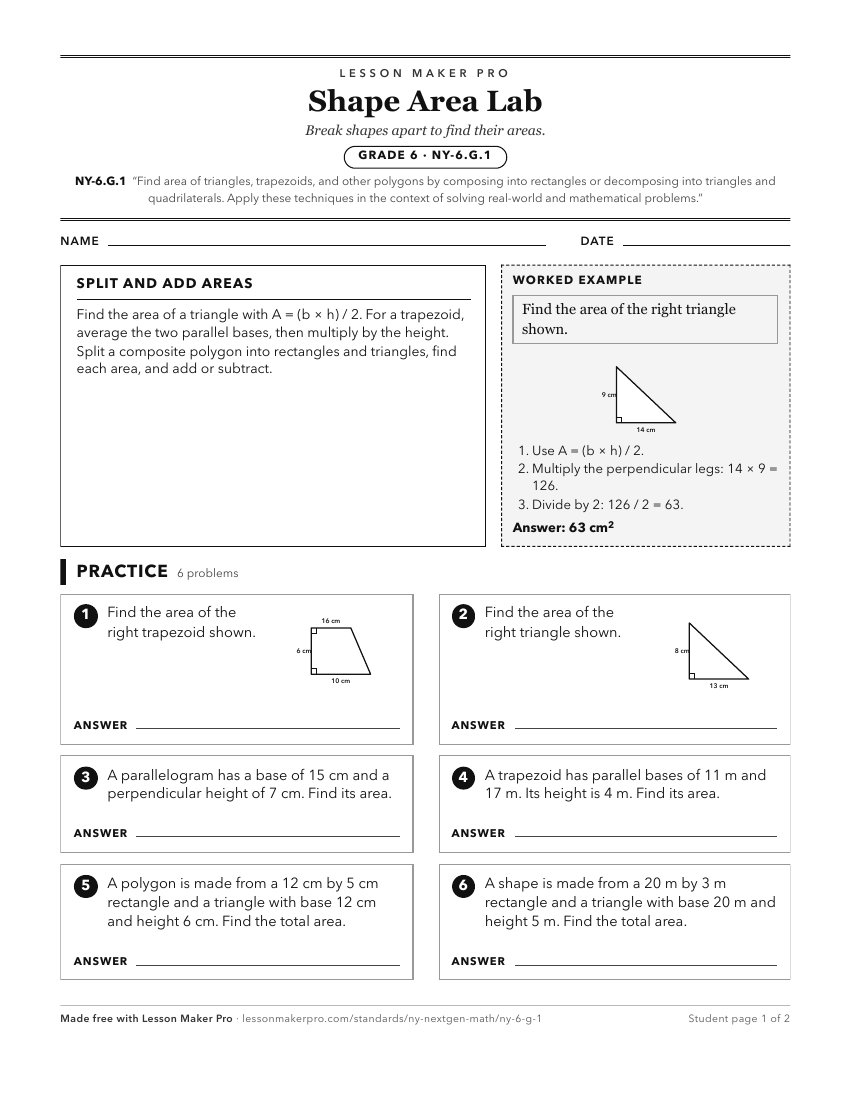
A ready-to-print activity worksheet aligned to NY-6.G.1, with an answer key for the teacher on its own page. No account needed.
PDF, US Letter, prints cleanly in black and white.
Download the worksheetKeep exploring
Related Standards
- NY-7.G.6
Solve real-world and mathematical problems involving area of two-dimensional objects composed of triangles and trapezoids.
- NY-6.G.4
Represent three-dimensional figures using nets made up of rectangles and triangles, and use the nets to find the surface area of these figures. Apply these tech...
- NY-3.MD.7.d
Recognize area as additive. Find areas of figures composed of non-overlapping rectangles, and apply this technique to solve real world problems.
- NY-1.G.2
Compose two-dimensional shapes (rectangles, squares, trapezoids, triangles, half-circles, and quarter-circles) or three-dimensional shapes (cubes, right rectang...
Turn this exact standard into a lesson
Grade, subject, topic, and the complete standard are prefilled. Create one free, no account needed.
Also for this standard:Make a WorksheetMake a QuizMake a Sub Lesson