NY Next Generation Math NY-8.EE.1
The Standard
Know and apply the properties of integer exponents to generate equivalent numerical expressions.
New York State Next Generation Mathematics Learning Standards
Teacher's field guide
What This Standard Means
What Students Need to Do
- Students combine powers with the same base when multiplying, dividing, or raising a power to another power. They rewrite zero and negative exponents and verify that the resulting numerical expressions have equal values.
What Mastery Looks Like
- A student rewrites 5^3 × 5^-6 as 5^-3 and then as 1/125, explaining each step. The student also recognizes that (2^3)^4 equals 2^12.
Common Misconceptions
- Students may multiply exponents when multiplying powers with the same base, rather than adding them. They may read a negative exponent as a negative value or claim that a nonzero number raised to zero equals zero.
How to Assess It
- Give students 2^4 × 2^-6 and (3^2)^3. Ask for an equivalent value for each expression and one sentence naming the rule used.
Lesson moves
Ways to Teach It
Sort cards that show exponential expressions, expanded factors, and equivalent values, then have students defend each matched set.
Ask students to compare 2^-3 and -2^3, calculate both values, and explain why the negative signs play different roles.
Play an exponent-rule relay where teams simplify one product, quotient, power of a power, and zero-exponent expression.
Use a powers-of-ten table to connect positive and negative exponents to metric units larger and smaller than one meter.
Free download
Printable NY-8.EE.1 Worksheet
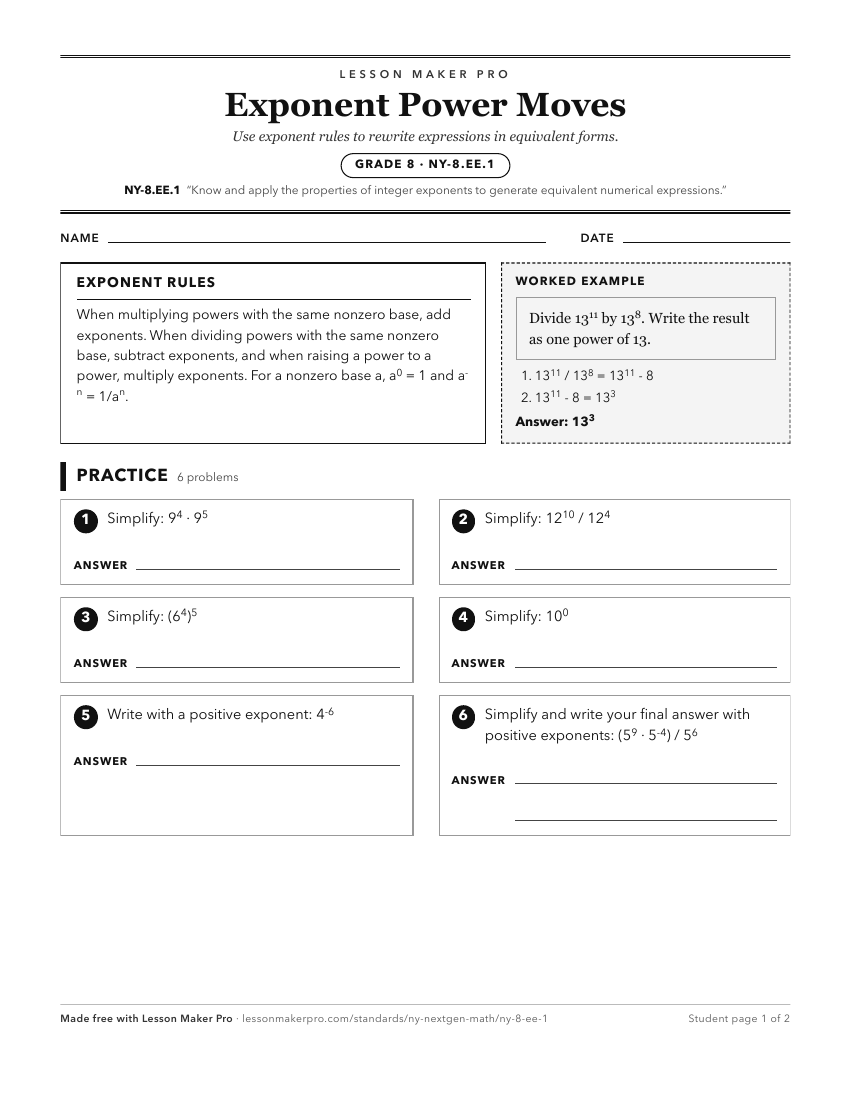
A ready-to-print activity worksheet aligned to NY-8.EE.1, with an answer key for the teacher on its own page. No account needed.
PDF, US Letter, prints cleanly in black and white.
Download the worksheetKeep exploring
Related Standards
Turn this exact standard into a lesson
Grade, subject, topic, and the complete standard are prefilled. Create one free, no account needed.
Also for this standard:Make a WorksheetMake a QuizMake a Sub Lesson