NY Next Generation Math NY-6.NS.4
The Standard
Find the greatest common factor of two whole numbers less than or equal to 100. Use the distributive property to express a sum of two whole numbers 1–100 with a common factor as a multiple of a sum of two whole numbers with no common factor other than 1. Find the least common multiple of two whole numbers less than or equal to 12.
New York State Next Generation Mathematics Learning Standards
Teacher's field guide
What This Standard Means
What Students Need to Do
- Students find greatest common factors for pairs up to 100 and least common multiples for pairs up to 12. They factor a sum using the greatest common factor so the terms inside share no factor greater than one.
What Mastery Looks Like
- The student finds the greatest common factor of 36 and 48 as 12 and rewrites 36 + 48 as 12(3 + 4). The student finds the least common multiple of 8 and 12 as 24.
Common Misconceptions
- Students may confuse greatest common factor with least common multiple or list a factor that is not common. They may factor out a common factor but leave another common factor inside.
How to Assess It
- Ask students for the greatest common factor of 84 and 60, a fully factored form of 84 + 60, and the least common multiple of 8 and 12.
Lesson moves
Ways to Teach It
Build factor arrays for two numbers, mark shared dimensions, and use skip-count lists to locate a least common multiple.
Ask students how they know the numbers inside a fully factored sum have no common factor above one.
Play GCF-or-LCM sort with grouping situations, repeating-cycle situations, and number pairs within the stated limits.
Use greatest common factor for equal supply bundles and least common multiple for schedules that repeat together.
Free download
Printable NY-6.NS.4 Worksheet
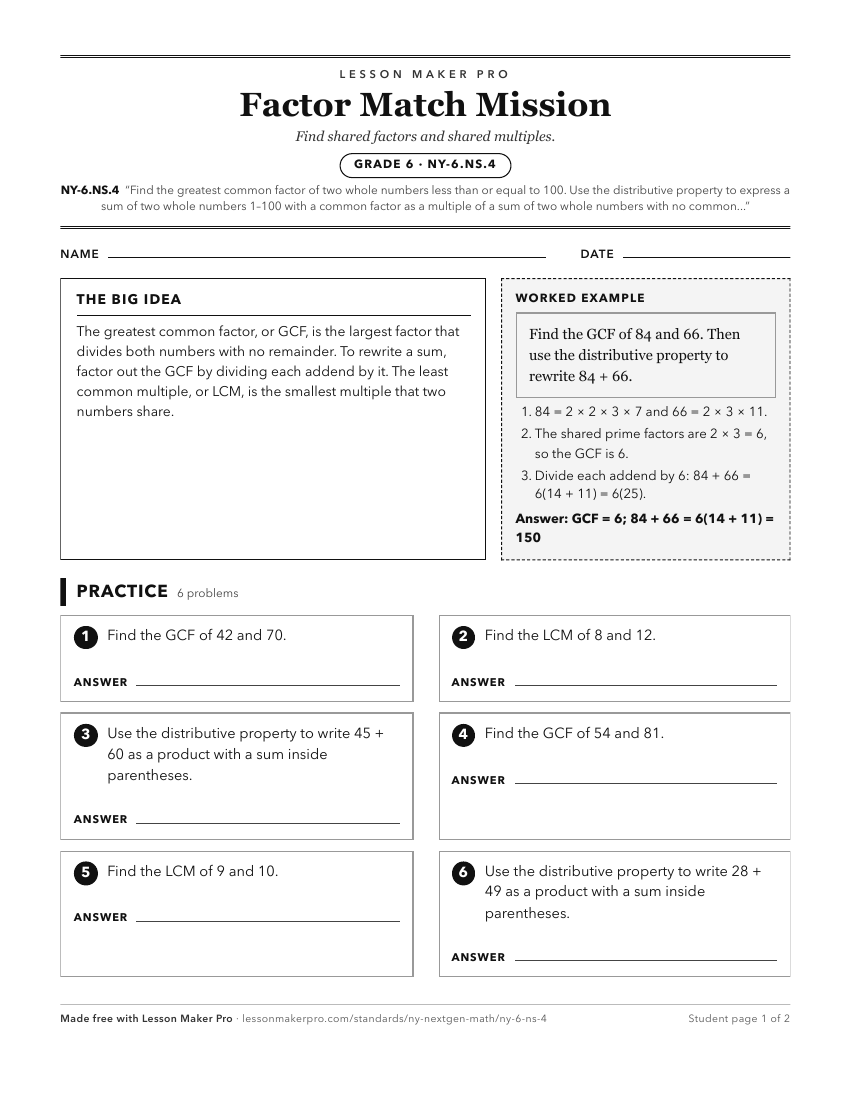
A ready-to-print activity worksheet aligned to NY-6.NS.4, with an answer key for the teacher on its own page. No account needed.
PDF, US Letter, prints cleanly in black and white.
Download the worksheetKeep exploring
Related Standards
- NY-5.NBT.6
Find whole-number quotients of whole numbers with up to four-digit dividends and two-digit divisors, using strategies based on place value, the properties of op...
- NY-4.OA.4
Find all factor pairs for a whole number in the range 1–100. Recognize that a whole number is a multiple of each of its factors. Determine whether a given whole...
- NY-3.OA.4
Determine the unknown whole number in a multiplication or division equation relating three whole numbers.
Turn this exact standard into a lesson
Grade, subject, topic, and the complete standard are prefilled. Create one free, no account needed.
Also for this standard:Make a WorksheetMake a QuizMake a Sub Lesson