NY Next Generation Math NY-4.MD.7
The Standard
Recognize angle measure as additive. When an angle is decomposed into non-overlapping parts, the angle measure of the whole is the sum of the angle measures of the parts. Solve addition and subtraction problems to find unknown angles on a diagram in real world and mathematical problems.
New York State Next Generation Mathematics Learning Standards
Teacher's field guide
What This Standard Means
What Students Need to Do
- Students treat an angle's measure as the sum of its nonoverlapping parts. They write and solve addition or subtraction equations to find unknown angles in diagrams and contexts.
What Mastery Looks Like
- A student sees a 90-degree angle split into 35 degrees and an unknown part and writes 35 + x = 90. The student finds x = 55 degrees and checks the sum.
Common Misconceptions
- Students may add overlapping angles, subtract in the wrong order, or ignore the whole angle measure. They may use side lengths rather than angle measures.
How to Assess It
- Show a 120-degree angle split into 47 degrees and an unknown angle. Ask for an equation, the missing measure, and a labeled check.
Lesson moves
Ways to Teach It
Overlay two paper angle pieces inside a larger angle, then record how their nonoverlapping measures add to the whole.
Ask students how the whole angle determines whether to add or subtract.
Play missing-angle match with diagrams, equations, unknown measures, and completed checks.
Find an unknown turn in a route or design when the total turn and one part are known.
Free download
Printable NY-4.MD.7 Worksheet
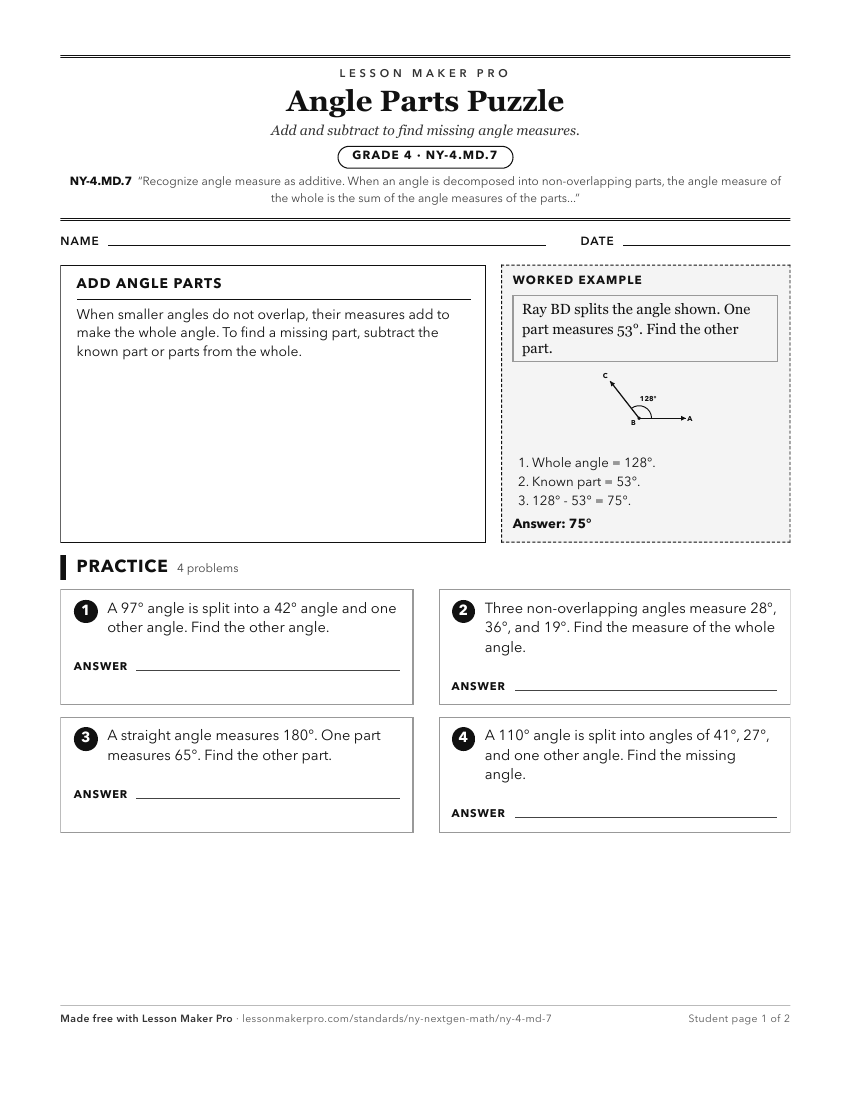
A ready-to-print activity worksheet aligned to NY-4.MD.7, with an answer key for the teacher on its own page. No account needed.
PDF, US Letter, prints cleanly in black and white.
Download the worksheetKeep exploring
Related Standards
- NY-7.G.5
Use facts about supplementary, complementary, vertical, and adjacent angles in a multi-step problem to write and solve simple equations for an unknown angle in ...
- NY-4.MD.5
Recognize angles as geometric shapes that are formed wherever two rays share a common endpoint, and understand concepts of angle measurement.
- NY-3.MD.7.d
Recognize area as additive. Find areas of figures composed of non-overlapping rectangles, and apply this technique to solve real world problems.
Turn this exact standard into a lesson
Grade, subject, topic, and the complete standard are prefilled. Create one free, no account needed.
Also for this standard:Make a WorksheetMake a QuizMake a Sub Lesson