NY Next Generation Math NY-3.OA.8.b
The Standard
Assess the reasonableness of answers using mental computation and estimation strategies including rounding.
New York State Next Generation Mathematics Learning Standards
Teacher's field guide
What This Standard Means
What Students Need to Do
- Students decide whether answers to two-step whole-number problems are reasonable. They use mental computation and estimation, including rounding, to check results.
What Mastery Looks Like
- The student creates a useful estimate and compares it with the exact answer. The student detects an implausible result and explains the likely size of the correct answer.
Common Misconceptions
- Students may treat an estimate as an exact solution. They may round numbers so aggressively that the estimate no longer provides a useful check.
How to Assess It
- Present a solved two-step problem claiming 198 plus 304 minus 91 equals 1,411. Ask students to check the claim with rounding or mental math.
Lesson moves
Ways to Teach It
Estimate totals and differences from number cards before revealing exact calculations.
Ask students what estimate would catch an extra zero in a two-step answer.
Play Reasonable or Not with answer cards and quick mental or rounding checks.
Estimate the remaining tickets after combining two ticket groups and selling some.
Free download
Printable NY-3.OA.8.b Worksheet
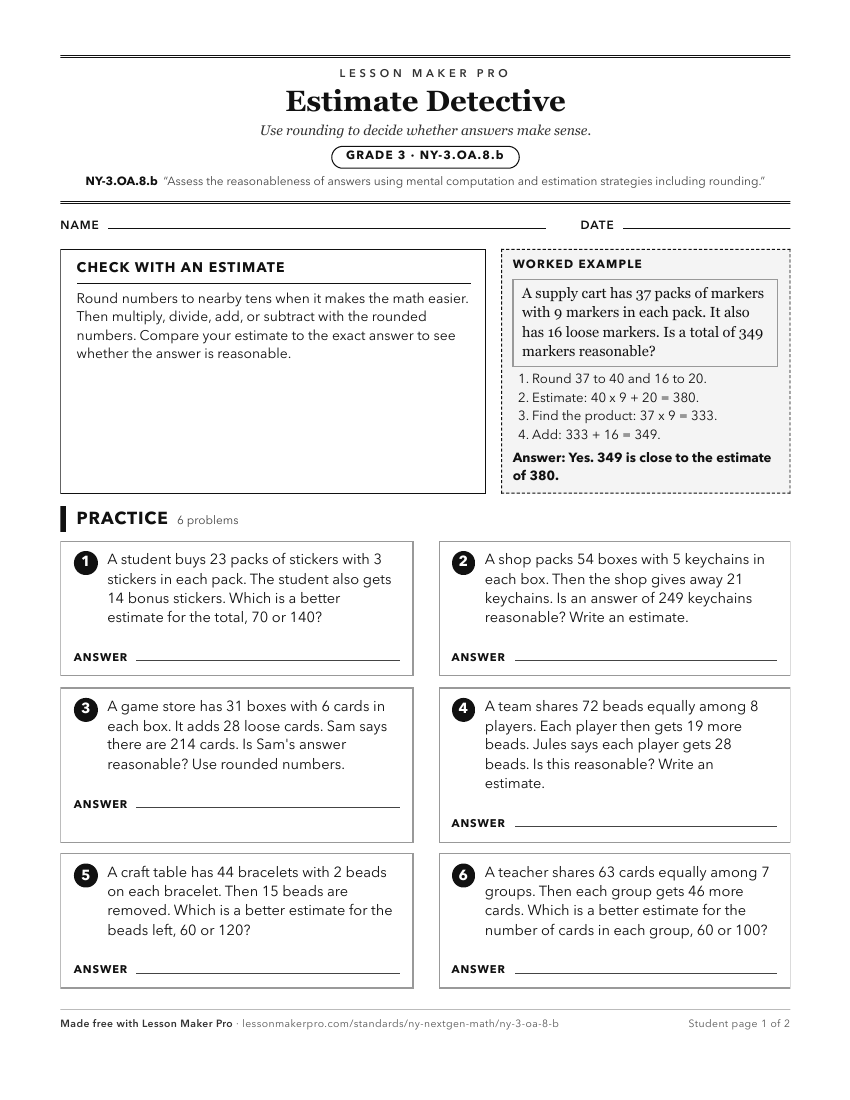
A ready-to-print activity worksheet aligned to NY-3.OA.8.b, with an answer key for the teacher on its own page. No account needed.
PDF, US Letter, prints cleanly in black and white.
Download the worksheetKeep exploring
Related Standards
- NY-4.OA.3.b
The 4th Grade version of this standard.
- NY-3.OA.8
Solve two-step word problems posed with whole numbers and having whole-number answers using the four operations.
- NY-5.NF.2
Solve word problems involving addition and subtraction of fractions referring to the same whole, including cases of unlike denominators. Use benchmark fractions...
- NY-7.EE.3
Solve multi-step real-world and mathematical problems posed with positive and negative rational numbers in any form (whole numbers, fractions, and decimals), us...
Turn this exact standard into a lesson
Grade, subject, topic, and the complete standard are prefilled. Create one free, no account needed.
Also for this standard:Make a WorksheetMake a QuizMake a Sub Lesson