NY Next Generation Math AII-S.CP.1
The Standard
Describe events as subsets of a sample space (the set of outcomes) using characteristics (or categories) of the outcomes, or as unions, intersections, or complements of other events ("or," "and," "not").
New York State Next Generation Mathematics Learning Standards
Teacher's field guide
What This Standard Means
What Students Need to Do
- Students define events as subsets of a sample space and describe combinations using or, and, and not. They move between words, sets, lists, and diagrams.
What Mastery Looks Like
- The student lists a complete sample space and correctly identifies an event, its complement, a union, and an intersection. The notation and verbal descriptions agree.
Common Misconceptions
- Students may use and when outcomes only need one condition or omit overlap from a union. They may treat a complement as an unrelated event.
How to Assess It
- Give a small sample space and two events. Ask students to list the union, intersection, and complement and describe each in words.
Lesson moves
Ways to Teach It
Sort outcome cards into overlapping hoops to build unions, intersections, and complements physically.
Ask how the word or changes when two events can happen together.
Play event-expression match with sample spaces, set notation, Venn regions, and verbal descriptions.
Describe quality-control outcomes using defect categories and combined events.
Free download
Printable AII-S.CP.1 Worksheet
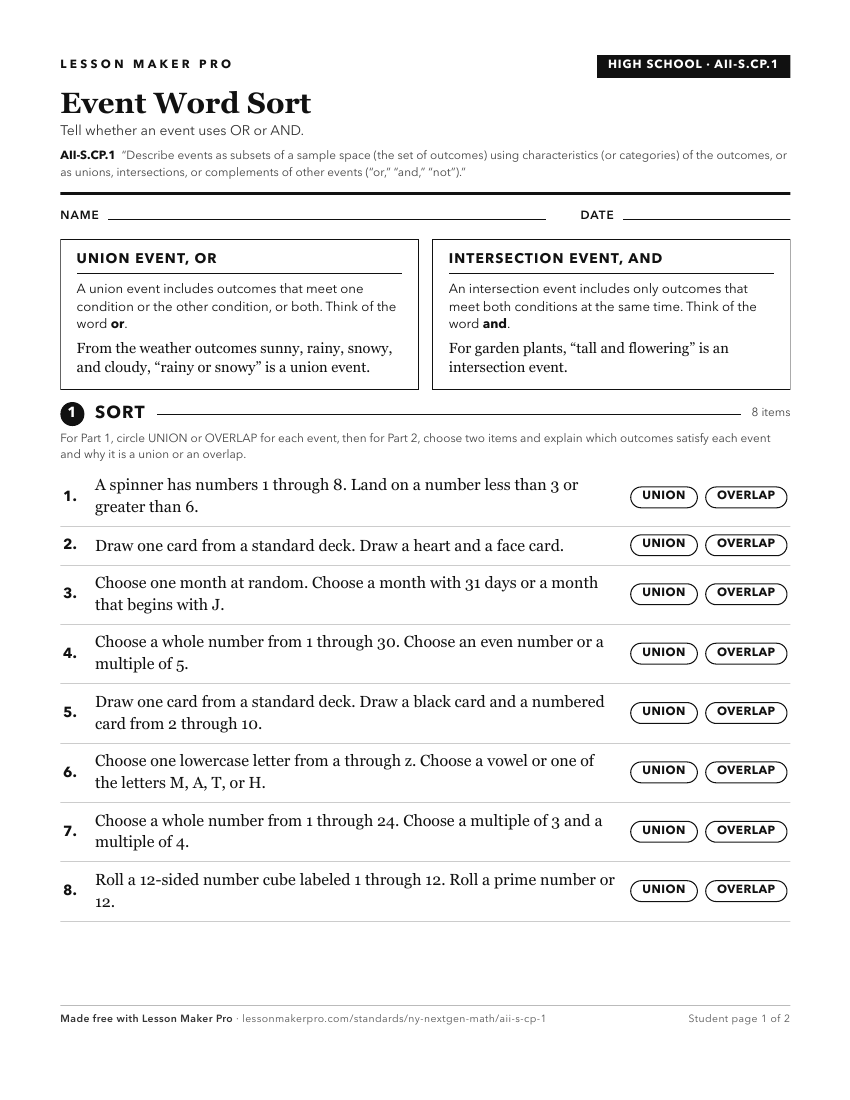
A ready-to-print activity worksheet aligned to AII-S.CP.1, with an answer key for the teacher on its own page. No account needed.
PDF, US Letter, prints cleanly in black and white.
Download the worksheetKeep exploring
Related Standards
- NY-6.SP.8.a
Develop a uniform probability model by assigning equal probability to all outcomes, and use the model to determine probabilities of simple events.
- NY-7.SP.8.a
Understand that, just as with simple events, the probability of a compound event is the fraction of outcomes in the sample space for which the compound event oc...
- NY-7.SP.8.b
Represent sample spaces for compound events using methods such as organized lists, sample space tables, and tree diagrams. For an event described in everyday la...
- NY-7.SP.8
Find probabilities of compound events using organized lists, sample space tables, tree diagrams, and simulation.
Turn this exact standard into a lesson
Grade, subject, topic, and the complete standard are prefilled. Create one free, no account needed.
Also for this standard:Make a WorksheetMake a QuizMake a Sub Lesson