NGSS K-ESS3-3
The Standard
Communicate solutions that will reduce the impact of humans on the land, water, air, and/or other living things in the local environment.
Next Generation Science Standards
Teacher's field guide
What This Standard Means
What Students Need to Do
- Students identify how everyday choices can affect nearby land, water, air, plants, or animals. They share a simple solution and explain how it helps.
What Mastery Looks Like
- Given a problem such as litter or wasted paper, students name a realistic action like reusing, recycling, or cleaning up. They explain the benefit with words or pictures.
Common Misconceptions
- Students may think all human activity harms nature or that recycling fixes every problem. They may confuse reusing an item with throwing it into a recycling bin.
How to Assess It
- Show a picture of litter beside a pond. Ask, “What could people do to help, and how would that help the pond or animals?”
Lesson moves
Ways to Teach It
Give pairs clean classroom waste to sort into reuse, recycle, and trash bins, then ask them to explain one choice.
Ask, “What could our class change to help plants, animals, land, water, or air?” Record and illustrate one idea.
Play a matching game with problem cards, such as litter, and solution cards, such as using a trash can.
Walk around the schoolyard, spot one way people affect nature, and make a picture sign suggesting a helpful action.
Free download
Printable K-ESS3-3 Worksheet
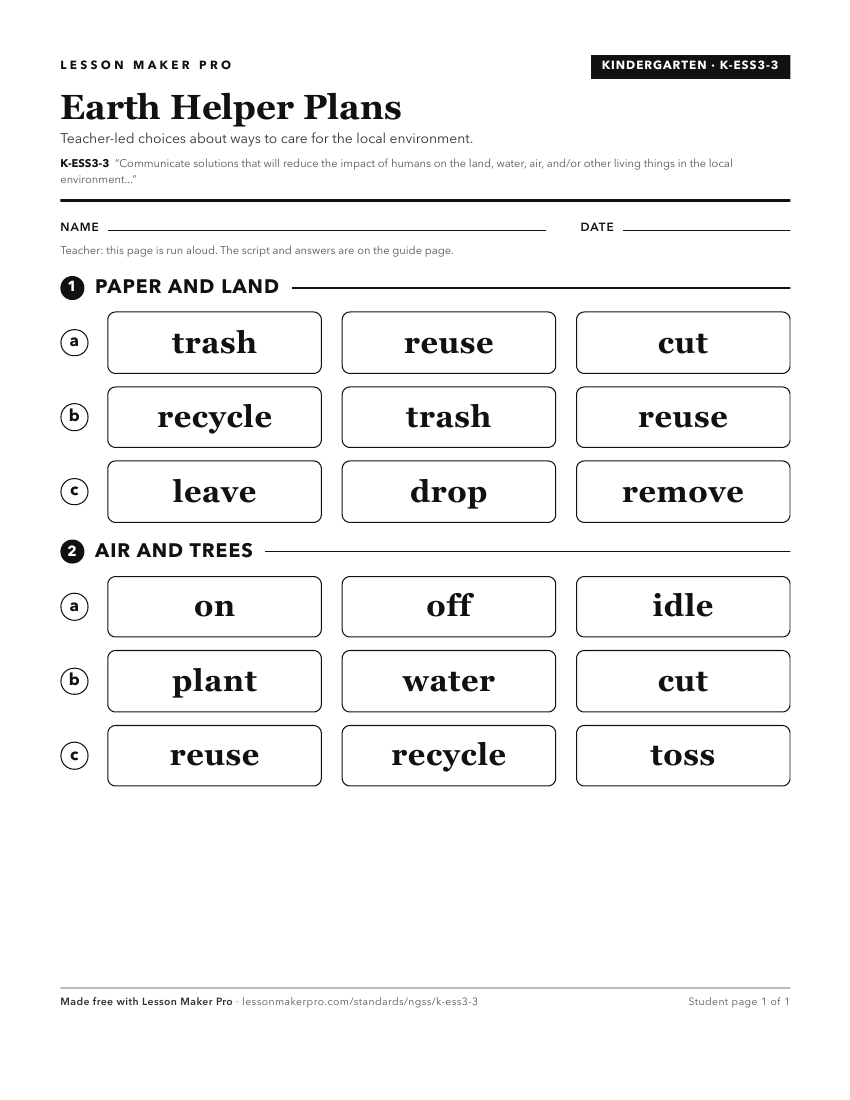
A ready-to-print activity worksheet aligned to K-ESS3-3, with an answer key for the teacher on its own page. No account needed.
PDF, US Letter, prints cleanly in black and white.
Download the worksheetKeep exploring
Related Standards
- MS-ESS3-3
Apply scientific principles to design a method for monitoring and minimizing a human impact on the environment.
- HS-ESS3-4
Evaluate or refine a technological solution that reduces impacts of human activities on natural systems.
- HS-LS2-7
Design, evaluate, and refine a solution for reducing the impacts of human activities on the environment and biodiversity.
- 4-ESS3-2
Generate and compare multiple solutions to reduce the impacts of natural Earth processes on humans.
Turn this exact standard into a lesson
Grade, subject, topic, and the complete standard are prefilled. Create one free, no account needed.
Also for this standard:Make a WorksheetMake a QuizMake a Sub Lesson