NGSS HS-ESS3-4
The Standard
Evaluate or refine a technological solution that reduces impacts of human activities on natural systems.
Next Generation Science Standards
Teacher's field guide
What This Standard Means
What Students Need to Do
- Students use evidence to judge how well a technology reduces pollution, habitat loss, resource use, or another environmental impact. They compare benefits, costs, limits, and unintended effects, then propose a supported design change.
What Mastery Looks Like
- A student can interpret before-and-after data and compare a solution against clear criteria and constraints. The student identifies tradeoffs and supports a practical design change with evidence.
Common Misconceptions
- Students may assume the best solution removes all environmental harm or has the highest single performance score. They may ignore cost, scale, energy use, waste, or effects on other species. Some propose changes based on opinion rather than data.
How to Assess It
- Exit ticket: Filter A removes 82% of nitrate but creates 20 kilograms of cartridge waste monthly. Filter B removes 68% with reusable parts. Choose or refine one filter, using both data points to justify your answer.
Lesson moves
Ways to Teach It
Build runoff filters from gravel, sand, and cotton, measure turbidity before and after, then redesign based on the results.
Write a recommendation choosing between two pollution-control designs, citing performance, cost, waste, and effects on local species.
Run a design-ranking game where teams draw cost, habitat, and pollution constraint cards, then revise their technology choice.
Analyze local recycling, stormwater, or land-use data and propose one measurable improvement for the school or community.
Free download
Printable HS-ESS3-4 Worksheet
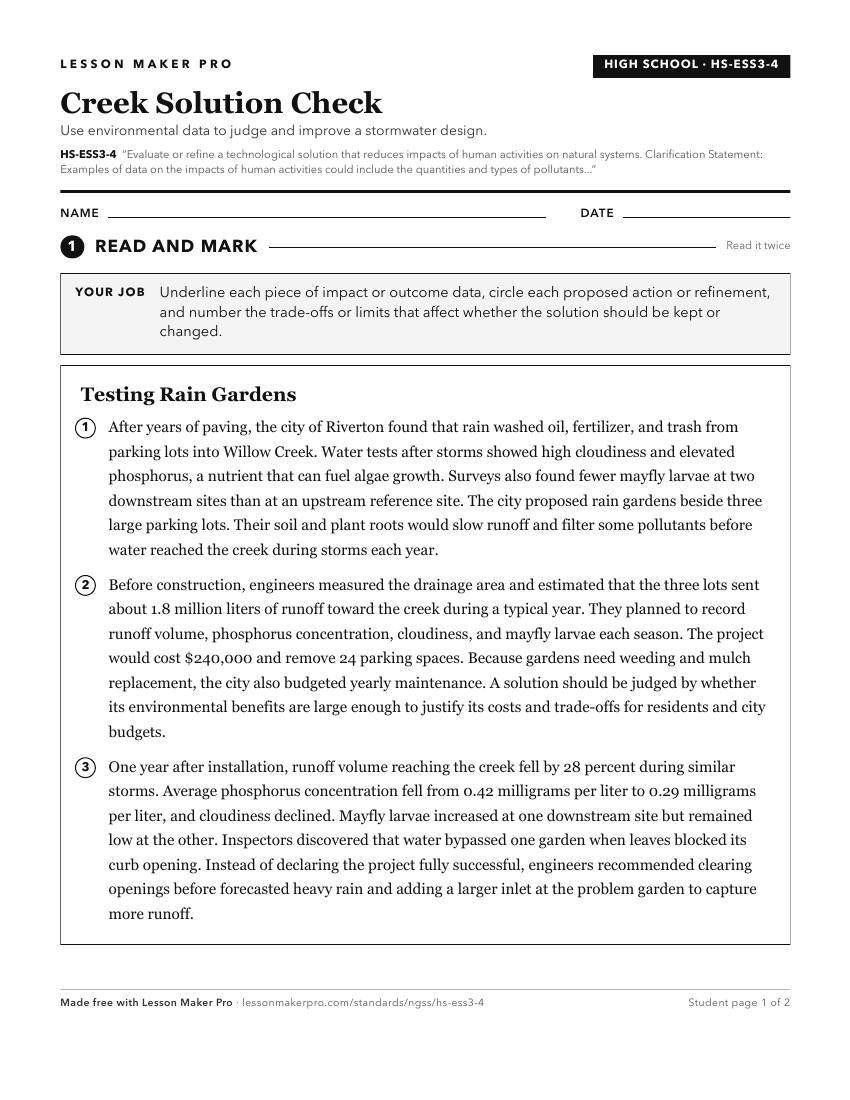
A ready-to-print activity worksheet aligned to HS-ESS3-4, with an answer key for the teacher on its own page. No account needed.
PDF, US Letter, prints cleanly in black and white.
Download the worksheetLearning progression
Where This Standard Sits
See the whole path on the Earth & Space Science progression map.
Before This Standard
If students are struggling here, check these first.
- MS-ESS3-3
Students move from designing ways to monitor and reduce impacts to judging and improving technologies that reduce human effects on systems.
- MS-ESS3-4
Understanding how population and resource use harm Earth systems helps students judge whether technologies actually reduce those human impacts.
Keep exploring
Related Standards
- K-ESS3-3
Communicate solutions that will reduce the impact of humans on the land, water, air, and/or other living things in the local environment.
- HS-LS2-7
Design, evaluate, and refine a solution for reducing the impacts of human activities on the environment and biodiversity.
- 4-ESS3-2
Generate and compare multiple solutions to reduce the impacts of natural Earth processes on humans.
Turn this exact standard into a lesson
Grade, subject, topic, and the complete standard are prefilled. Create one free, no account needed.
Also for this standard:Make a WorksheetMake a QuizMake a Sub Lesson