NGSS HS-ESS3-5
The Standard
Analyze geoscience data and the results from global climate models to make an evidence-based forecast of the current rate of global or regional climate change and associated future impacts to Earth systems.
Next Generation Science Standards
Teacher's field guide
What This Standard Means
What Students Need to Do
- Students read observed climate records and model projections for one variable, such as temperature or precipitation. They calculate or describe its current rate of change. They use that evidence to forecast one related Earth system impact, such as sea level rise or ice loss.
What Mastery Looks Like
- A student calculates a rate from observed values using the correct units and time interval, then compares it with a model trend. They make a dated forecast for one related impact, cite specific graph values, and describe uncertainty without dismissing the overall pattern.
Common Misconceptions
- Students often treat one hot year or major storm as proof of a climate trend. They may read model results as exact predictions rather than outcomes based on stated assumptions. They may report total change instead of rate, omit units, or name an impact unsupported by the data.
How to Assess It
- Give students paired graphs showing observed and projected regional temperature and snowpack through 2050. Ask them to calculate recent warming per decade and write a two-sentence snowpack forecast supported by two graph values.
Lesson moves
Ways to Teach It
Students plot 30 years of local annual temperature data on graph paper, draw a line of best fit, and calculate change per decade.
Discuss the prompt, "Which claim about 2050 snowpack is best supported by these temperature and model graphs, and why?"
Run a card sort matching climate graphs, calculated rates, model scenarios, and likely impacts, then have groups defend one match.
Compare a nearby tide gauge record with a regional sea level projection, then forecast how high tide flooding may change by 2050.
Free download
Printable HS-ESS3-5 Worksheet
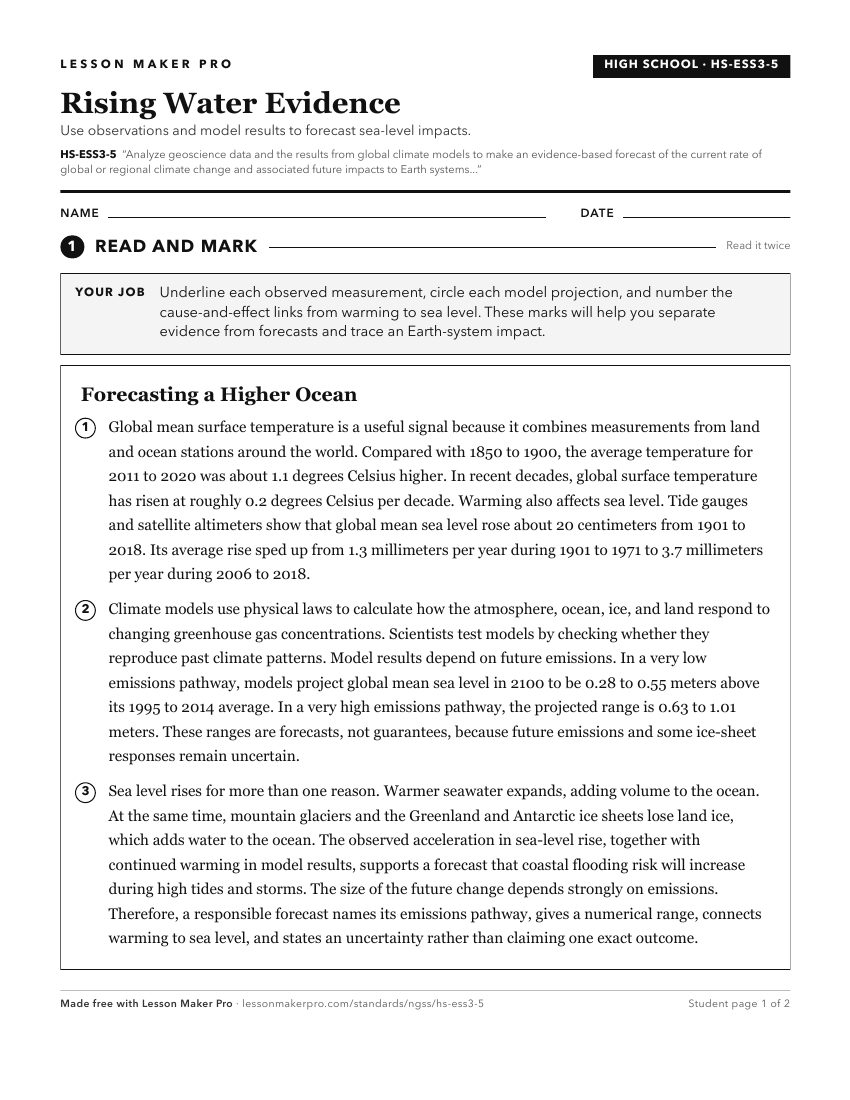
A ready-to-print activity worksheet aligned to HS-ESS3-5, with an answer key for the teacher on its own page. No account needed.
PDF, US Letter, prints cleanly in black and white.
Download the worksheetLearning progression
Where This Standard Sits
See the whole path on the Earth & Space Science progression map.
Before This Standard
If students are struggling here, check these first.
Keep exploring
Related Standards
- MS-ESS2-2
Construct an explanation based on evidence for how geoscience processes have changed Earth's surface at varying time and spatial scales.
- MS-ESS2-6
Develop and use a model to describe how unequal heating and rotation of the Earth cause patterns of atmospheric and oceanic circulation that determine regional ...
- HS-ESS2-2
Analyze geoscience data to make the claim that one change to Earth's surface can create feedbacks that cause changes to other Earth systems.
- HS-ESS2-4
Use a model to describe how variations in the flow of energy into and out of Earth systems result in changes in climate.
Turn this exact standard into a lesson
Grade, subject, topic, and the complete standard are prefilled. Create one free, no account needed.
Also for this standard:Make a WorksheetMake a QuizMake a Sub Lesson