NGSS HS-ESS2-2
The Standard
Analyze geoscience data to make the claim that one change to Earth's surface can create feedbacks that cause changes to other Earth systems.
Next Generation Science Standards
Teacher's field guide
What This Standard Means
What Students Need to Do
- Students read graphs, maps, and tables to identify how a surface change affects the atmosphere, hydrosphere, biosphere, or geosphere. They use data to support a claim and trace a feedback loop that strengthens or slows the original change.
What Mastery Looks Like
- A student can identify a trend in each data set, cite specific values, and connect the trends in a clear cause and effect chain. The chain returns to the starting condition and correctly labels whether the feedback amplifies or reduces it.
Common Misconceptions
- Students often describe a one-way chain as feedback, without showing how the later effect changes the starting condition. They may treat correlation as proof of cause, confuse short-term weather with climate trends, or assume every feedback increases change.
How to Assess It
- Give students graphs of Arctic ice area and average surface temperature for the same years. Ask: Write a claim and cite two data points to explain the ice and temperature feedback loop.
Lesson moves
Ways to Teach It
Place black paper and foil under lamps with temperature probes, then use the results to model how changing ice cover affects warming.
Write a six-step explanation answering: How can removing vegetation lead to more runoff, erosion, and further vegetation loss?
Sort cause, effect, and evidence cards for dam construction, then arrange them into a feedback loop and defend one disputed link.
Compare local aerial photos before and after development, then predict changes in runoff, groundwater recharge, sediment movement, and nearby erosion.
Free download
Printable HS-ESS2-2 Worksheet
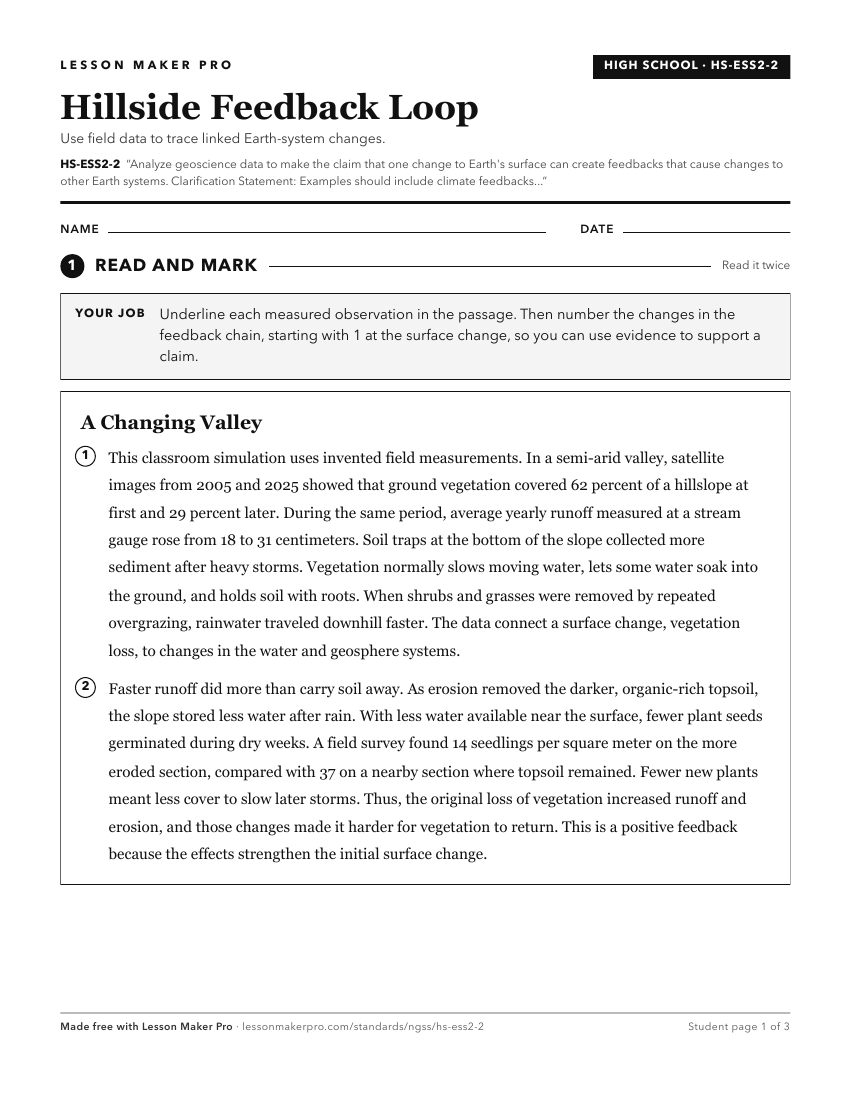
A ready-to-print activity worksheet aligned to HS-ESS2-2, with an answer key for the teacher on its own page. No account needed.
PDF, US Letter, prints cleanly in black and white.
Download the worksheetLearning progression
Where This Standard Sits
See the whole path on the Earth & Space Science progression map.
Before This Standard
If students are struggling here, check these first.
- MS-ESS2-1
Understanding Earth's material cycles and energy flows helps students interpret how surface changes propagate through connected Earth systems.
- MS-ESS2-5
Students extend data-based explanations of atmospheric interactions to broader Earth system feedbacks linking surface changes with other systems.
- MS-ESS2-2
Middle school links surface changes to geoscience processes, which supports high school analysis of data showing feedbacks among Earth systems.
- MS-ESS2-6
Understanding how heating and circulation shape climate supports analyzing how surface changes trigger feedbacks across Earth systems.
Keep exploring
Related Standards
- HS-ESS3-6
Use a computational representation to illustrate the relationships among Earth systems and how those relationships are being modified due to human activity.
- HS-ESS2-4
Use a model to describe how variations in the flow of energy into and out of Earth systems result in changes in climate.
- HS-ESS3-5
Analyze geoscience data and the results from global climate models to make an evidence-based forecast of the current rate of global or regional climate change a...
Turn this exact standard into a lesson
Grade, subject, topic, and the complete standard are prefilled. Create one free, no account needed.
Also for this standard:Make a WorksheetMake a QuizMake a Sub Lesson