Montana Math MT.CORE.ALG.MOD.1.a
The Standard
- MT.CORE.ALG.MOD.1
- Model situations in context, with linear, quadratic, and exponential functions. This standard should incorporate cultural context relating to Montana Indigenous Peoples and local communities by: Determining if a set of data is best modeled by a linear function, quadratic function, exponential function, or none, and explaining why, and Understanding that there are contexts where solutions may not lie on the curve.
Model situations in context, with linear, quadratic, and exponential functions. This standard should incorporate cultural context relating to Montana Indigenous Peoples and local communities by: Determining if a set of data is best modeled by a linear function, quadratic function, exponential function, or none, and explaining why, and
2026 Montana Mathematics Content Standards · Algebraic and Functional Reasoning
Teacher's field guide
What This Standard Means
What Students Need to Do
- Students graph data from situations such as Montana tribal college enrollment and local school enrollment. They compare changes over equal time steps, then choose a linear, quadratic, exponential, or no clear model and explain why.
What Mastery Looks Like
- Students use a graph, first differences, second differences, and ratios to judge which model fits. They write an equation for a reasonable fit or explain why none of the three models works well.
Common Misconceptions
- Students may call every curved graph exponential, even when second differences are steady. They may compare changes across unequal time gaps or force a model onto data with no clear pattern.
How to Assess It
- Exit ticket: A fictional community center logs 25, 28, 33, 40, 49 visits in years 0 to 4. Name the best model, show a number check, and write its equation.
Lesson moves
Ways to Teach It
Plot four fictional yearly enrollment tables on graph paper, then mark first differences, second differences, and ratios beside each graph.
Ask, 'Which table fits none of the three models, and what numbers support your choice?' Have students defend their answer in two sentences.
Match cards showing data tables, graphs, and model labels; include a 'none' card for data with no clear pattern.
Graph publicly reported Salish Kootenai College enrollment by year, then discuss whether any model gives a reasonable next-year estimate.
Free download
Printable MT.CORE.ALG.MOD.1.a Worksheet
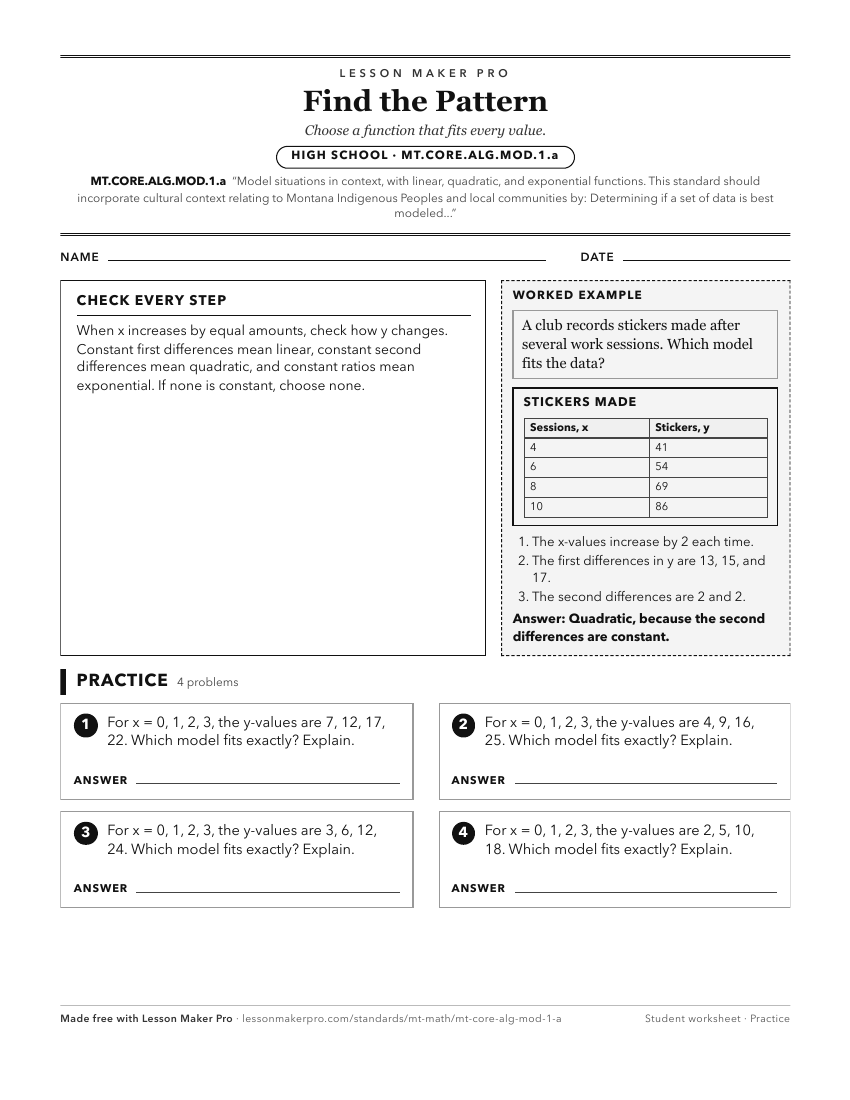
A ready-to-print activity worksheet aligned to MT.CORE.ALG.MOD.1.a, with an answer key for the teacher on its own page. No account needed.
PDF, US Letter, prints cleanly in black and white.
Download the worksheetKeep exploring
Related Standards
- MT.PLUS.ALG.MOD.1
Model situations in context with polynomial, exponential, logarithmic, and trigonometric functions. This standard should incorporate cultural context relating t...
- MT.PLUS.ALG.MOD.1.a
Determining if a set of data is best modeled by a polynomial, exponential, logarithmic, or trigonometric function or none, and explaining why, and
- MT.8.F.4
Given linear data relating two quantities, construct a linear function that models the data and interpret the rate of change and initial value of a linear funct...
- MT.CORE.ALG.MOD.1
Model situations in context, with linear, quadratic, and exponential functions. This standard should incorporate cultural context relating to Montana Indigenous...
Turn this exact standard into a lesson
Grade, subject, topic, and the complete standard are prefilled. Create one free, no account needed.
Also for this standard:Make a WorksheetMake a QuizMake a Sub Lesson