Mississippi Science P.K.5B.3
The Standard
- P.K.5B
- Students will demonstrate an understanding of how solid objects can be constructed from a smaller set.
Explain why things may not work the same if some of the parts are missing.
2026 Mississippi College- and Career-Readiness Standards for Science · Organization of Matter and Chemical Interactions
Teacher's field guide
What This Standard Means
What Students Need to Do
- Students name the parts of a familiar object and tell what each part does. They predict what will change when a part is taken away.
What Mastery Looks Like
- A student can point to a toy car’s wheels and explain that it may wobble if one wheel is gone. They can make a similar prediction about another object.
Common Misconceptions
- Some students think any missing piece will stop an object from working, even if that piece is only decoration. Others can name the missing part but not explain what it did.
How to Assess It
- Show a picture of a wagon with one wheel missing. Ask, “What might happen when you push it? Why?”
Lesson moves
Ways to Teach It
Build a block bridge with two supports, remove one, and have students test whether a toy animal can cross.
Show a backpack without straps and ask, “How could you carry it now? What did the straps help you do?”
Play a matching game with pictures of objects missing a part and cards showing what those parts do.
Let students make a pencil mark, then try to erase it with a pencil that has an eraser and one that does not.
Free download
Printable P.K.5B.3 Worksheet
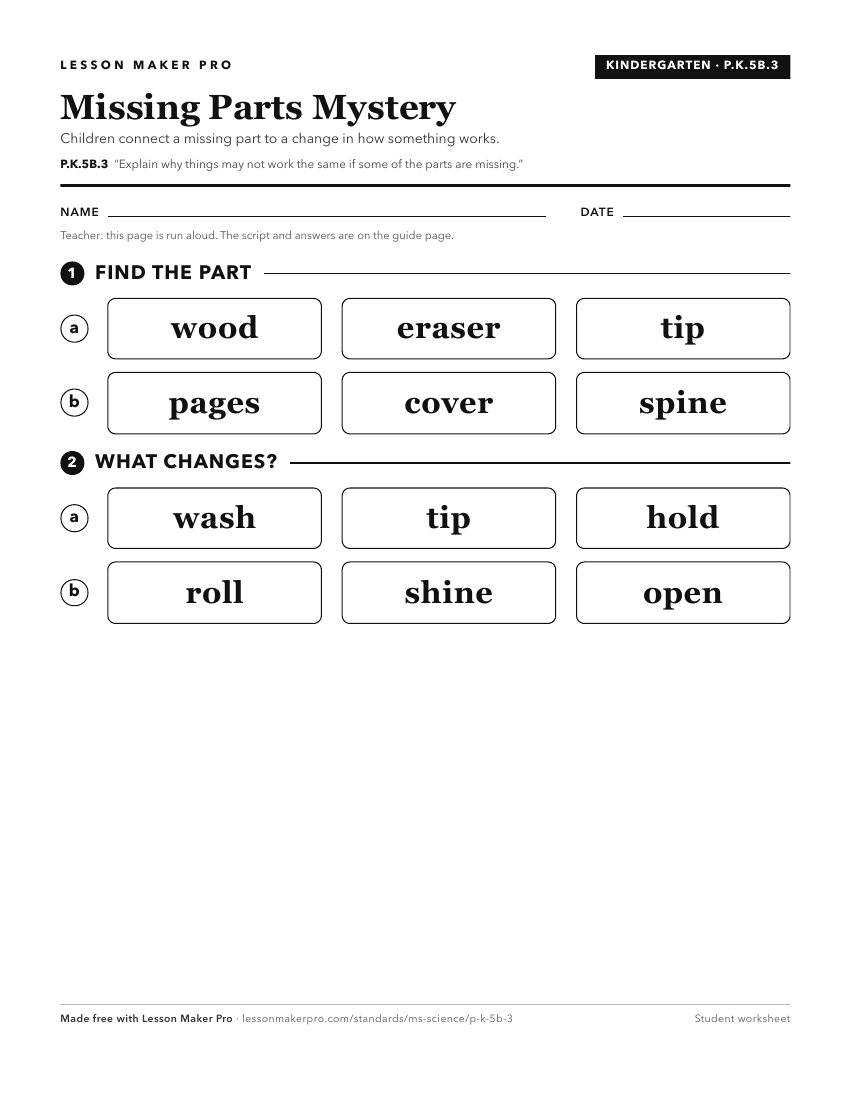
A ready-to-print activity worksheet aligned to P.K.5B.3, with an answer key for the teacher on its own page. No account needed.
PDF, US Letter, prints cleanly in black and white.
Download the worksheetKeep exploring
Related Standards
- L.4.1.3
Construct models of organ systems (e.g., circulatory, digestive, respiratory, muscular, skeletal, nervous) to demonstrate both the unique function of the system...
- HAP.4.1
Use models to compare the structure and function of the skeletal system.
- L.8.2A.4
Construct a model of meiosis to explain its role in sexual reproduction, which results in offspring that have a new combination of genetic information different...
- L.6.1.3
Develop and use models to explain how specific cellular components (cell wall, cell membrane, nucleus, chloroplast, vacuole, and mitochondria) function together...
Turn this exact standard into a lesson
Grade, subject, topic, and the complete standard are prefilled. Create one free, no account needed.
Also for this standard:Make a WorksheetMake a QuizMake a Sub Lesson