Mississippi Science HAP.6.6
The Standard
- HAP.6
- Students will investigate the structures and functions of the nervous system, including the cause and effect of diseases and disorders.
Describe the major characteristics of the autonomic nervous system. Contrast the roles of the sympathetic and parasympathetic nervous systems in maintaining homeostasis.
2026 Mississippi College- and Career-Readiness Standards for Science · Nervous System
Teacher's field guide
What This Standard Means
What Students Need to Do
- Students identify the autonomic nervous system as the part that controls automatic functions, such as heart rate and digestion. They explain how its two branches adjust those functions during stress and rest.
What Mastery Looks Like
- Given a near-accident, a student predicts a faster heart rate and slower digestion as the sympathetic branch prepares the body to respond. They explain how the parasympathetic branch slows the heart and supports digestion afterward.
Common Misconceptions
- Students may think one branch turns the other off completely, or that sympathetic means feeling sympathy. They may think homeostasis means heart rate never changes, rather than adjusting to the body's needs.
How to Assess It
- Exit ticket: A student nearly falls off a bike, then sits safely on a bench. Name the branch most active in each moment and predict what happens to heart rate and digestion.
Lesson moves
Ways to Teach It
Have students count their pulse at rest, after 30 seconds of marching in place, and after two minutes of seated recovery.
Ask, “Why might your heart race before a speech, then slow afterward?” Have students name the branch involved at each point.
Give pairs cards showing changes in heart rate, pupils, and digestion; have them sort the cards by branch and explain their choices.
Use a student’s school day, from a surprise fire drill to a quiet lunch, to predict changes in heart rate and digestion.
Free download
Printable HAP.6.6 Worksheet
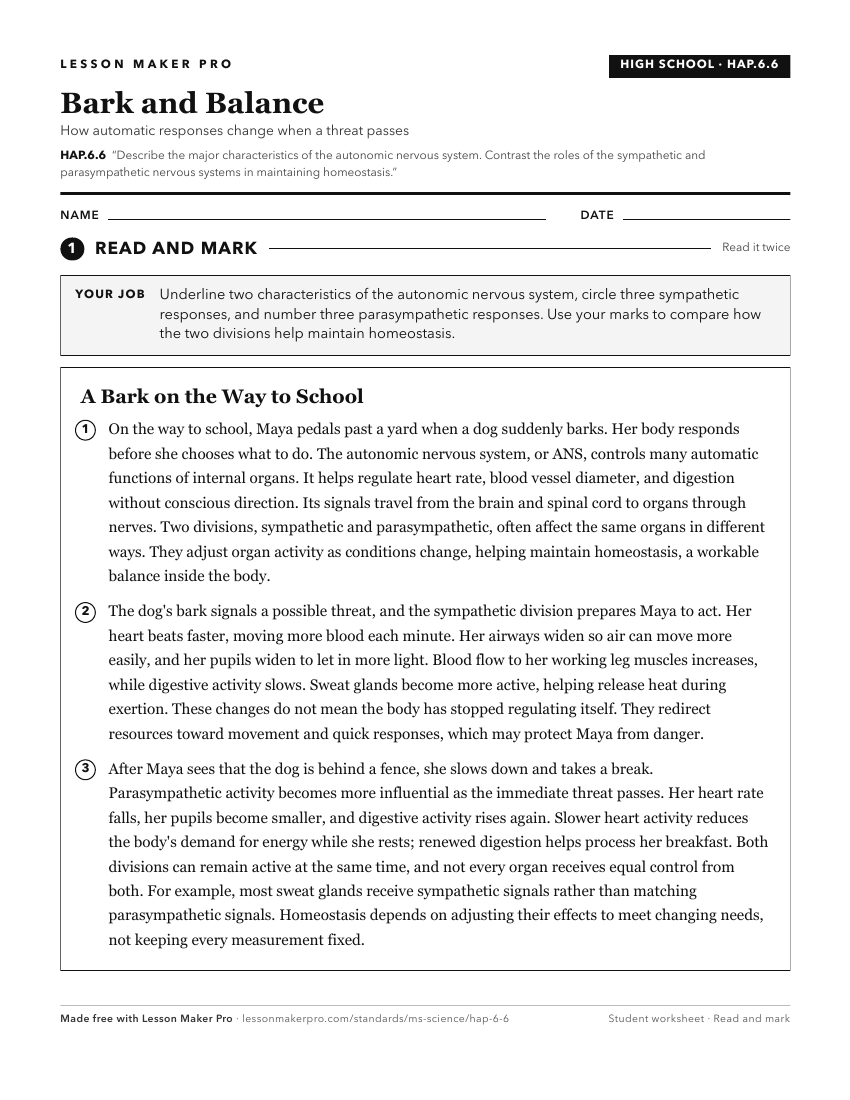
A ready-to-print activity worksheet aligned to HAP.6.6, with an answer key for the teacher on its own page. No account needed.
PDF, US Letter, prints cleanly in black and white.
Download the worksheetKeep exploring
Related Standards
- HAP.7.3
Model specific mechanisms through which the endocrine system maintains homeostasis (e.g., insulin/glucagon and glucose regulation; T3 / T4 and metabolic rates; ...
- HAP.6.4
Compare and contrast the structures and functions of the central and peripheral nervous systems. Investigate how the systems interact to maintain homeostasis (e...
- HAP.4.5
Construct explanations detailing how mechanisms (e.g., Ca2+ regulation) are used by the skeletal system to maintain homeostasis.
- HAP.14.1
Understand the structure and function of the urinary system in relation to maintenance of homeostasis.
Turn this exact standard into a lesson
Grade, subject, topic, and the complete standard are prefilled. Create one free, no account needed.
Also for this standard:Make a WorksheetMake a QuizMake a Sub Lesson