Mississippi Science HAP.10.4
The Standard
- HAP.10
- Students will investigate the structures and functions of the cardiovascular system, including the cause and effect of diseases and disorders.
Demonstrate the role of valves in regulating blood flow.
2026 Mississippi College- and Career-Readiness Standards for Science · Cardiovascular System
Teacher's field guide
What This Standard Means
What Students Need to Do
- Students trace blood through the heart and show which way it can pass through each valve. They explain how pressure opens a valve and how the valve stops blood from flowing backward.
What Mastery Looks Like
- A student can show that the valves between the atria and ventricles close when the ventricles contract. They can show that the valves leading to the arteries open, and explain what would happen if either set leaked.
Common Misconceptions
- Students may think valves push blood rather than open and close as pressure changes. Some think all heart valves open at the same time or that closed valves stop blood flow everywhere.
How to Assess It
- On a heart diagram, have students label each valve open or closed while the ventricles contract. Ask them to draw one arrow showing where blood would go if a closed valve leaked.
Lesson moves
Ways to Teach It
Tape a cardstock flap over a gap on a heart diagram; have students push a bead through it, then try moving it backward.
Ask students to write: Why must the valve between an atrium and ventricle close when the ventricle squeezes?
Give pairs OPEN and CLOSED cards; call out 'atria squeeze' or 'ventricles squeeze' and have them show each valve's position.
Show a photo of varicose veins and ask students to mark where blood could pool if a vein valve leaks.
Free download
Printable HAP.10.4 Worksheet
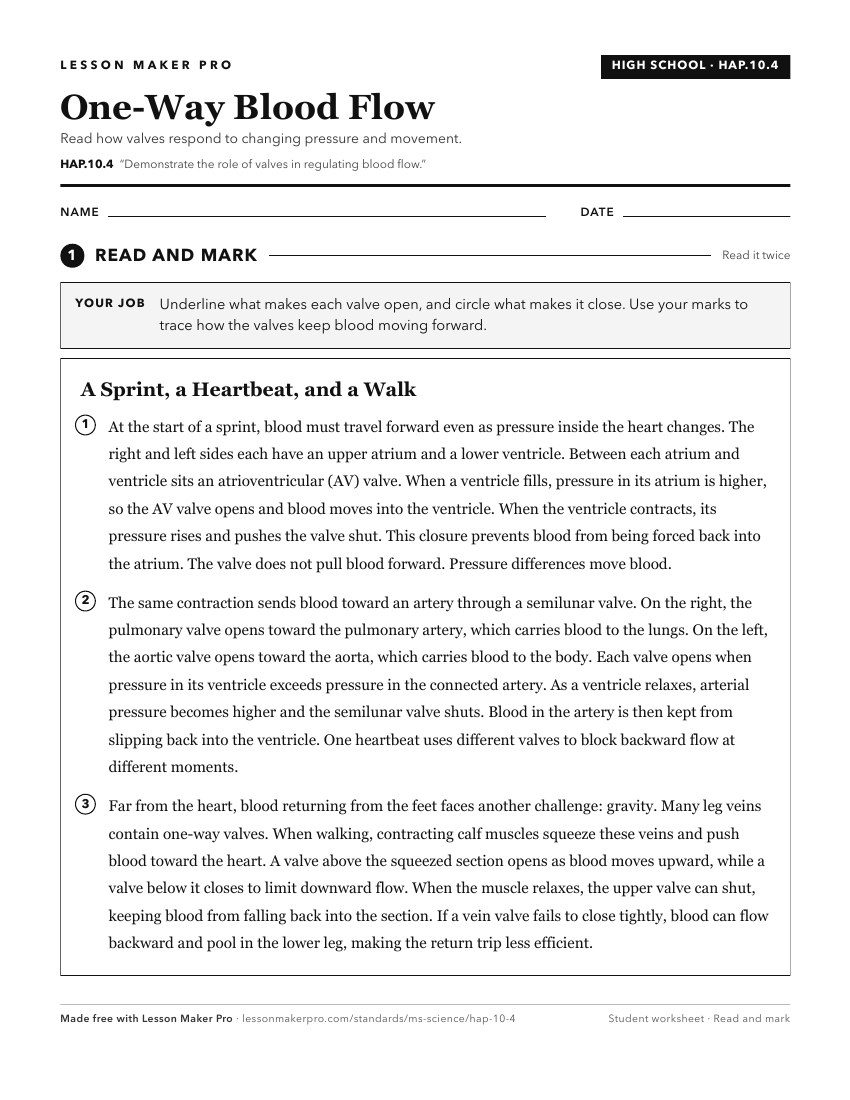
A ready-to-print activity worksheet aligned to HAP.10.4, with an answer key for the teacher on its own page. No account needed.
PDF, US Letter, prints cleanly in black and white.
Download the worksheetKeep exploring
Related Standards
- HAP.10.6
Research and analyze the effects of various pathological conditions (e.g., hypertension, myocardial infarction, mitral valve prolapses, varicose veins, and arrh...
- HAP.10.3
Investigate the structure and function of different types of blood vessels (e.g., arteries, capillaries, veins). Identify the role each plays in the transport a...
- HAP.10.7
Enrichment: Use an engineering design process to develop, model, and test effective treatments for cardiovascular diseases (e.g., methods to regulate heart rate...
- HAP.10.1
Design and use models to investigate the functions of the organs of the cardiovascular system.
Turn this exact standard into a lesson
Grade, subject, topic, and the complete standard are prefilled. Create one free, no account needed.
Also for this standard:Make a WorksheetMake a QuizMake a Sub Lesson