Mississippi Science ESS.4.3
The Standard
- ESS.4
- Students will develop an understanding of Earth’s resources and the impact of human activities.
Analyze earthquake and volcanic data to determine patterns that can lead to predicting such hazards and mitigating impact to humans.
2026 Mississippi College- and Career-Readiness Standards for Science · Earth’s Resources and Human Activity
Teacher's field guide
What This Standard Means
What Students Need to Do
- Students map earthquake locations and examine volcano data for patterns. They use those patterns to identify places at risk and suggest ways to reduce harm.
What Mastery Looks Like
- Students can explain why a cluster of quakes along a fault points to earthquake risk, or why tremors and rising ground call for closer volcano monitoring. They suggest a practical safety step without claiming to know when an event will happen.
Common Misconceptions
- A cluster of small quakes does not mean a large quake will happen tomorrow. Rising ground does not mean a volcano will erupt. Hazard maps show where damage is more likely, not exactly when it will occur.
How to Assess It
- Exit ticket: Eight quakes cluster along a fault near a town, and a nearby volcano has new tremors and rising ground. Name both hazards, one safety step for each, and one thing the data cannot tell us.
Lesson moves
Ways to Teach It
Give pairs a blank world map and 20 earthquake and volcano coordinates; have them plot dots and circle clusters.
Ask: Can three days of tremors and rising ground tell us an eruption date? Write a claim using both clues.
Hand out four volcano monitoring cards with tremor counts and ground movement; teams rank monitoring needs and defend their choices.
Show a Mount St. Helens lahar map; have students trace a route that avoids river valleys and explain why.
Free download
Printable ESS.4.3 Worksheet
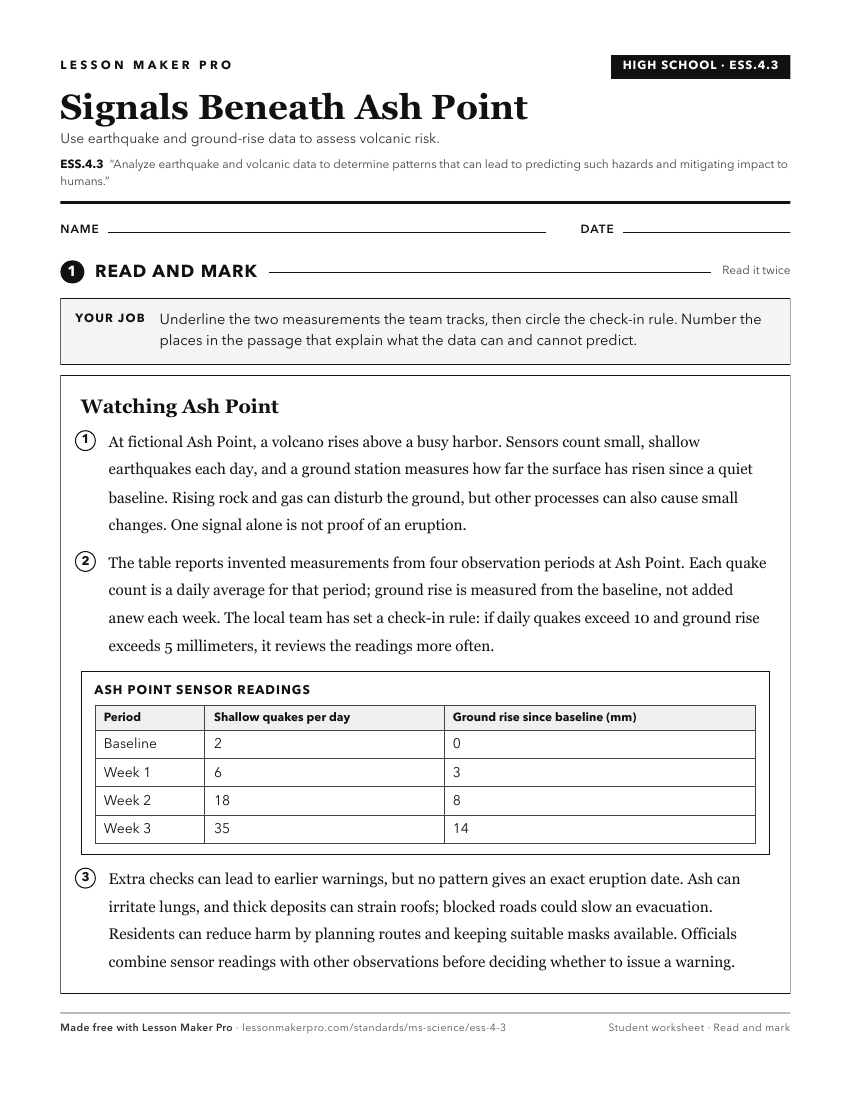
A ready-to-print activity worksheet aligned to ESS.4.3, with an answer key for the teacher on its own page. No account needed.
PDF, US Letter, prints cleanly in black and white.
Download the worksheetKeep exploring
Related Standards
- ESS.4.2
Research, assess, and communicate how Earth’s systems influence the distribution of life, including how various natural hazards and geologic events (e.g., volca...
- E.8.9B.1
Research and map various types of natural hazards to determine their impact on society.
- E.4.9C.1
Analyze and interpret data to describe (i.e., NASA, NOAA, USGS) and predict how natural processes (e.g., weathering, erosion, deposition, earthquakes, tsunamis,...
- ENV.4.2
Evaluate data and other information to explain how key natural resources (e.g., water sources, fertile soils, concentrations of minerals, and fossil fuels), nat...
Turn this exact standard into a lesson
Grade, subject, topic, and the complete standard are prefilled. Create one free, no account needed.
Also for this standard:Make a WorksheetMake a QuizMake a Sub Lesson