Mississippi Science E.8.9B.1
The Standard
- E.8.9B
- Students will demonstrate an understanding of natural hazards (volcanic eruptions, severe weather, earthquakes) and construct explanations for why some hazards are predictable and others are not.
Research and map various types of natural hazards to determine their impact on society.
2026 Mississippi College- and Career-Readiness Standards for Science · Earth’s Systems and Cycles
Teacher's field guide
What This Standard Means
What Students Need to Do
- Students use reports and maps to locate different natural hazards, such as floods, earthquakes, and wildfires. They connect each location to reported effects on people, homes, roads, or services.
What Mastery Looks Like
- A student marks hazard locations accurately, labels each type, and names the source of the location data. They explain a documented impact at each site and show that the same hazard can affect communities differently.
Common Misconceptions
- Students may mark where a hazard happened but treat the whole state as equally affected. They may assume more events mean more harm without checking who or what was exposed.
How to Assess It
- Give students a blank U.S. map and three short reports about a flood, earthquake, and wildfire. Ask them to mark each location and write one reported impact beside it.
Lesson moves
Ways to Teach It
Give pairs a blank U.S. map and three printed hazard reports; have them mark event sites and label reported damage.
Read two flood reports; ask students to explain why the reported damage differs, using one detail from each town.
Give teams event cards, short damage reports, and a U.S. map; have them match each report to a mapped location.
Use a FEMA flood map to find a road crossing a flood zone and explain how a closure could affect travel to school.
Free download
Printable E.8.9B.1 Worksheet
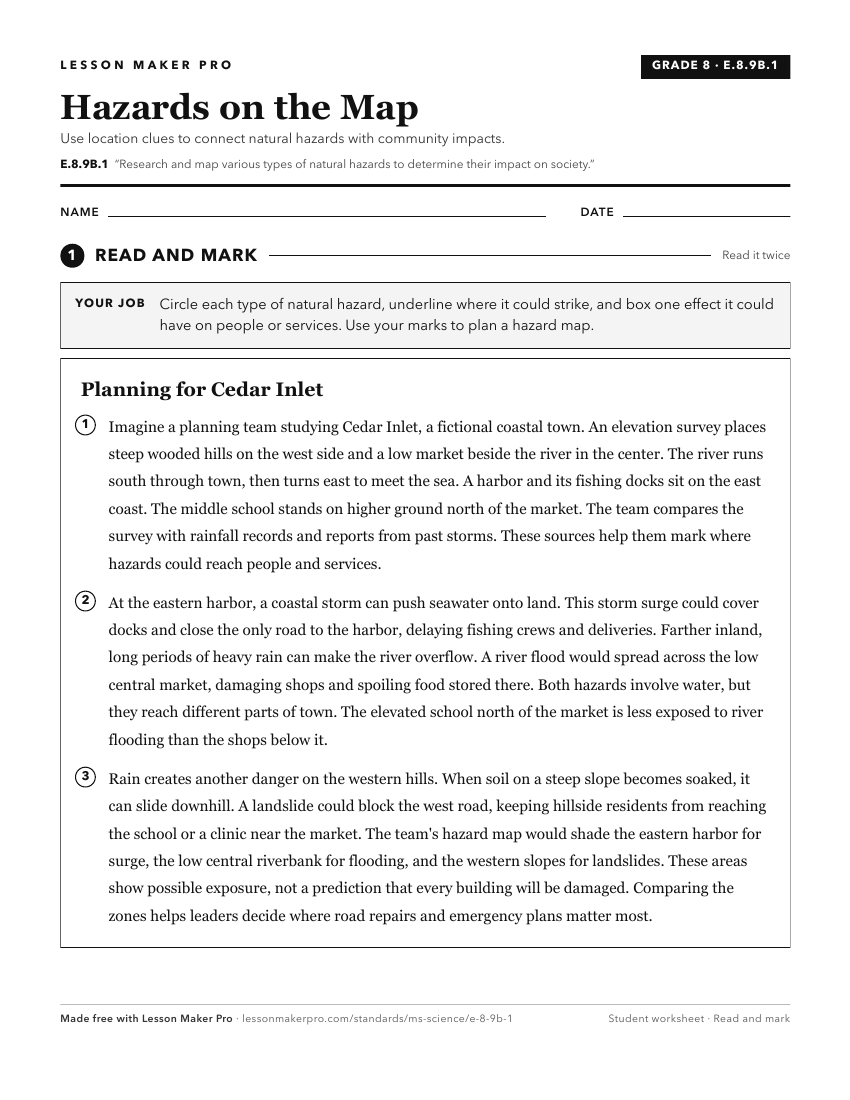
A ready-to-print activity worksheet aligned to E.8.9B.1, with an answer key for the teacher on its own page. No account needed.
PDF, US Letter, prints cleanly in black and white.
Download the worksheetKeep exploring
Related Standards
- ESS.4.2
Research, assess, and communicate how Earth’s systems influence the distribution of life, including how various natural hazards and geologic events (e.g., volca...
- ESS.4.3
Analyze earthquake and volcanic data to determine patterns that can lead to predicting such hazards and mitigating impact to humans.
- E.8.9B.2
Compare and contrast technologies that predict natural hazards to identify which types of technologies are most effective.
- ENV.4.2
Evaluate data and other information to explain how key natural resources (e.g., water sources, fertile soils, concentrations of minerals, and fossil fuels), nat...
Turn this exact standard into a lesson
Grade, subject, topic, and the complete standard are prefilled. Create one free, no account needed.
Also for this standard:Make a WorksheetMake a QuizMake a Sub Lesson