Mississippi Science ESS.4.2
The Standard
- ESS.4
- Students will develop an understanding of Earth’s resources and the impact of human activities.
Research, assess, and communicate how Earth’s systems influence the distribution of life, including how various natural hazards and geologic events (e.g., volcanic eruptions, earthquakes, landslides, tornadoes, and hurricanes) have shaped the course of human history.
2026 Mississippi College- and Career-Readiness Standards for Science · Earth’s Resources and Human Activity
Teacher's field guide
What This Standard Means
What Students Need to Do
- Students use maps and records to explain how water, climate, landforms, and hazards affect where living things are found. They trace how a natural event changed where people lived or how they got food.
What Mastery Looks Like
- Students can use rainfall, terrain, and population maps to explain a settlement pattern without relying on one factor alone. They can check a source's date and evidence, then explain how a named hazard changed a community.
Common Misconceptions
- Students may assume a disaster alone determines where people live, ignoring water, jobs, and protection from hazards. They may use a modern map as proof of where people lived centuries ago.
How to Assess It
- Give students a map of Pompeii beside Mount Vesuvius and a short account of the 79 CE eruption. Ask: "How did the eruption change where people could live? Use one detail from each source."
Lesson moves
Ways to Teach It
Layer printed maps of Egypt's rainfall, rivers, and population on transparent sheets, then circle places where people cluster.
Read an account of the 79 CE Vesuvius eruption, then write two sentences explaining how it changed life in Pompeii.
Match cards naming Vesuvius, the 1906 San Francisco earthquake, and Hurricane Katrina to printed maps and captions describing their effects.
Check a FEMA flood map for your town, then mark one safer site for new homes and explain your choice.
Free download
Printable ESS.4.2 Worksheet
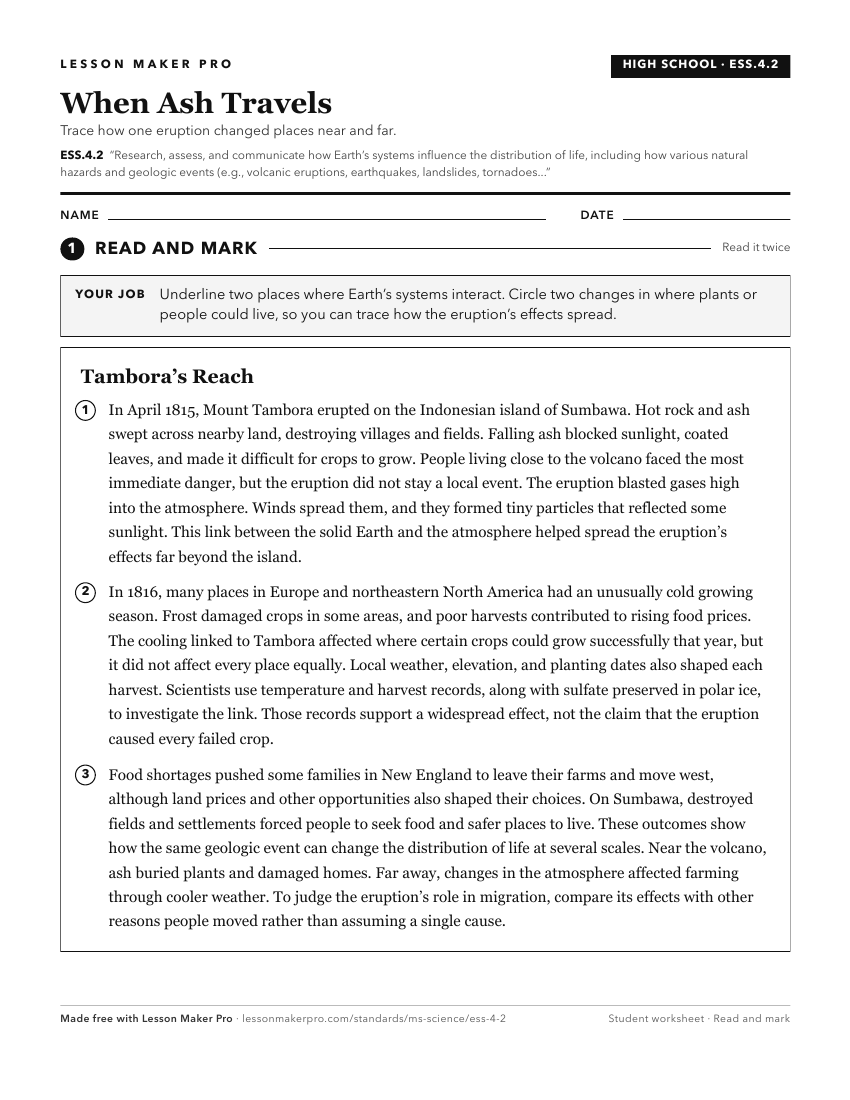
A ready-to-print activity worksheet aligned to ESS.4.2, with an answer key for the teacher on its own page. No account needed.
PDF, US Letter, prints cleanly in black and white.
Download the worksheetKeep exploring
Related Standards
- E.8.9B.1
Research and map various types of natural hazards to determine their impact on society.
- E.4.9C.1
Analyze and interpret data to describe (i.e., NASA, NOAA, USGS) and predict how natural processes (e.g., weathering, erosion, deposition, earthquakes, tsunamis,...
- ENV.4.2
Evaluate data and other information to explain how key natural resources (e.g., water sources, fertile soils, concentrations of minerals, and fossil fuels), nat...
- ESS.4.1
Research, evaluate, and communicate about how human life on Earth shapes Earth’s systems and responds to the interaction of Earth’s systems (e.g., geosphere, hy...
Turn this exact standard into a lesson
Grade, subject, topic, and the complete standard are prefilled. Create one free, no account needed.
Also for this standard:Make a WorksheetMake a QuizMake a Sub Lesson