Mississippi Science BOT.5.3
The Standard
- BOT.5
- Students will explore adaptations that allow plants to survive in various habitats.
Construct a model using technology that illustrates the levels of succession within a habitat (e.g., graveyard exploration, forest fire area, or reclamation sites).
2026 Mississippi College- and Career-Readiness Standards for Science · Plant Adaptations to Varying Habitats
Teacher's field guide
What This Standard Means
What Students Need to Do
- Students use slides or a digital diagram to model how a habitat changes after a disturbance. They show whether soil remains, which plants appear in order, and how the habitat changes over time.
What Mastery Looks Like
- A student can make a labeled timeline of a burned forest, from surviving soil and grasses to shrubs, young trees, and later forest. They explain why this is secondary succession and why the stages do not happen on a fixed schedule.
Common Misconceptions
- Students may call regrowth after a fire primary succession, even though soil remains. They may assume every habitat eventually becomes a forest or that each stage takes a set number of years.
How to Assess It
- Exit ticket: Make a four-frame slide timeline showing a burned forest's soil, grasses, shrubs, and trees. Label why the plants change between frames.
Lesson moves
Ways to Teach It
Give pairs photos of burned ground, grasses, shrubs, and trees; have them build a labeled timeline in Google Slides.
Ask, 'Why might grasses grow before trees after a fire?' Have students write two sentences using soil and plant growth rates.
Hand out cards labeled burned ground with soil, grasses, shrubs, saplings, and forest; teams race to order them and explain each transition.
Show two dated wildfire recovery photos from a park website; students place each on their slide timeline and predict which plants come next.
Free download
Printable BOT.5.3 Worksheet
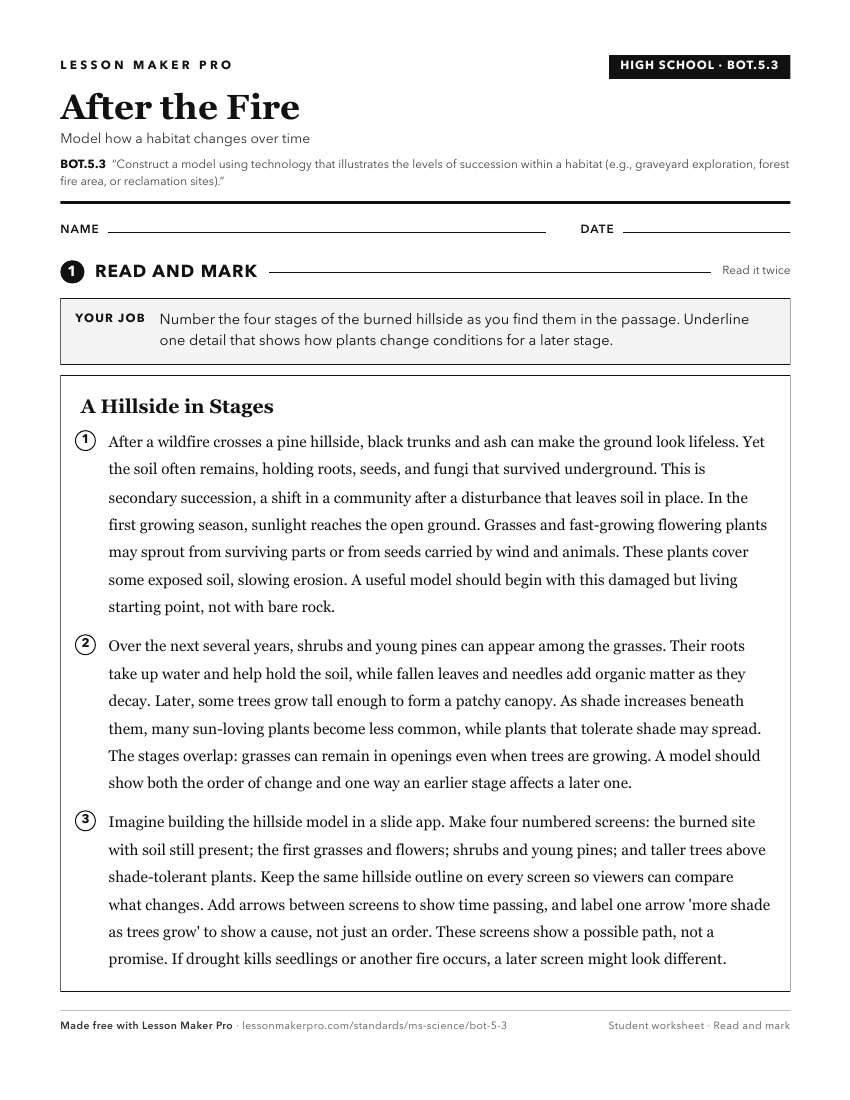
A ready-to-print activity worksheet aligned to BOT.5.3, with an answer key for the teacher on its own page. No account needed.
PDF, US Letter, prints cleanly in black and white.
Download the worksheetKeep exploring
Related Standards
- L.K.1B.1
Develop and use models to exemplify how animals use their body parts to (a) obtain food and other resources, (b) protect themselves, and (c) move from place to ...
- L.6.3.2
Develop and use models to describe the levels of organization within ecosystems (species, populations, communities, ecosystems, and biomes).
- BIO.5.7
Investigate and evaluate factors involved in primary and secondary ecological succession using local, real-world examples.
- FB.6.4
Develop and use models to discuss the climate, flora, and fauna of the terrestrial and aquatic biomes of the world.
Turn this exact standard into a lesson
Grade, subject, topic, and the complete standard are prefilled. Create one free, no account needed.
Also for this standard:Make a WorksheetMake a QuizMake a Sub Lesson