Maryland Math 8.DS.A.1.a
The Standard
- 8.DS.A.1
- Evaluate predictions and conclusions drawn from bivariate data.
Determine whether observed associations in sample data justify generalizations about a broader population.
Maryland College and Career Ready Standards for Mathematics (2025) · MAKE SENSE OF STATISTICAL INQUIRY. NEW CLUSTER
Teacher's field guide
What This Standard Means
What Students Need to Do
- Students find a pattern between two traits in sample data. They decide whether the people surveyed represent the larger group. They state which group the pattern might describe.
What Mastery Looks Like
- A student can describe a pattern in a two-way table and identify who was surveyed. They can explain why a random sample may support a broader claim, while volunteers from one club may not.
Common Misconceptions
- Students may think a large sample represents everyone, even if it includes only volunteers. They may also treat a pattern as proof that one trait caused the other.
How to Assess It
- Exit ticket: In a voluntary poll of 40 basketball players, 24 of 30 who practice weekly and 2 of 10 who do not report high confidence. Does this support a claim about all eighth graders? Explain.
Lesson moves
Ways to Teach It
Give pairs cards marked with two traits, such as sports participation and sleep; compare the pattern in a random draw with a preselected draw.
Ask students to write whether a pattern found in one homeroom could describe every eighth grader, and explain who might be missing.
Play Sample or Stretch: show survey groups and claims about exercise and sleep; students hold up a choice and explain it.
Show a headline claiming a schoolwide link between screen time and sleep from a gaming club poll; have students rewrite the claim.
Free download
Printable 8.DS.A.1.a Worksheet
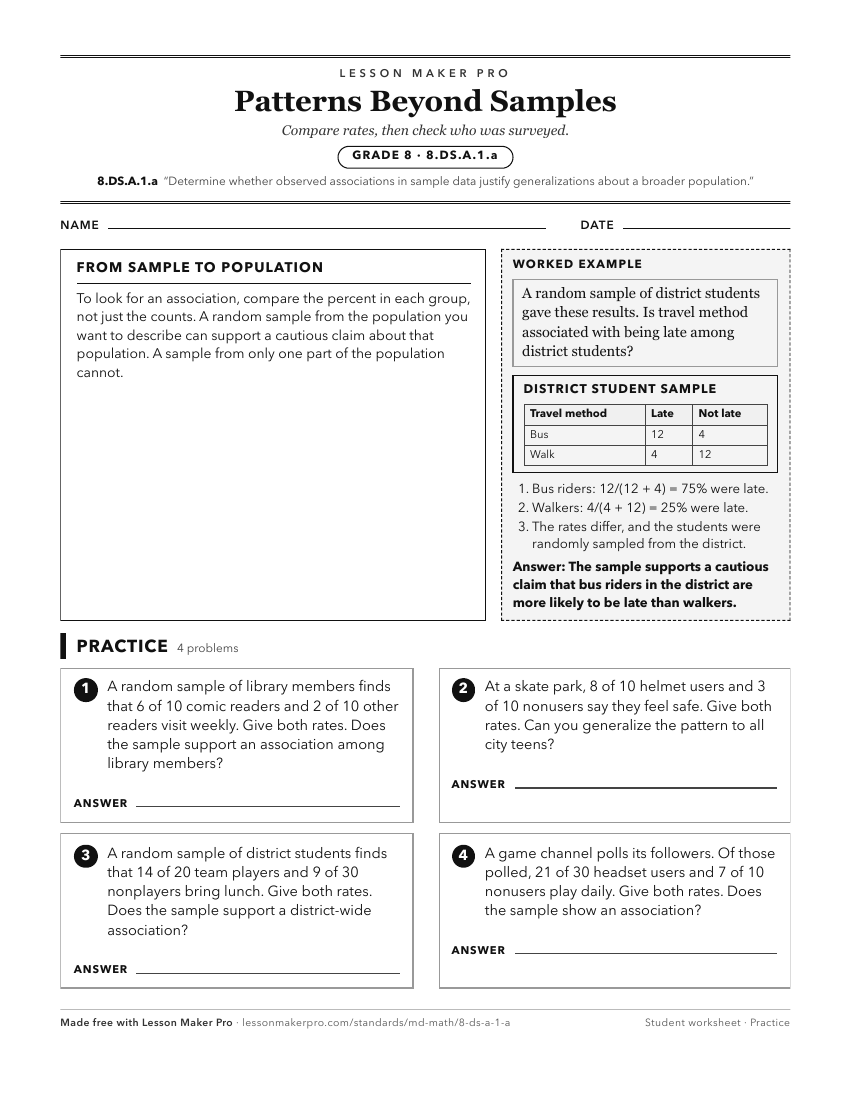
A ready-to-print activity worksheet aligned to 8.DS.A.1.a, with an answer key for the teacher on its own page. No account needed.
PDF, US Letter, prints cleanly in black and white.
Download the worksheetKeep exploring
Related Standards
- 3.DS.A.1.c
Identify patterns in the data and evaluate whether these patterns might apply to different contexts or situations.
- 7.DS.A.2.a
Use data from a single random sample to estimate an unknown characteristic of a population.
- 7.DS.A.1
Determine when generalizations about a population are appropriate based on how the sample was selected.
- 7.DS.A.1.a
Decide whether a sample is representative of a population by explaining how it was selected and how that selection affects the accuracy of conclusions.
Turn this exact standard into a lesson
Grade, subject, topic, and the complete standard are prefilled. Create one free, no account needed.
Also for this standard:Make a WorksheetMake a QuizMake a Sub Lesson