Maryland Math 7.DS.A.1.a
The Standard
- 7.DS.A.1
- Determine when generalizations about a population are appropriate based on how the sample was selected.
Decide whether a sample is representative of a population by explaining how it was selected and how that selection affects the accuracy of conclusions.
Maryland College and Career Ready Standards for Mathematics (2025) · MAKE SENSE OF STATISTICAL INQUIRY.
Teacher's field guide
What This Standard Means
What Students Need to Do
- Students identify who a survey is about, who was asked, and how those people were chosen. They decide whether the selection favors or leaves out groups, then explain how that could affect a claim about everyone.
What Mastery Looks Like
- A student can explain why surveying only basketball players may misrepresent the school’s sports preferences. They can suggest choosing names at random from a full school roster and recognize that a random sample can still differ from the whole school.
Common Misconceptions
- Students may think a large sample is automatically fair, even if everyone comes from one group. They may think random selection guarantees a perfect match or confuse the people surveyed with the whole population.
How to Assess It
- Exit ticket: A school asks 20 students on the 6:30 a.m. bus whether school should start later. Can their answers represent all students? Name a group left out and explain how the result might be skewed.
Lesson moves
Ways to Teach It
Layer 10 blue under 30 red counters; sample 10 from the top, replace, mix, draw 10 blindly, and compare both samples.
A school asks only students in the lunch line whether lunch is long enough. Who is missing, and how might answers shift?
Rank poll cards labeled 'random roster names,' 'volunteers,' 'first arrivals,' and 'seventh graders' by how well each represents the school.
Show a mock online bus-delay poll; ask which riders might be missed and how that could skew the reported delay rate.
Free download
Printable 7.DS.A.1.a Worksheet
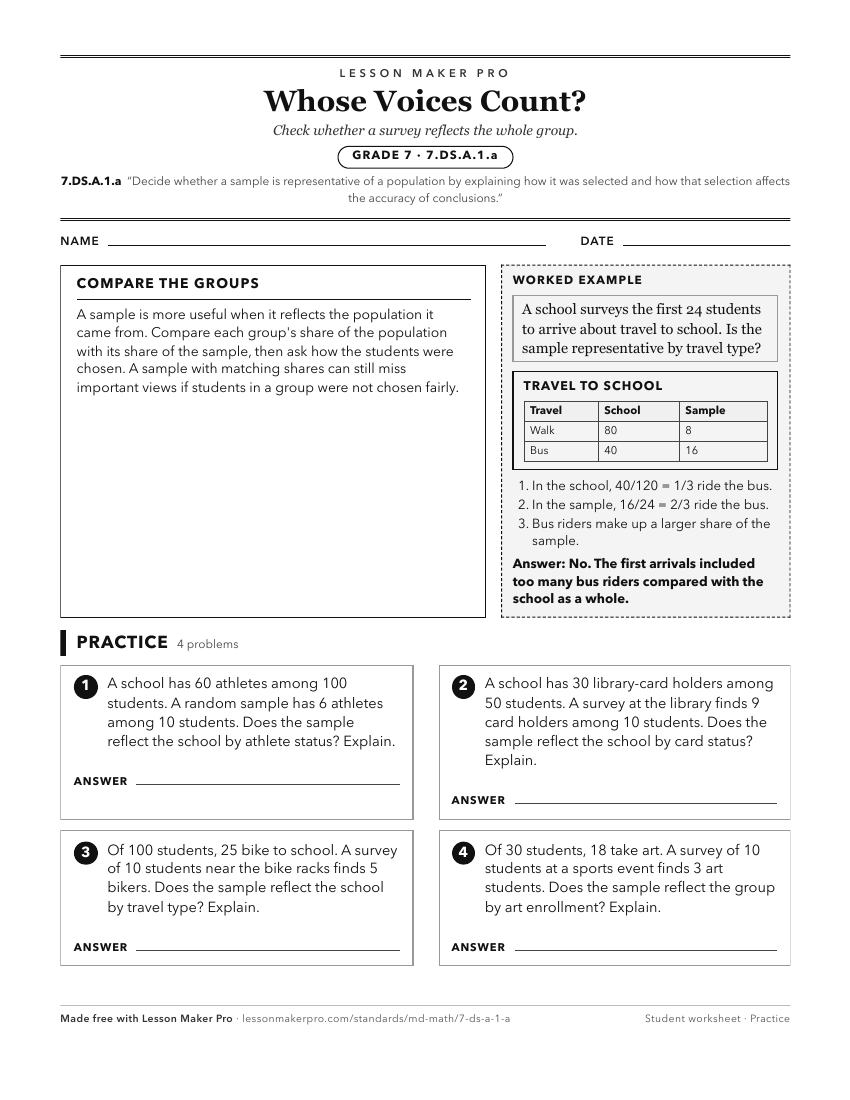
A ready-to-print activity worksheet aligned to 7.DS.A.1.a, with an answer key for the teacher on its own page. No account needed.
PDF, US Letter, prints cleanly in black and white.
Download the worksheetKeep exploring
Related Standards
- 8.DS.A.1.a
Determine whether observed associations in sample data justify generalizations about a broader population.
- 7.DS.A.1
Determine when generalizations about a population are appropriate based on how the sample was selected.
- 7.DS.A.2
Use data from random samples to make and evaluate estimates or predictions about a population.
- 7.DS.A.1.b
Explain how a random sample increases the likelihood that the sample represents the population.
Turn this exact standard into a lesson
Grade, subject, topic, and the complete standard are prefilled. Create one free, no account needed.
Also for this standard:Make a WorksheetMake a QuizMake a Sub Lesson