Maryland Math 3.DS.A.1.c
The Standard
- 3.DS.A.1
- Ask and answer questions by collecting, organizing and summarizing data, recognizing the importance of context when analyzing data.
Identify patterns in the data and evaluate whether these patterns might apply to different contexts or situations.
Maryland College and Career Ready Standards for Mathematics (2025) · REPRESENT AND INTERPRET DATA.
Teacher's field guide
What This Standard Means
What Students Need to Do
- Students read a table or graph and name a pattern, such as which choice is most common. They decide whether that pattern might hold for another group or place and explain why.
What Mastery Looks Like
- A student sees that more classmates ride the bus than walk. They explain that a school where most children live nearby might have more walkers.
Common Misconceptions
- Students may think the tallest bar shows what everyone prefers, not just the group surveyed. They may assume another group will have the same results even when its circumstances differ.
How to Assess It
- Exit ticket: In one class, 14 students ride the bus and 6 walk. Which choice is more common, and would you expect the same result at a school where most children live nearby? Explain.
Lesson moves
Ways to Teach It
Survey classmates about bus, car, or walking, then build a bar graph with linking cubes and name the most common choice.
Ask: Would a school where most children live nearby have the same travel pattern as our class? Why?
Give pairs a chart with 8 dog votes and 3 cat votes; have them mark claims about their class and all third graders as supported or unproven.
Show a store's winter tally of 12 hot drinks and 5 cold drinks; ask whether a beach kiosk in July would match.
Free download
Printable 3.DS.A.1.c Worksheet
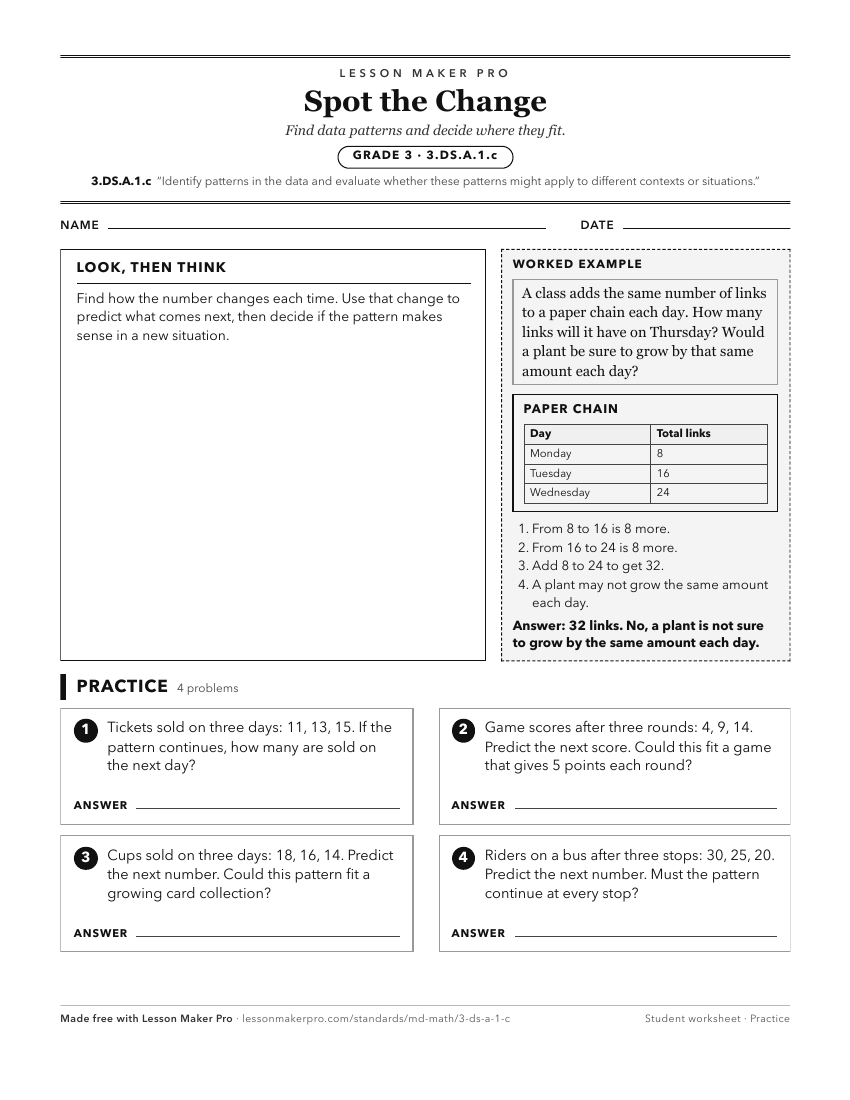
A ready-to-print activity worksheet aligned to 3.DS.A.1.c, with an answer key for the teacher on its own page. No account needed.
PDF, US Letter, prints cleanly in black and white.
Download the worksheetKeep exploring
Related Standards
- 3.DS.A.1
Ask and answer questions by collecting, organizing and summarizing data, recognizing the importance of context when analyzing data.
- 5.DS.A.1
Ask and answer questions by collecting, organizing and summarizing data, recognizing the importance of context when analyzing data.
- 4.DS.A.1
Ask and answer questions by collecting, organizing and summarizing data, recognizing the importance of context when analyzing data.
- 8.DS.A.1.a
Determine whether observed associations in sample data justify generalizations about a broader population.
Turn this exact standard into a lesson
Grade, subject, topic, and the complete standard are prefilled. Create one free, no account needed.
Also for this standard:Make a WorksheetMake a QuizMake a Sub Lesson