Maryland Math 5.NOS.B.5
Standard Cluster
Divide multi-digit whole numbers with up to four-digit dividends and two-digit divisors. Apply estimation strategies to estimate quotients. Use partial quotients efficiently to divide. Use properties of operations and/or the inverse relationship between multiplication and division to divide. Represent and explain the computation by connecting rectangular arrays, area models, and/or equations to the meaning of division.
Maryland College and Career Ready Standards for Mathematics (2025) · PERFORM OPERATIONS ON MULTI-DIGIT WHOLE NUMBERS AND WITH DECIMALS TO HUNDREDTHS.
Cluster contents
Standards in This Cluster
5.NOS.B.5 is a cluster heading. These are the individual standards under it.
- 5.NOS.B.5.a
Apply estimation strategies to estimate quotients.
- 5.NOS.B.5.b
Use partial quotients efficiently to divide.
- 5.NOS.B.5.c
Use properties of operations and/or the inverse relationship between multiplication and division to divide.
- 5.NOS.B.5.d
Represent and explain the computation by connecting rectangular arrays, area models, and/or equations to the meaning of division.
Teacher's field guide
What This Cluster Means
What Students Need to Do
- Students estimate the answer before dividing a number of up to four digits by a two-digit number. They subtract large multiples of the divisor and add the group counts. They show those groups in an area model and an equation.
What Mastery Looks Like
- A student estimates that 1,248 ÷ 24 is near 50, then finds 52 by subtracting 1,200 and 48. They label both parts on a rectangle and check that 24 × 52 = 1,248.
Common Misconceptions
- Students may calculate 24 × 50 as 120 instead of 1,200. They may forget to add all the partial quotients or stop when the remainder is still 24 or more.
How to Assess It
- Exit ticket: Estimate 1,248 ÷ 24, then solve it using partial quotients. Label the parts of an area model and check your answer with multiplication.
Lesson moves
Ways to Teach It
Have pairs cut 24-by-50 and 24-by-2 rectangles from grid paper, then join them to model 1,248 ÷ 24.
Ask, “Why is 24 × 50 a useful first step for 1,248 ÷ 24, and what do you do with the remaining 48?”
Play quotient match with cards for 1,344 ÷ 24, an estimate of 60, partial quotients 50 + 6, and 24 × 56 = 1,344.
A club packs 1,375 pencils in boxes of 24; have students estimate, calculate the number of full boxes, and explain the leftovers.
Free download
Printable 5.NOS.B.5 Worksheet
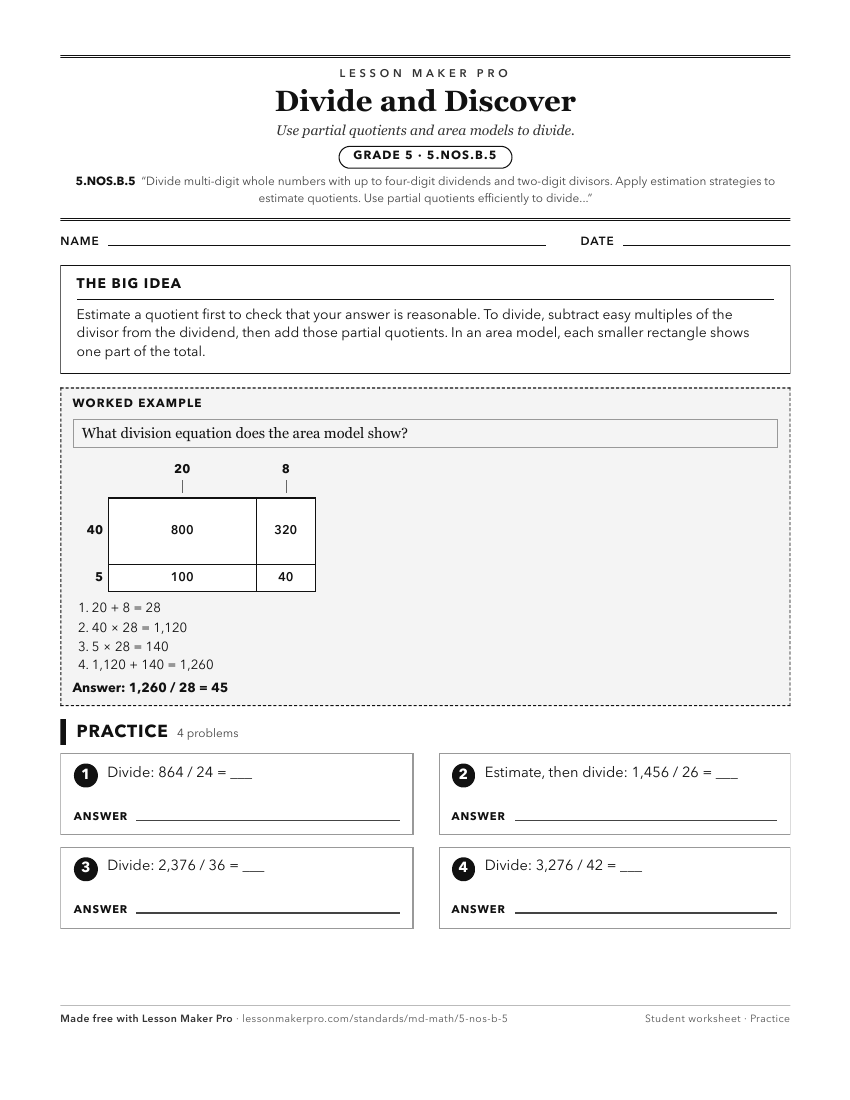
A ready-to-print activity worksheet aligned to 5.NOS.B.5, with an answer key for the teacher on its own page. No account needed.
PDF, US Letter, prints cleanly in black and white.
Download the worksheetKeep exploring
Related Standards
- 6.NOS.B.3
Fluently multiply and divide multi-digit decimals to the thousandths in context.
- 4.NOS.B.6
Divide whole numbers with up to four-digit dividends and one-digit divisors with and without remainders.
- 4.NOS.B.5
Multiply a whole number of up to four digits by a one-digit whole number, and multiply two two-digit numbers.
- 6.NOS.B.2
Fluently divide multi-digit numbers.
Turn this cluster into a lesson
Grade, subject, topic, and the complete cluster are prefilled. Create one free, no account needed.
Also for this cluster:Make a WorksheetMake a QuizMake a Sub Lesson