Maryland Math 4.NOS.B.5
Standard Cluster
Multiply a whole number of up to four digits by a one-digit whole number, and multiply two two-digit numbers. Apply estimation strategies to estimate products. Use strategies based on place value (e.g., partial products) to multiply. Use properties of operations (e.g., use doubling and halving strategy to think of 12 × 32 as 6 × 64) to multiply. Represent and explain the computation by connecting rectangular arrays, area models, and/or equations to the meaning of multiplication.
Maryland College and Career Ready Standards for Mathematics (2025) · USE PLACE VALUE UNDERSTANDING AND PROPERTIES OF OPERATIONS TO PERFORM MULTI-DIGIT ARITHMETIC.
Cluster contents
Standards in This Cluster
4.NOS.B.5 is a cluster heading. These are the individual standards under it.
- 4.NOS.B.5.a
Apply estimation strategies to estimate products.
- 4.NOS.B.5.b
Use strategies based on place value (e.g., partial products) to multiply.
- 4.NOS.B.5.c
Use properties of operations (e.g., use doubling and halving strategy to think of 12 × 32 as 6 × 64) to multiply.
- 4.NOS.B.5.d
Represent and explain the computation by connecting rectangular arrays, area models, and/or equations to the meaning of multiplication.
Teacher's field guide
What This Cluster Means
What Students Need to Do
- Students multiply numbers up to four digits by one digit, and two-digit numbers by two-digit numbers. They estimate first, then multiply using place value or doubling and halving. They show how an array, area model, or equation matches their work.
What Mastery Looks Like
- A student can break 2,314 × 3 into four place value parts and add the partial products. They can split a rectangle to solve 24 × 16 and label every part. They can tell whether their answer fits their estimate and explain why 12 × 32 equals 6 × 64.
Common Misconceptions
- Students may skip a place value when multiplying 2,314 × 3. For 24 × 16, they may multiply only 20 × 10 and 4 × 6, leaving out two parts. Some double one factor without halving the other.
How to Assess It
- On an exit ticket, ask students to estimate and solve 24 × 16 with a split rectangle, then solve 1,204 × 3 with partial products. Ask them to explain how one drawing or equation shows the multiplication.
Lesson moves
Ways to Teach It
Give pairs 23-by-14 grid rectangles to cut into tens and ones sections; have them label each section and add the partial products.
Ask, “Why do 12 × 32 and 6 × 64 match?” Have students write an equation and explain the doubling and halving.
Give pairs cards with problems like 1,206 × 4, matching partial products, and estimates; race to match each set and check the total.
Show a seating chart with 24 rows of 18 chairs; have students estimate the seats, then draw a split rectangle to find the total.
Free download
Printable 4.NOS.B.5 Worksheet
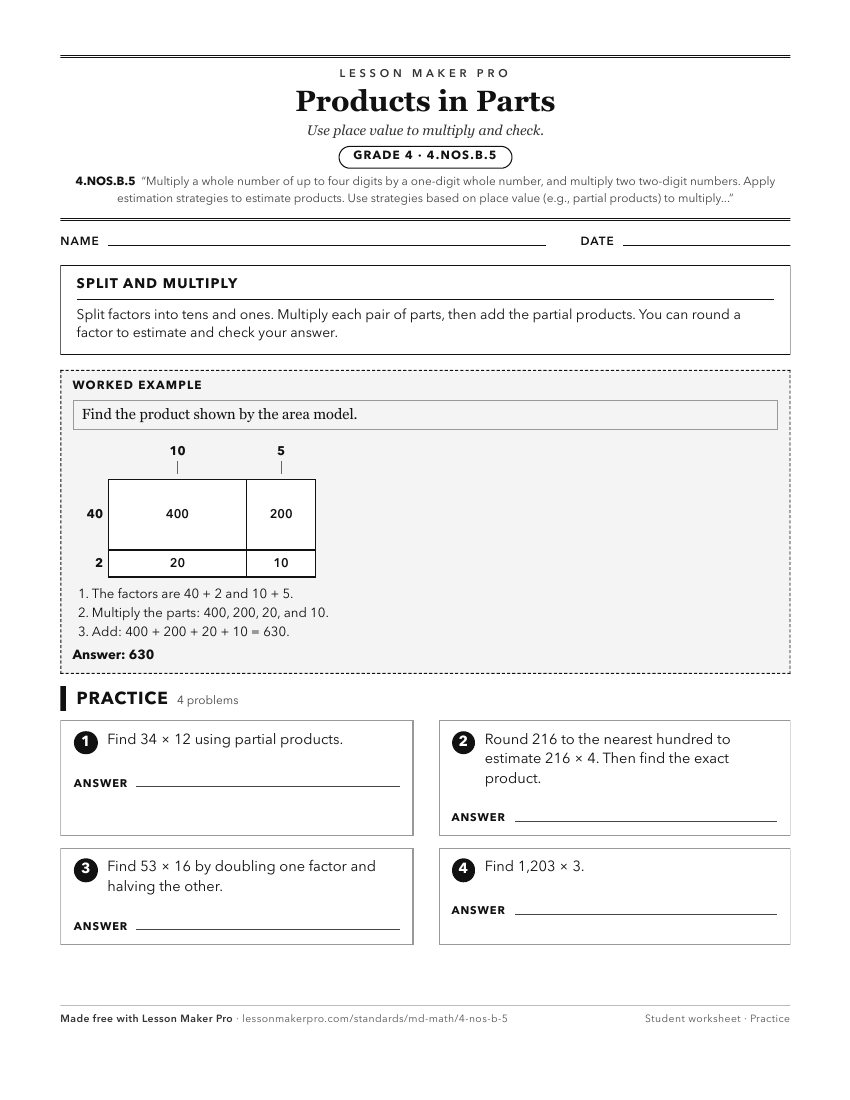
A ready-to-print activity worksheet aligned to 4.NOS.B.5, with an answer key for the teacher on its own page. No account needed.
PDF, US Letter, prints cleanly in black and white.
Download the worksheetKeep exploring
Related Standards
- 4.NOS.B.6
Divide whole numbers with up to four-digit dividends and one-digit divisors with and without remainders.
- 5.NOS.B.5
Divide multi-digit whole numbers with up to four-digit dividends and two-digit divisors.
- 4.NOS.B.4
Extend place value understanding and basic facts to multiply a multi-digit whole number by a multiple of ten.
Turn this cluster into a lesson
Grade, subject, topic, and the complete cluster are prefilled. Create one free, no account needed.
Also for this cluster:Make a WorksheetMake a QuizMake a Sub Lesson