Maryland Math 4.NOS.B.5.c
The Standard
- 4.NOS.B.5
- Multiply a whole number of up to four digits by a one-digit whole number, and multiply two two-digit numbers.
Use properties of operations (e.g., use doubling and halving strategy to think of 12 × 32 as 6 × 64) to multiply.
Maryland College and Career Ready Standards for Mathematics (2025) · USE PLACE VALUE UNDERSTANDING AND PROPERTIES OF OPERATIONS TO PERFORM MULTI-DIGIT ARITHMETIC.
Teacher's field guide
What This Standard Means
What Students Need to Do
- Students break apart a factor or double one factor and halve the other to make multiplication easier. They find the product and explain why the new expression has the same value.
What Mastery Looks Like
- For 18 × 25, a student uses 9 × 50 to get 450. They can also use 10 × 25 plus 8 × 25 and explain why both methods give 450.
Common Misconceptions
- Some students double both factors, which changes the product. Others halve an odd factor by rounding, then treat the product as equal. When breaking apart a factor, some forget to multiply one of the parts.
How to Assess It
- Exit ticket: Find 14 × 24 by halving one factor and doubling the other. Explain why your answer stays the same.
Lesson moves
Ways to Teach It
Build a 4-by-12 array with 48 counters, then rearrange the counters into an 8-by-6 array.
Ask students which is easier, 18 × 25 or 9 × 50, and have them explain why the answers match.
Draw two different cards labeled 12, 16, 18, 24, 25, or 32; write an equal product by doubling and halving.
Sketch 12 rows of 24 chairs, then 6 rows of 48 chairs; find the total seats in each arrangement.
Free download
Printable 4.NOS.B.5.c Worksheet
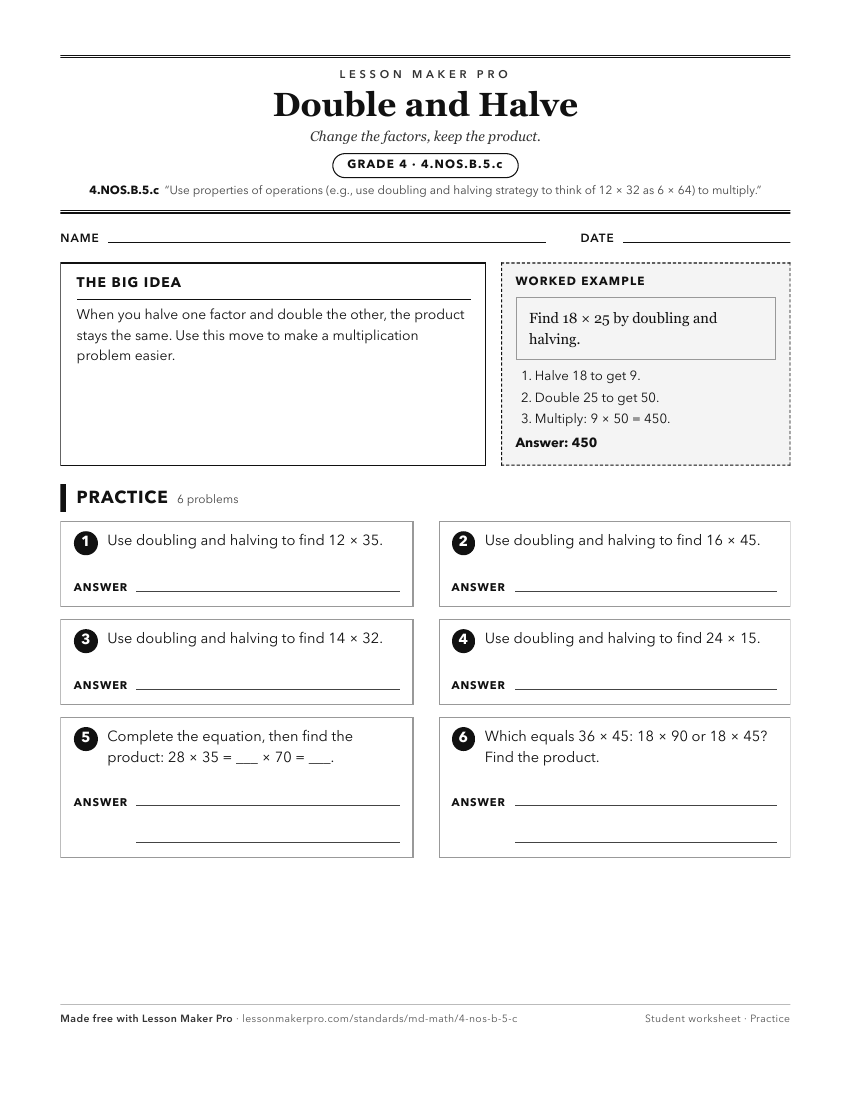
A ready-to-print activity worksheet aligned to 4.NOS.B.5.c, with an answer key for the teacher on its own page. No account needed.
PDF, US Letter, prints cleanly in black and white.
Download the worksheetKeep exploring
Related Standards
- 4.NOS.C.7.c
Use properties of operations (e.g., to solve 8 × 7, think of (5 × 7 + (3 × 7)) to multiply.
- 5.NOS.B.4.b
Use computational strategies (e.g., partial products, doubling and halving) efficiently to multiply.
- 5.NOS.B.7.d
Use properties of operations and/or the inverse relationship between multiplication and division to multiply and divide.
- 3.NOS.E.9.c
Use properties of operations (e.g., to solve 8 × 7, think of (5 × 7) + (3 × 7)) to multiply.
Turn this exact standard into a lesson
Grade, subject, topic, and the complete standard are prefilled. Create one free, no account needed.
Also for this standard:Make a WorksheetMake a QuizMake a Sub Lesson