Maryland Math 4.NOS.B.6
Standard Cluster
Divide whole numbers with up to four-digit dividends and one-digit divisors with and without remainders. Apply estimation strategies to estimate quotients. Use strategies based on place value (e.g., partial quotients) to divide. Use properties of operations and/or the inverse relationship between multiplication and division to divide. Represent and explain the computation by connecting rectangular arrays, area models, and/or equations to the meaning of division.
Maryland College and Career Ready Standards for Mathematics (2025) · USE PLACE VALUE UNDERSTANDING AND PROPERTIES OF OPERATIONS TO PERFORM MULTI-DIGIT ARITHMETIC.
Cluster contents
Standards in This Cluster
4.NOS.B.6 is a cluster heading. These are the individual standards under it.
- 4.NOS.B.6.a
Apply estimation strategies to estimate quotients.
- 4.NOS.B.6.b
Use strategies based on place value (e.g., partial quotients) to divide.
- 4.NOS.B.6.c
Use properties of operations and/or the inverse relationship between multiplication and division to divide.
- 4.NOS.B.6.d
Represent and explain the computation by connecting rectangular arrays, area models, and/or equations to the meaning of division.
Teacher's field guide
What This Cluster Means
What Students Need to Do
- Students estimate answers before dividing whole numbers by one-digit numbers. They use place-value chunks to divide, then connect an array or area model to an equation. They account for any remainder.
What Mastery Looks Like
- A student can estimate 1,253 ÷ 4 as about 300, then find 313 remainder 1. They can show 300, 10, and 3 in an area model and check that 4 × 313 + 1 = 1,253.
Common Misconceptions
- Some students divide each digit separately and forget to trade a leftover ten for ones. Others write the remainder as another digit in the quotient or leave a remainder as large as the divisor. Some cannot match the parts of an area model to their calculation.
How to Assess It
- Exit ticket: Estimate 1,347 ÷ 5. Find the quotient and remainder with an area model, then check your answer with multiplication.
Lesson moves
Ways to Teach It
Use base-ten blocks to share 1,253 among four groups, trading the leftover ten for ones and naming the one left over.
Show 4 × (300 + 10 + 3) + 1 = 1,253 beside a matching area model; ask what each part represents.
Roll four digits for a dividend and one digit for a divisor; estimate, divide with partial quotients, then check by multiplication.
Pack 1,347 pencils in boxes of five; estimate the number of full boxes, then find the full boxes and leftover pencils.
Free download
Printable 4.NOS.B.6 Worksheet
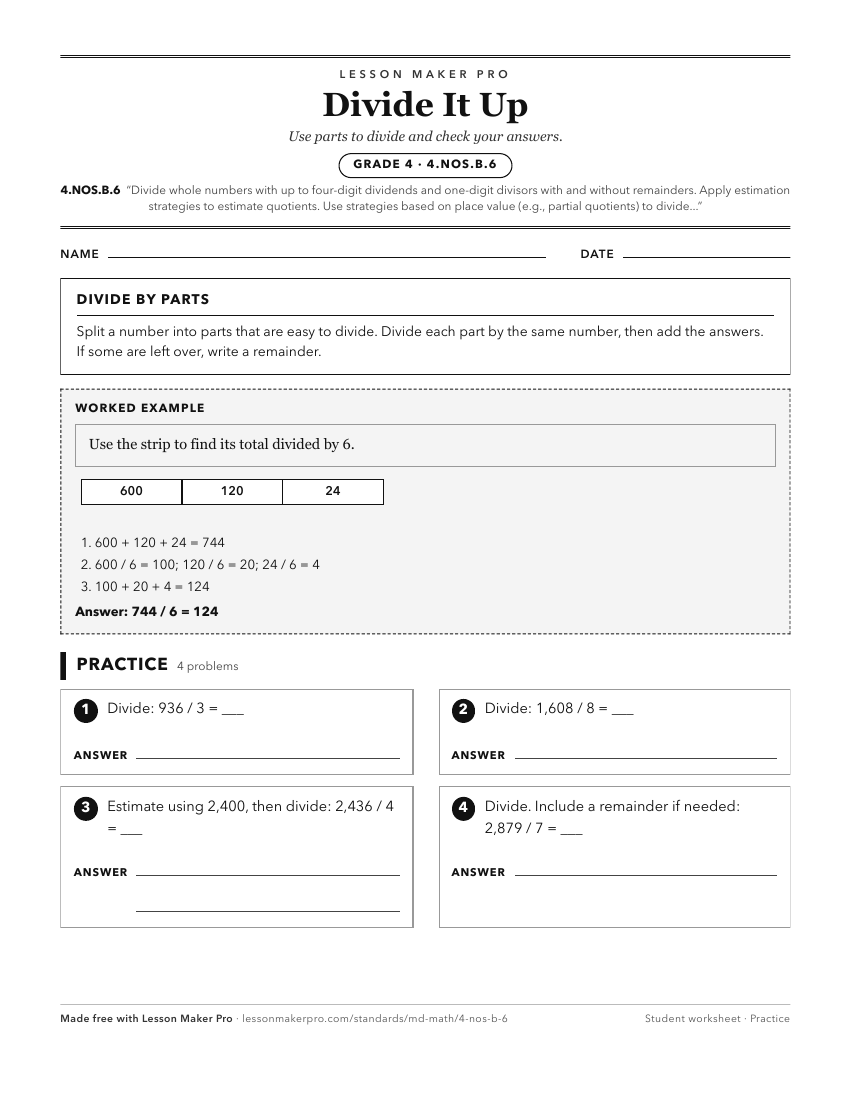
A ready-to-print activity worksheet aligned to 4.NOS.B.6, with an answer key for the teacher on its own page. No account needed.
PDF, US Letter, prints cleanly in black and white.
Download the worksheetKeep exploring
Related Standards
- 5.NOS.B.5
Divide multi-digit whole numbers with up to four-digit dividends and two-digit divisors.
- 4.NOS.B.5
Multiply a whole number of up to four digits by a one-digit whole number, and multiply two two-digit numbers.
- 6.NOS.B.2
Fluently divide multi-digit numbers.
- 3.NOS.B.3
Represent and interpret whole-number quotients (0-10) as dividing an amount into known number of groups (partitive) or as dividing an amount into groups of know...
Turn this cluster into a lesson
Grade, subject, topic, and the complete cluster are prefilled. Create one free, no account needed.
Also for this cluster:Make a WorksheetMake a QuizMake a Sub Lesson