Kentucky Reading and Writing C.1.2
Standard Cluster
Compose informative and/or explanatory texts, using a combination of drawing, dictating, writing and digital resources, to establish a topic and provide information about the topic. With guidance and support from adults, strengthen writing through peer collaboration and adding details through writing and/or pictures as needed. Introduce the topic. Supply information with detail to develop the topic. Use grade-appropriate conjunctions to connect sentences and paragraphs. Use grade-appropriate transition words and phrases to develop text structure in sentences and paragraphs. Provide a concluding section. With guidance and support from peers and adults, develop and strengthen writing as needed by planning, revising and editing.
Kentucky Academic Standards for Reading and Writing (2025) · Text Types and Purpose
Cluster contents
Standards in This Cluster
C.1.2 is a cluster heading. These are the individual standards under it.
- C.1.2.a
With guidance and support from adults, strengthen writing through peer collaboration and adding details through writing and/or pictures as needed.
- C.1.2.b
Introduce the topic.
- C.1.2.c
Supply information with detail to develop the topic.
- C.1.2.d
Use grade-appropriate conjunctions to connect sentences and paragraphs.
- C.1.2.e
Use grade-appropriate transition words and phrases to develop text structure in sentences and paragraphs.
- C.1.2.f
Provide a concluding section.
- C.1.2.g
With guidance and support from peers and adults, develop and strengthen writing as needed by planning, revising and editing.
Teacher's field guide
What This Cluster Means
What Students Need to Do
- Students introduce a topic and give facts about it through writing, drawing, or dictation. They connect ideas with words like “and” and “then,” add an ending, and improve their work after feedback.
What Mastery Looks Like
- A student can explain how a bean grows with an opening, two accurate details, and an ending. They use “first” and “then” to show order and add a missing detail after a partner asks a question.
Common Misconceptions
- Students may write only a label or a list of facts, with no opening or ending. They may use “then” for facts that do not happen in order, or add a picture that gives no new information.
How to Assess It
- Show students pictures of a bean seed, a sprout, and a small plant. Ask them to write or dictate an explanation with an opening, two details linked by “then” or “and,” and an ending.
Lesson moves
Ways to Teach It
Give pairs a bean seed and a sprouted bean to sketch, label, and describe in two sentences.
Have partners read plant drafts aloud; each listener asks, “What happens next?” and the writer adds a detail or picture.
Give pairs sentence strips about plant growth to put in order, then have them add “first,” “then,” and a closing sentence.
Have students write a care card for the class plant with an opening, two care facts, and an ending.
Free download
Printable C.1.2 Worksheet
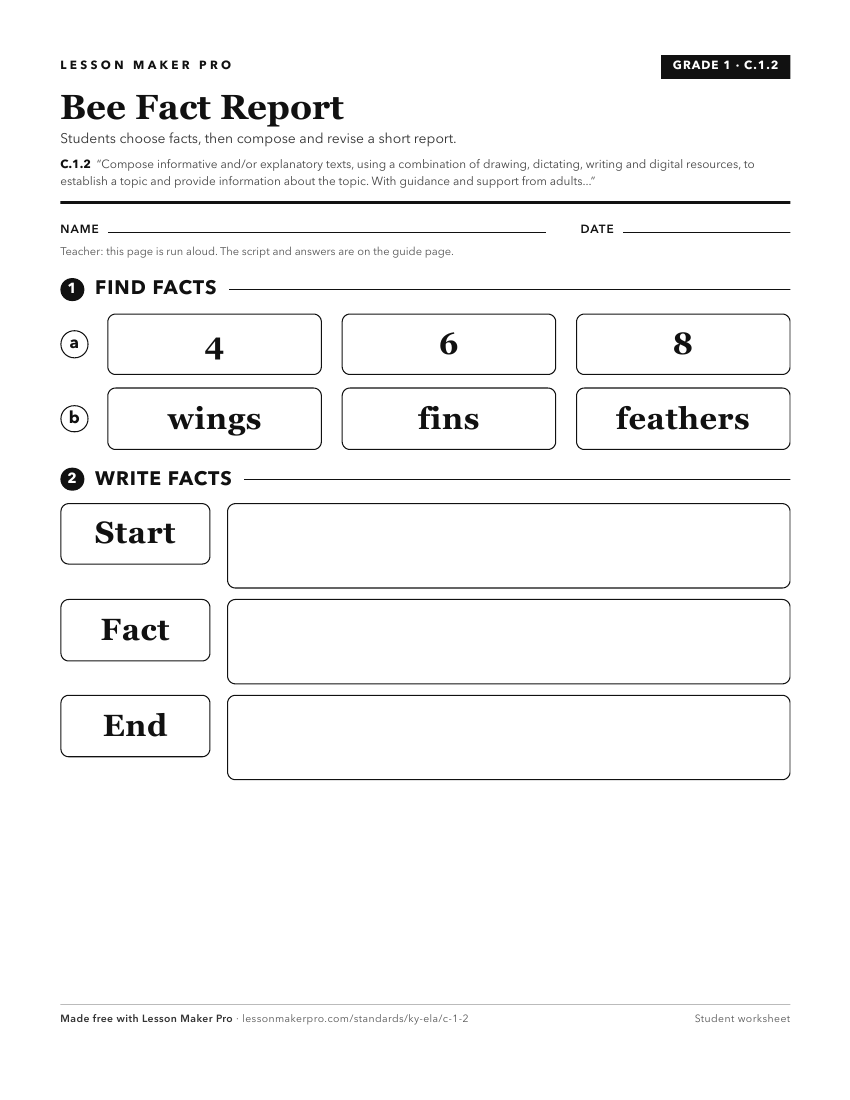
A ready-to-print activity worksheet aligned to C.1.2, with an answer key for the teacher on its own page. No account needed.
PDF, US Letter, prints cleanly in black and white.
Download the worksheetKeep exploring
Related Standards
- C.2.2
Compose informative and/or explanatory texts, using writing and digital resources, to establish a topic and provide information about the topic.
- C.3.2
Compose informative and/or explanatory texts, using writing and digital resources, to examine a topic and provide information.
- C.5.2
Compose informative and/or explanatory texts, using writing and digital resources, to examine a topic and convey ideas and information clearly.
- C.K.2
Compose informative and/or explanatory texts, using a combination of drawing, dictating, writing and digital resources, to establish a topic and supply informat...
Turn this cluster into a lesson
Grade, subject, topic, and the complete cluster are prefilled. Create one free, no account needed.
Also for this cluster:Make a WorksheetMake a QuizMake a Sub Lesson