Indiana Social Studies WH.6.1
The Standard
Identify and explain the impact of nationalism, imperialism, militarism, and alliances on relationships between countries.
2026 Indiana Academic Standards: K-12 Social Studies
Teacher's field guide
What This Standard Means
What Students Need to Do
- Students identify demands for national self-rule, disputes over colonies, military buildup, and defense pacts in events from the early 1900s. They explain how each changed relations between named countries.
What Mastery Looks Like
- A student can explain why Serbian support for Slavs in Austria-Hungary raised tensions between the two countries. They can connect the Morocco dispute to French-German rivalry and battleship building to British-German distrust. They can explain how the France-Russia pact gave each country a partner against Germany.
Common Misconceptions
- Students may think nationalism means only pride in one's country, missing demands for self-rule. They may confuse military buildup with imperialism. Some assume a defense pact meant every ally had to fight in every dispute.
How to Assess It
- Exit ticket: Explain how British-German battleship building and the France-Russia pact each changed relations between countries before World War I.
Lesson moves
Ways to Teach It
On a 1914 map, pairs place cards for Serbian nationalism, Morocco, British-German battleships, and the France-Russia pact, then draw tension or support arrows.
Ask students which raised tensions more in 1914, British-German battleship building or the France-Russia pact, and require one specific consequence.
Read four cards on Morocco, battleship building, Serbian nationalism, and the France-Russia pact; students race to hold up the matching factor label.
Show a NATO member map and ask how a mutual defense promise might change a member's response to an attack.
Free download
Printable WH.6.1 Worksheet
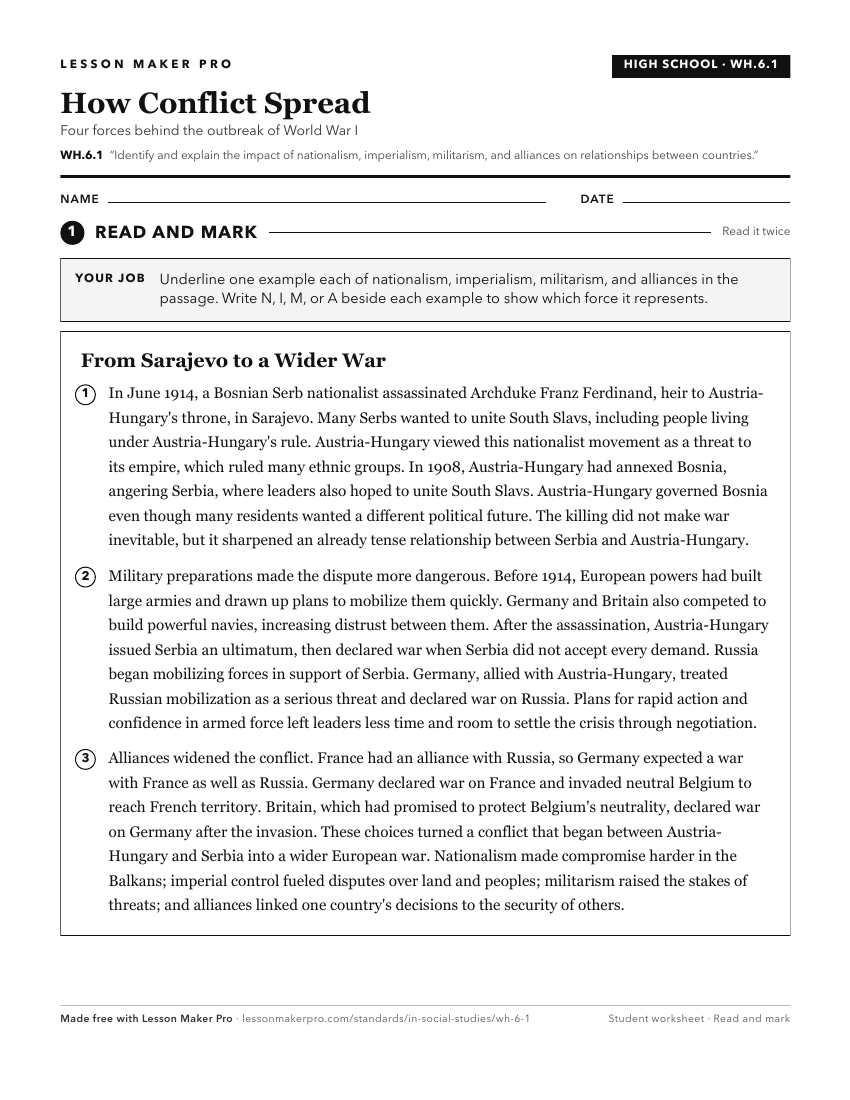
A ready-to-print activity worksheet aligned to WH.6.1, with an answer key for the teacher on its own page. No account needed.
PDF, US Letter, prints cleanly in black and white.
Download the worksheetKeep exploring
Related Standards
- 8.E.4
Explain and evaluate examples of domestic and international interdependence throughout United States history.
- WH.6.4
Identify the causes (i.e., social, political, militaristic, and economic) and key events of World War II, and analyze the impact this war had on the global comm...
- GHW.10.1
Differentiate between a state (country) and a nation, specifically focusing on the concepts of territorial control and self-determination of internal and foreig...
- 8.H.15
Define nationalism and explain how it affected domestic policy, foreign policy, and the development of an industrial economy during this period.
Turn this exact standard into a lesson
Grade, subject, topic, and the complete standard are prefilled. Create one free, no account needed.
Also for this standard:Make a WorksheetMake a QuizMake a Sub Lesson