Indiana Social Studies 8.H.15
The Standard
Define nationalism and explain how it affected domestic policy, foreign policy, and the development of an industrial economy during this period.
2026 Indiana Academic Standards: K-12 Social Studies
Teacher's field guide
What This Standard Means
What Students Need to Do
- Students define nationalism as loyalty to the country as a whole. They explain how it shaped tariffs, roads and canals, and the Monroe Doctrine. They connect those choices to the growth of factories and trade.
What Mastery Looks Like
- A student can explain how a tariff made imports cost more and helped U.S. factories compete. They can show how roads and canals moved goods, and how national pride shaped the Monroe Doctrine's warning to European powers.
Common Misconceptions
- Students may confuse nationalism with sectionalism and assume a policy helped every region equally. They may think tariffs lowered the price of imports or that the Monroe Doctrine was a trade law.
How to Assess It
- Exit ticket: Define nationalism, then explain how it connects to a protective tariff, the Monroe Doctrine, and factory growth.
Lesson moves
Ways to Teach It
Give pairs cards labeled tariff, national road, canal, textile mill, and Monroe Doctrine; sort them under domestic, foreign, or economy and draw two links.
Ask, "Would a tariff that helps U.S. factories serve everyone equally?" Have students defend an answer using a factory owner and a buyer.
Give students policy cards (tariff, federal road, Monroe Doctrine) and effect cards (factory sales, cheaper shipping, European warning); race to match and explain.
Show a local highway map; students trace a product's route to a store and compare it with how canals linked early U.S. factories to buyers.
Free download
Printable 8.H.15 Worksheet
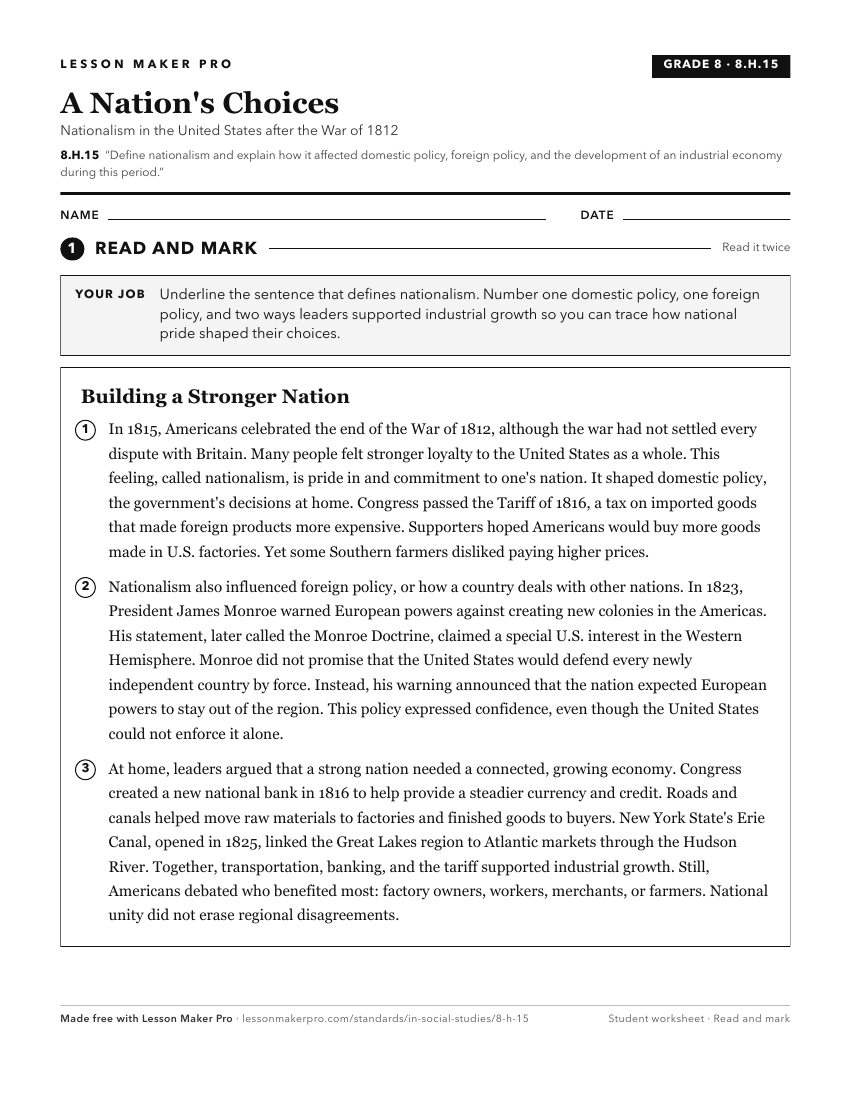
A ready-to-print activity worksheet aligned to 8.H.15, with an answer key for the teacher on its own page. No account needed.
PDF, US Letter, prints cleanly in black and white.
Download the worksheetKeep exploring
Related Standards
- USH.3.4
Analyze why the United States joined World War I and how the war affected the nation.
- USH.7.1
Explain the significance of social, economic, and political issues during the period 1980 to the present and how these issues affected individuals and organizat...
- WH.6.1
Identify and explain the impact of nationalism, imperialism, militarism, and alliances on relationships between countries.
- GHW.10.1
Differentiate between a state (country) and a nation, specifically focusing on the concepts of territorial control and self-determination of internal and foreig...
Turn this exact standard into a lesson
Grade, subject, topic, and the complete standard are prefilled. Create one free, no account needed.
Also for this standard:Make a WorksheetMake a QuizMake a Sub Lesson