Indiana Social Studies WG.4.14
The Standard
Use global political, economic, cultural, or social flows to describe and illustrate interdependence between places, countries and regions.
2026 Indiana Academic Standards: K-12 Social Studies · Economic Interdependence (Globalization)
Teacher's field guide
What This Standard Means
What Students Need to Do
- Students map where a product, payment, person, or idea travels. They explain how an event in one place can change life or work somewhere else.
What Mastery Looks Like
- A student maps cobalt moving from the DRC to China, phones moving from China to the United States, and payments moving back. They explain how a mining slowdown could affect factories and phone stores.
Common Misconceptions
- Students may think a product is made entirely in the country on its label. They may track goods but miss payments moving back, or assume a disruption affects only one place.
How to Assess It
- Give students a blank map and three labels: DRC cobalt, China phone factory, and Indiana phone store. Ask them to draw and label the flows, then explain how a mining slowdown could affect the store.
Lesson moves
Ways to Teach It
Give groups DRC cobalt, China factory, and Indiana store cards; have them connect places with yarn and label arrows for materials, phones, and payments.
Ask: If DRC cobalt exports stop for a month, what might happen to a Chinese factory and an Indiana phone store?
For a flow sort, give cards saying 'phones: China to Indiana' and 'remittances: Indiana to Mexico'; students map each arrow and name its effect.
Check a shirt's 'Made in' label, map its trip to your town, and explain how shoppers and overseas factories rely on sales.
Free download
Printable WG.4.14 Worksheet
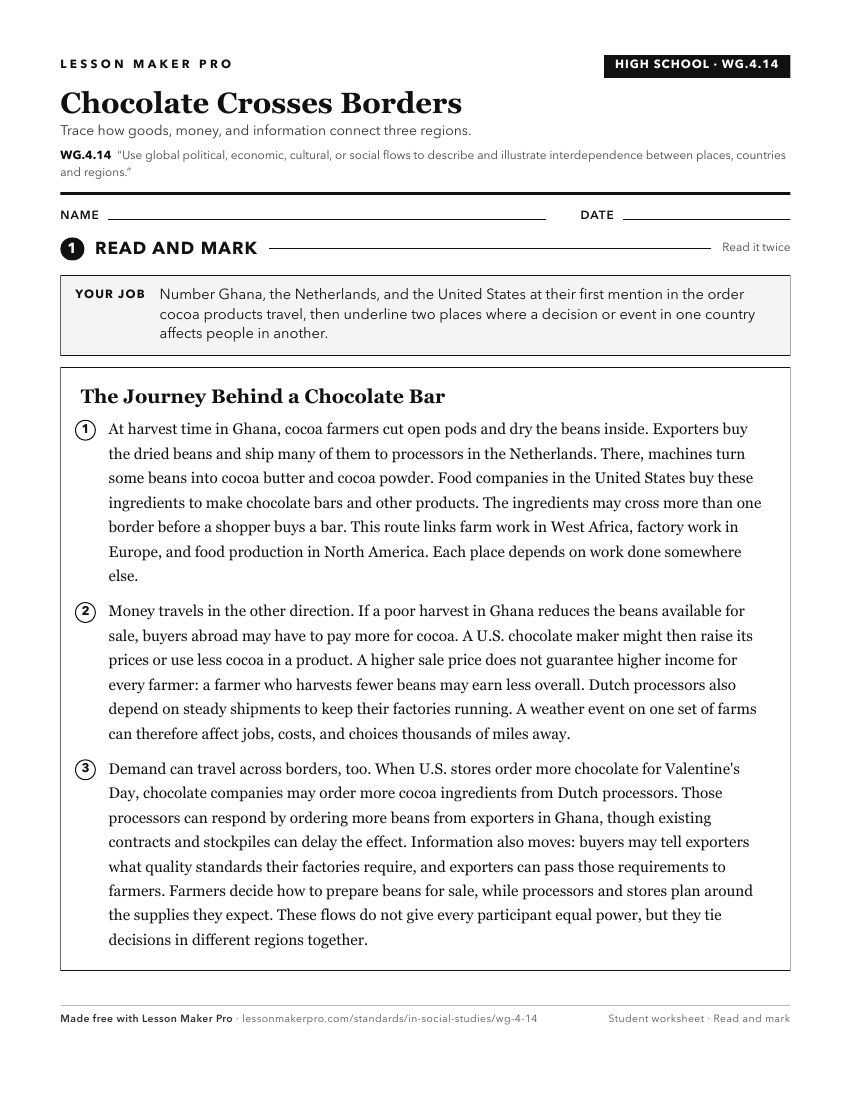
A ready-to-print activity worksheet aligned to WG.4.14, with an answer key for the teacher on its own page. No account needed.
PDF, US Letter, prints cleanly in black and white.
Download the worksheetKeep exploring
Related Standards
- WG.4.19
Identify and report on the impact of international networks and organizations that connect countries and influence of places, countries, and regions.
- WG.4.13
Identify contemporary spatial patterns in the movement of goods, services, and ideas throughout the world.
- GHW.8.2
Prepare graphic representations, such as maps, tables, and timelines, to describe the global movement of goods and services between and among countries and worl...
- GE.4.1
Synthesize evidence which suggests that most of the world’s countries are interdependent.
Turn this exact standard into a lesson
Grade, subject, topic, and the complete standard are prefilled. Create one free, no account needed.
Also for this standard:Make a WorksheetMake a QuizMake a Sub Lesson